FASHION SCOUT ONES TO WATCH AW26: SEVEN BORDERS, ONE RUNWAY
The lights went down and the concrete floor of the Fashion Scout venue took on the quality of a stage before an orchestra tunes — that held-breath stillness where anticipation lives in the body rather than the mind. Projected images bloomed across the rear wall in shifting washes of colour, each designer's visual world briefly announced and then dissolved, as though the runway itself were dreaming. The front row was tight, shoulder-to-shoulder: editors, buyers, a scattering of art school students leaning forward on stacked knees. The air smelled faintly of steamer water and hairspray. This was Fashion Scout's Ones To Watch showcase for Autumn/Winter 2026, the platform's latest chapter in what is now approaching two decades of excavating emerging talent for the London Fashion Week schedule — and the evening carried the particular charge of a programme built not around commercial consensus, but around the question of what fashion might still become.
Fashion Scout's co-director Biljana Poposka Roberts described the season as "fashion without borders," and the phrase felt less like a tagline than an observation of fact. Seven designers presented, arriving from Spain, Armenia, India, South Korea, the UK, and points in between, each channelling radically different cultural memories through the shared grammar of cut fabric and moving bodies. The showcase has history worth noting: past Ones To Watch alumni include Eudon Choi, Phoebe English, Susan Fang, and Maximilian Raynor, all of whom used this runway as a first serious stage before establishing
internationally recognised labels. As founder Martyn Roberts put it, the platform's commitment remains "to provide designers with a professionally produced, internationally visible platform that allows their work to stand confidently on the global stage." Approaching its twentieth anniversary this September, Fashion Scout enters a landmark year, and the AW26 edition felt like a deliberate statement of curatorial ambition — global in reach, uncompromising in its expectation that craft should speak louder than spectacle.
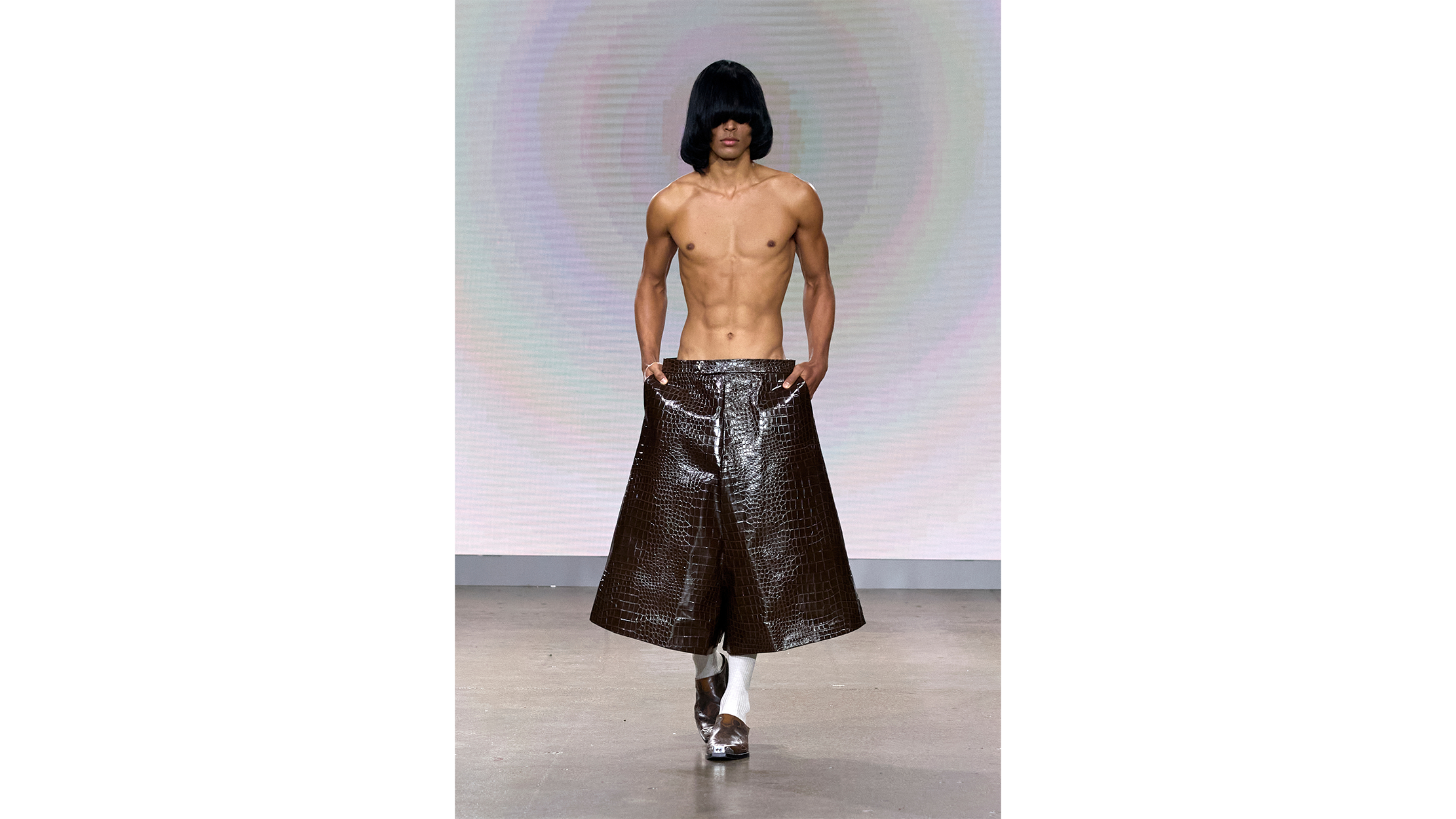
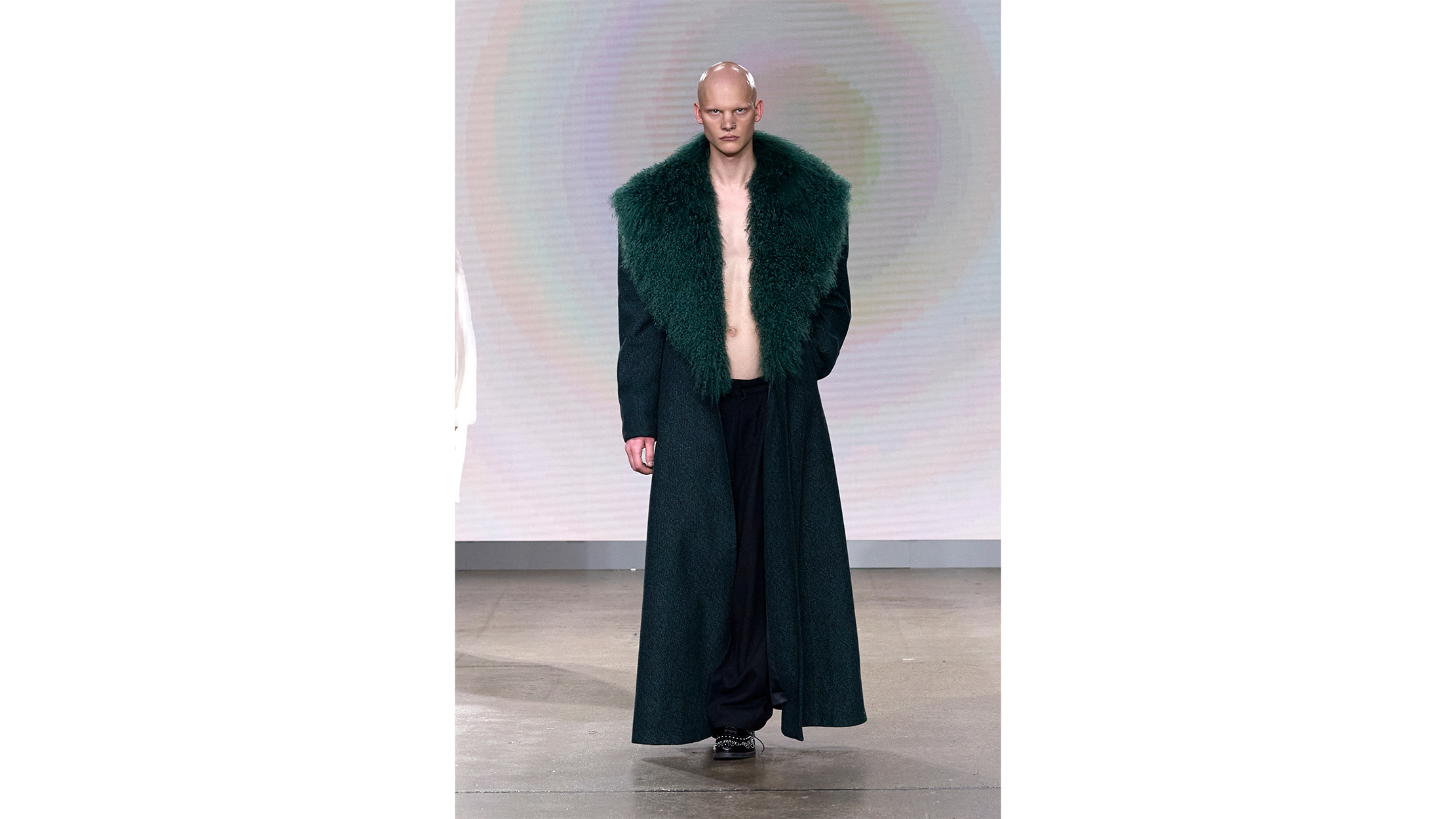
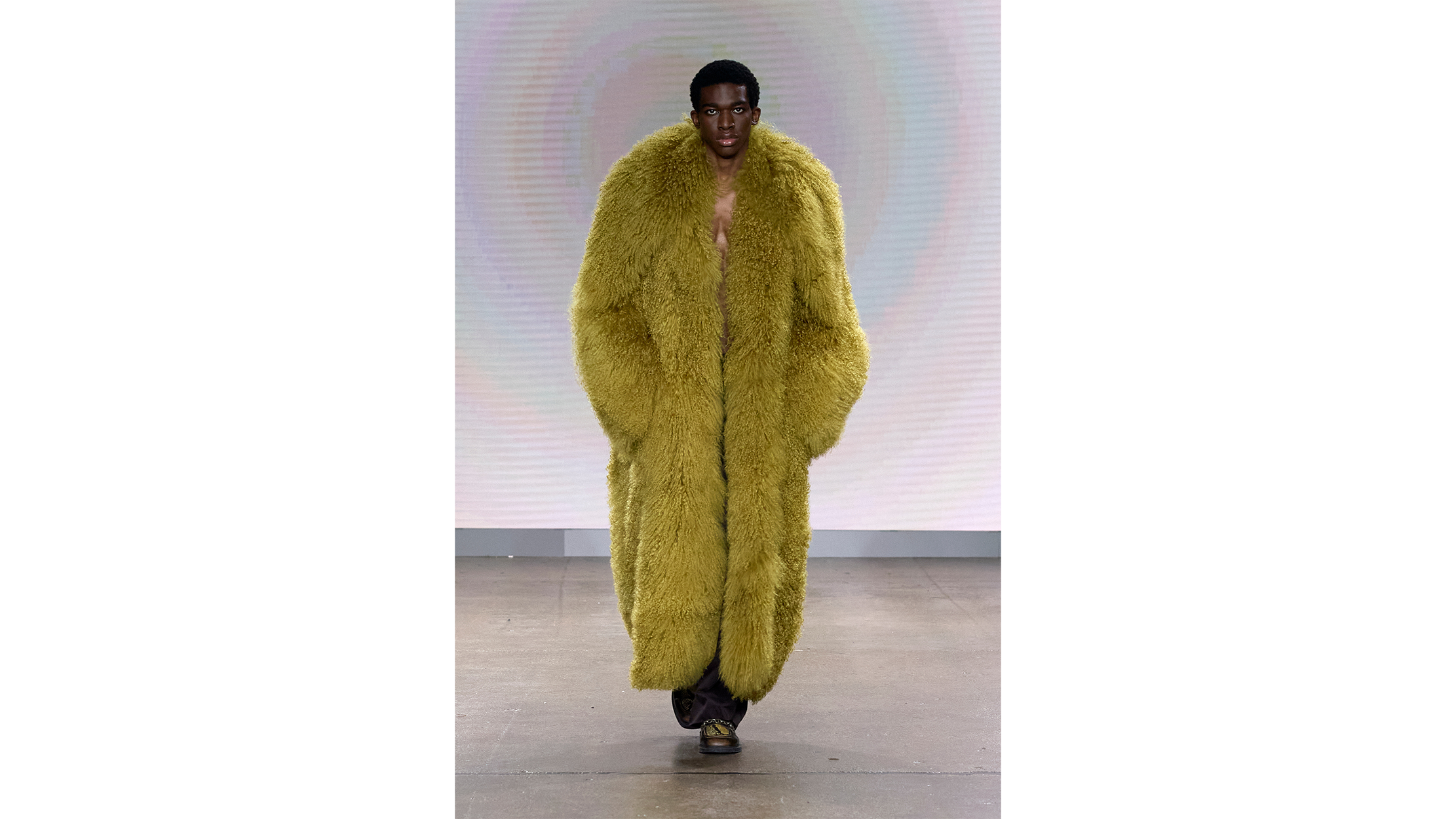
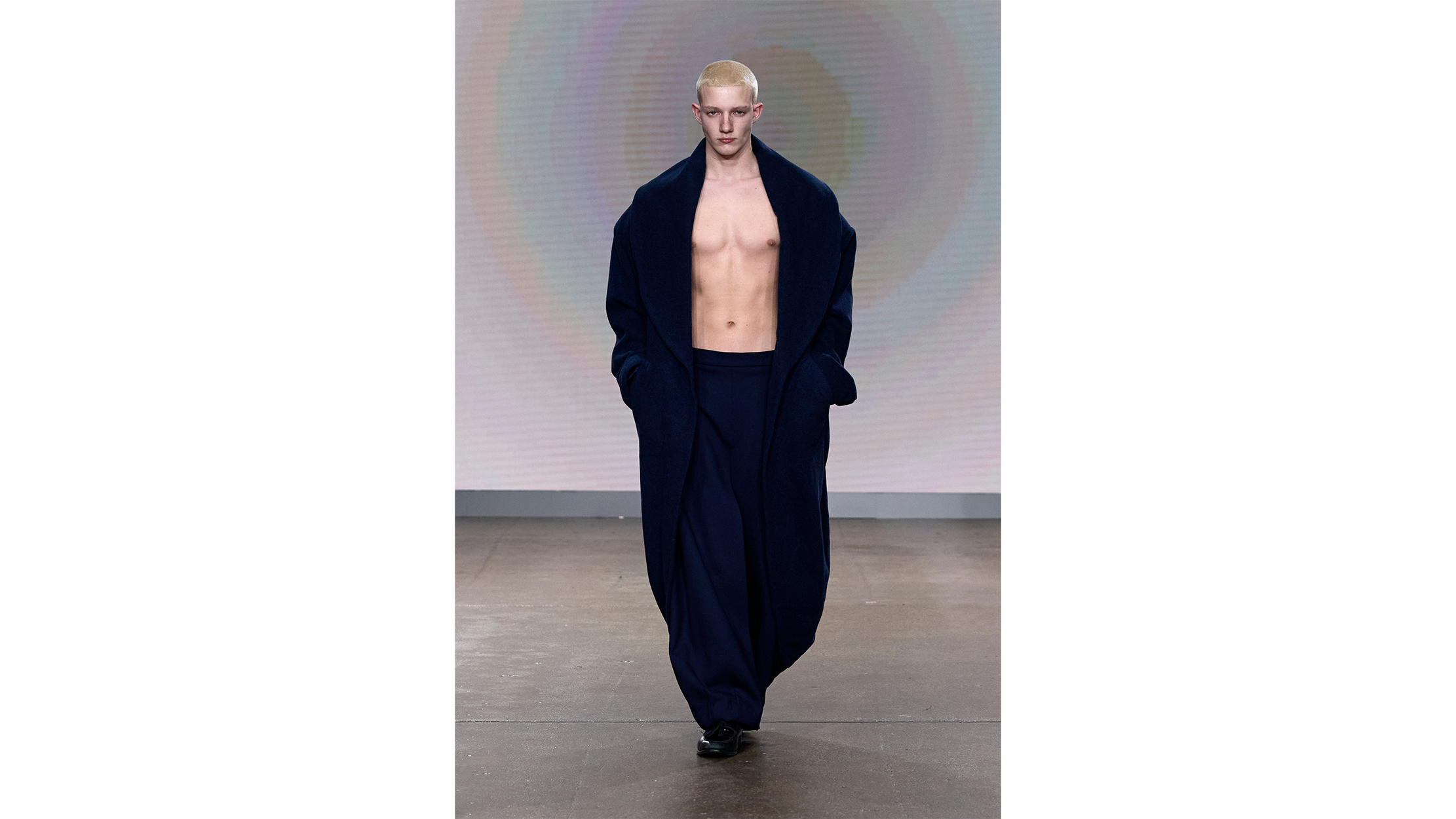
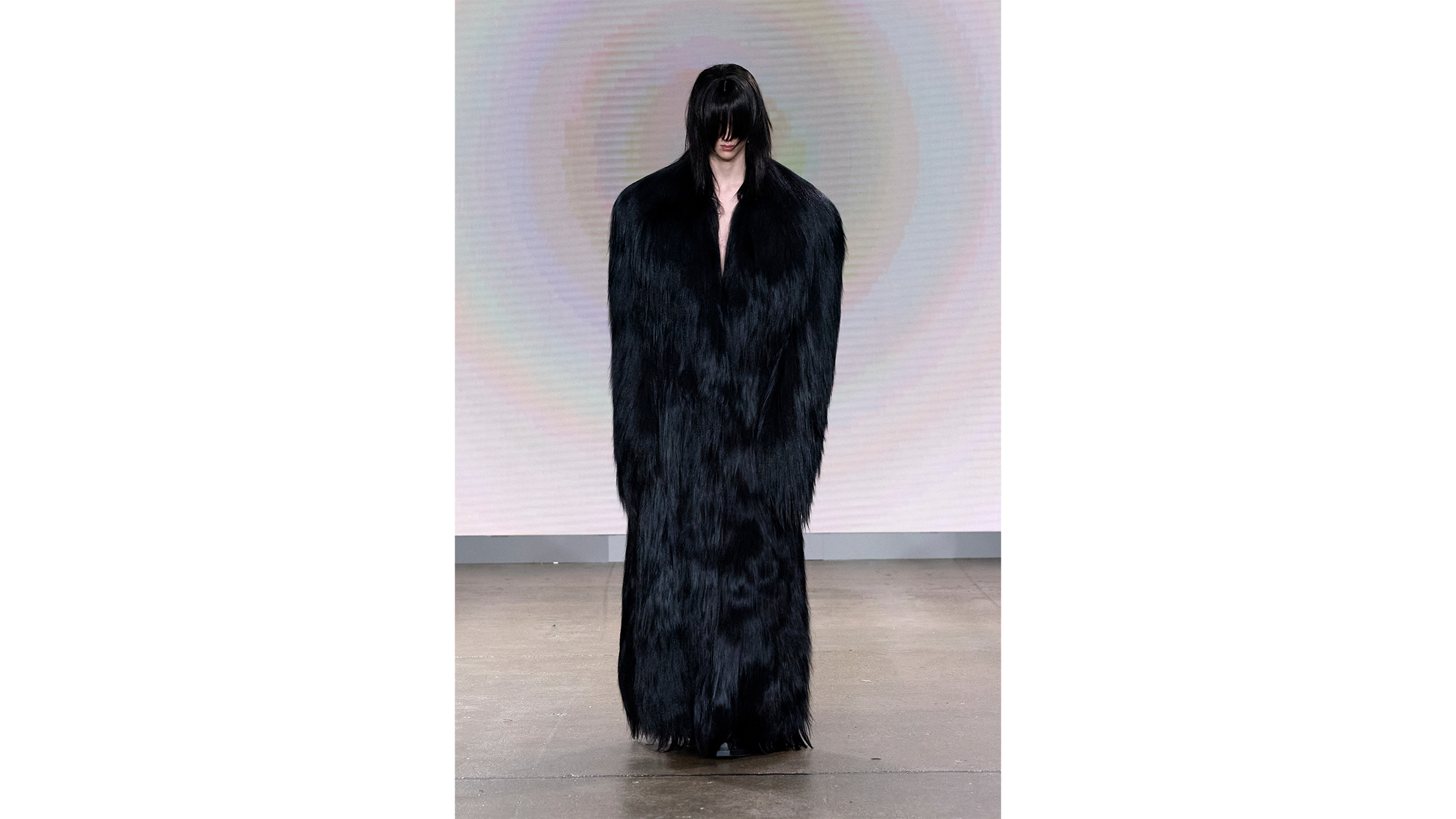
Adolf Maldonado opened the evening with a collection titled 'Arthropoda' that made the room lean in. The Spanish, London-based designer, a First Class Honours graduate of London Metropolitan University and the son of a dressmaker — drew his inspiration from insects, from exoskeletons and the strange beauty of microscopic textures, and translated that fascination into sculptural silhouettes that balanced feminine and masculine codes with unusual confidence. What arrested the eye, though, were the coats. Voluminous shaggy-pile outerwear appeared in acid chartreuse, deep forest green, and glossy jet black, worn open over bare torsos and pooling toward the floor like something between armour and animal pelt. The fur coats moved with an almost geological weight, catching the light in rippling waves that shifted hue with every stride. Between these maximalist moments came a wide, A-line skirt in dark crocodile-embossed leather, glinting under the runway spots with a reptilian sheen, and enveloping navy wool overcoats cut with the generous proportions of a sculptor working in soft stone. The effect was of nature rendered monumental — quiet power made visible through surface and volume, delicacy and strength held in the same breath.
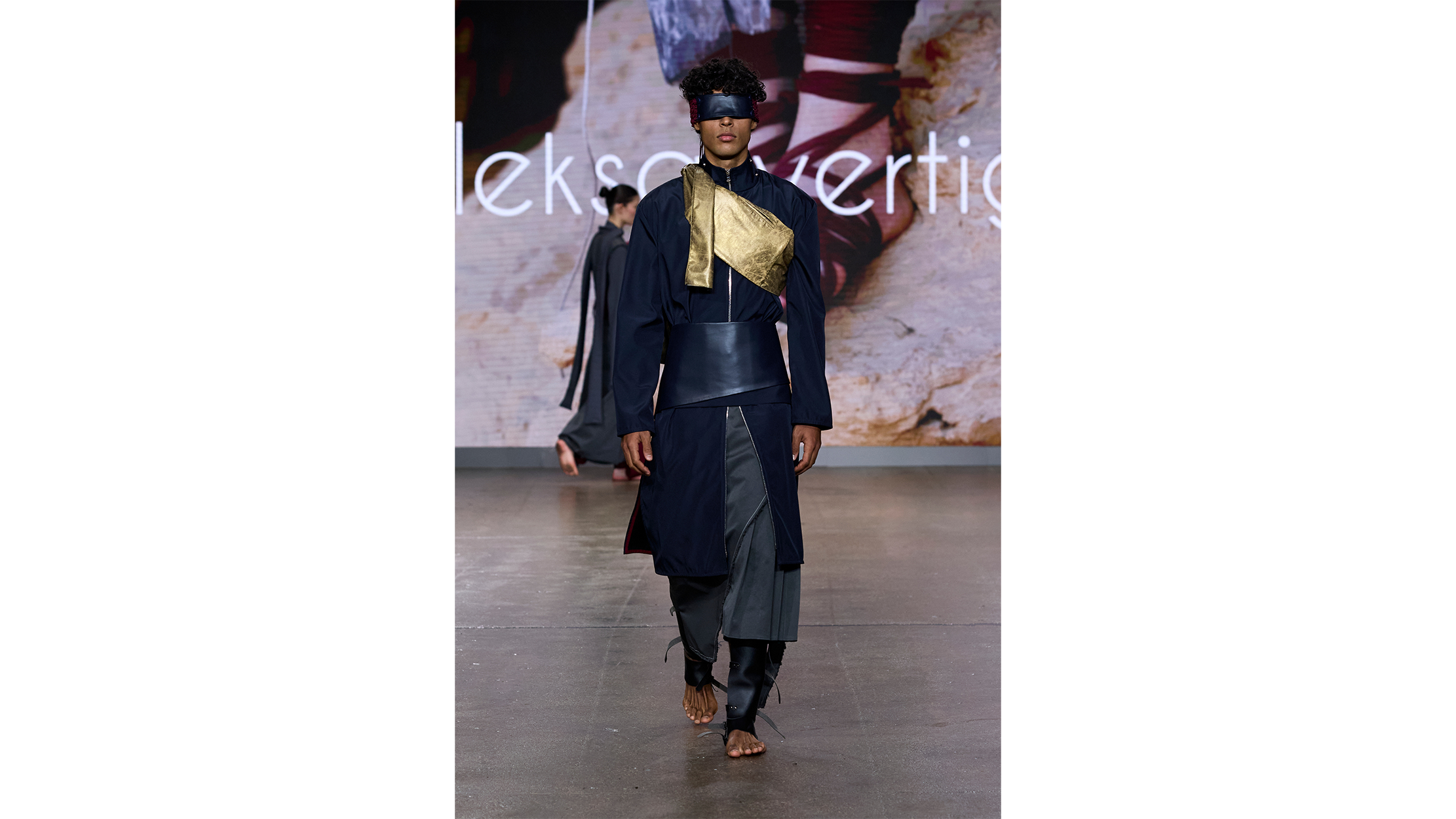
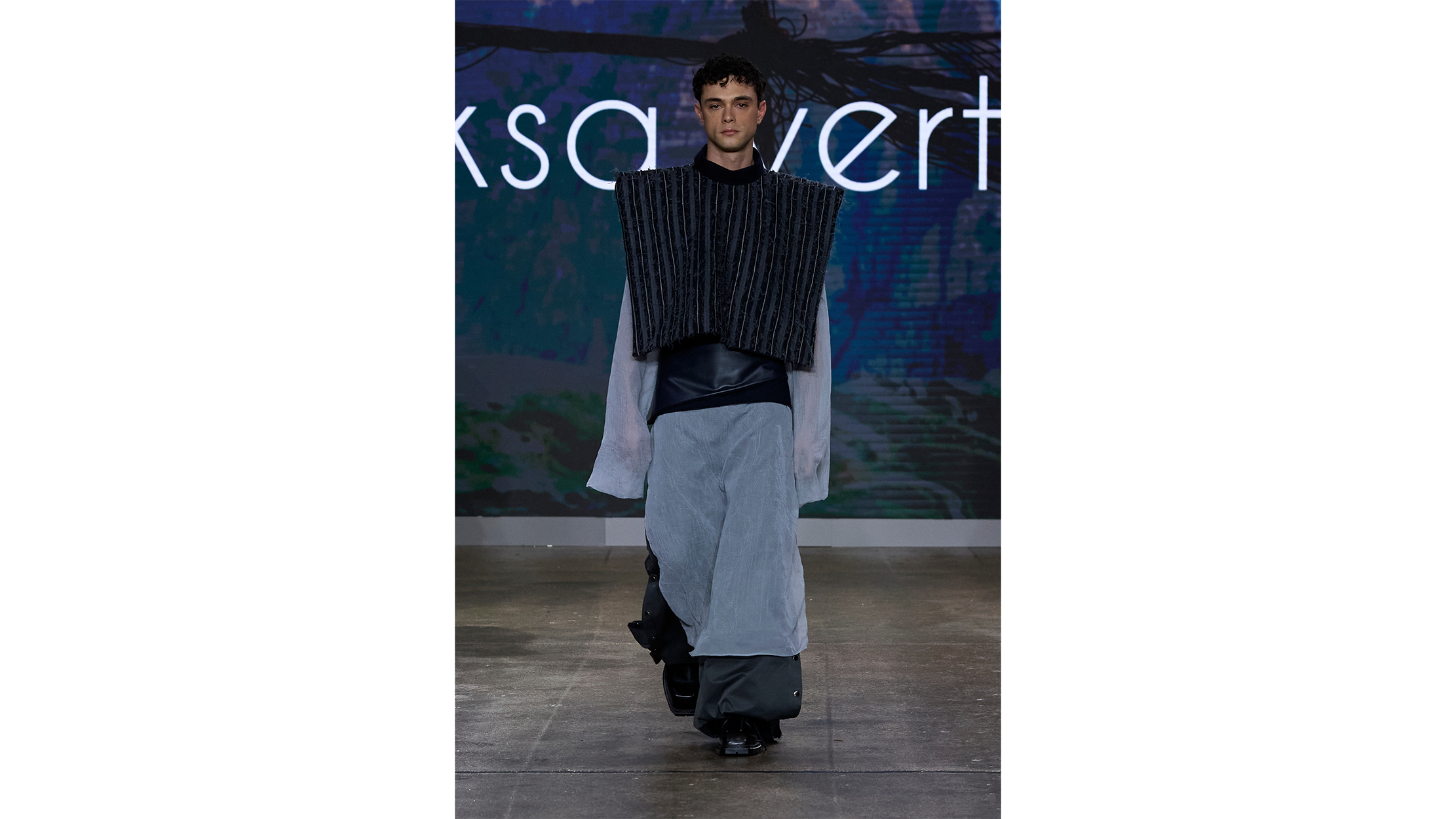
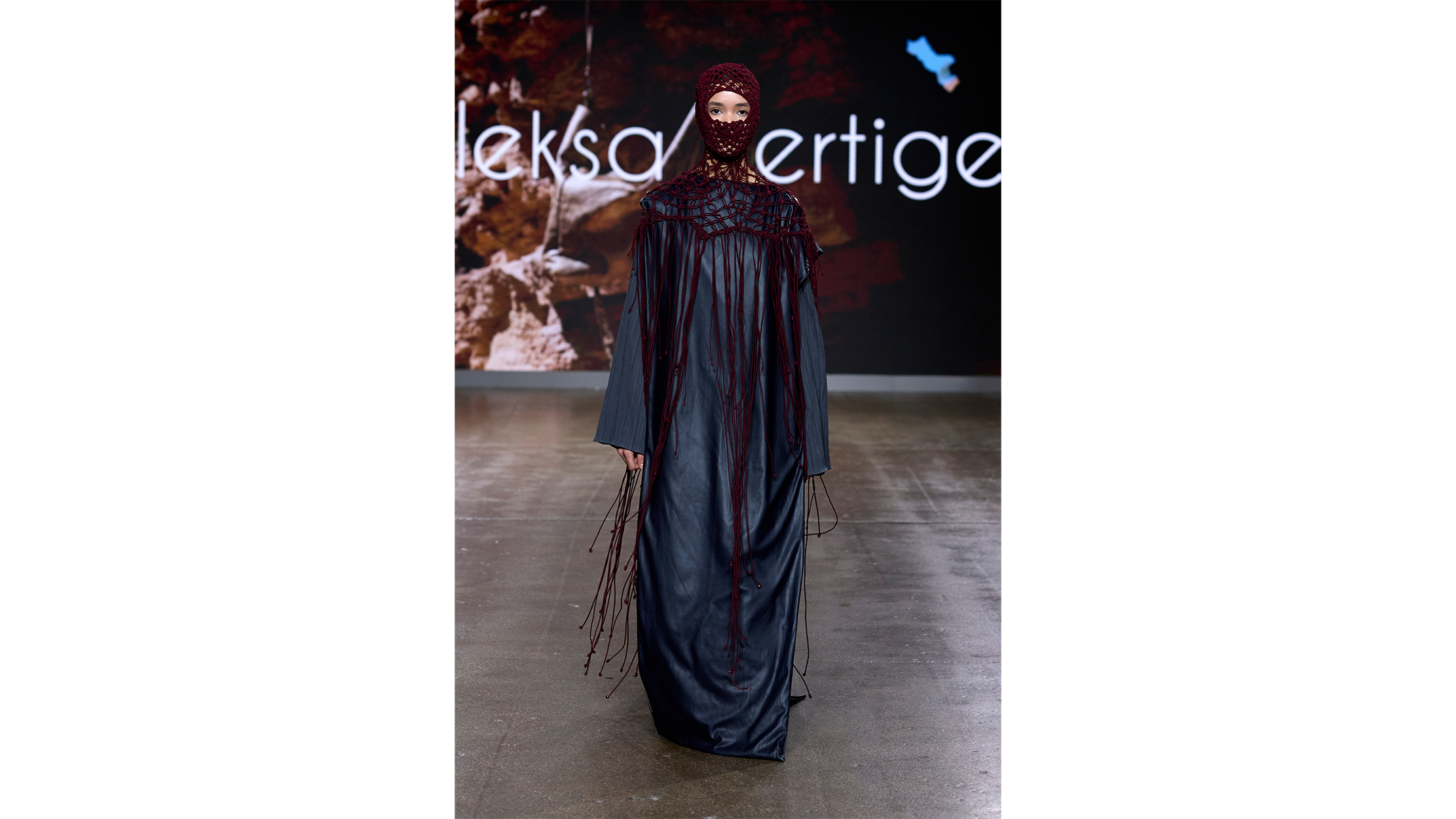
Aleksa Vertige followed with a collection rooted in Bushidō, the samurai code of honour, a conceptual leap that felt both unexpected and deeply considered. Emma Aleksanyan, the 22-year-old designer from Artsakh who won Fashion Scout Armenia 2025, built her looks around discipline and integrity rendered as architectural form. A model walked barefoot in a navy tunic cinched at the waist with a broad leather obi belt, a gold drape cutting diagonally across the chest like a sash of rank, a leather blindfold concealing the eyes — the effect was martial and ceremonial, as though the wearer had stepped out of a ritual only half-remembered. Elsewhere, a structured, vertically ribbed breastplate sat over sheer pale sleeves and a long washed-silk skirt, its exaggerated square shoulders suggesting samurai armour abstracted into something tender and contemporary. The collection's most striking moment came in a floor-length dark blue leather column dress overlaid with an intricate deep burgundy macramé capelet and matching macramé balaclava, the knotted cords cascading like ceremonial fringe. The macramé work — hand knotted, rooted in artisanal tradition, introduced a tactile, almost ritualistic dimension to the structured silhouettes around it. Aleksanyan's palette of muted blues, greys, and that singular deep red held the collection in a world of controlled intensity, and her unisex approach felt less like a gesture toward inclusivity than a natural consequence of her subject matter: honour, after all, has no gender.
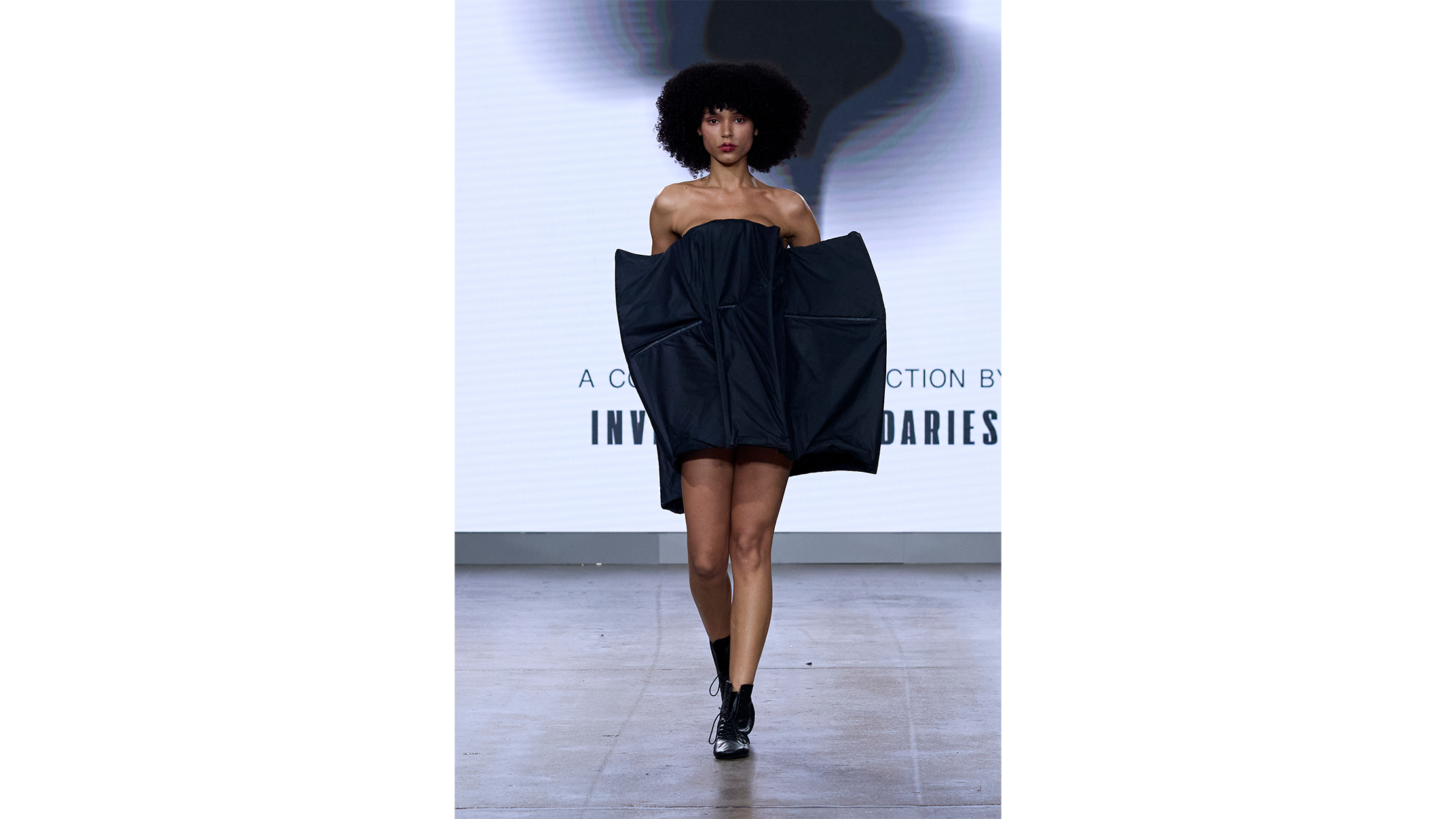
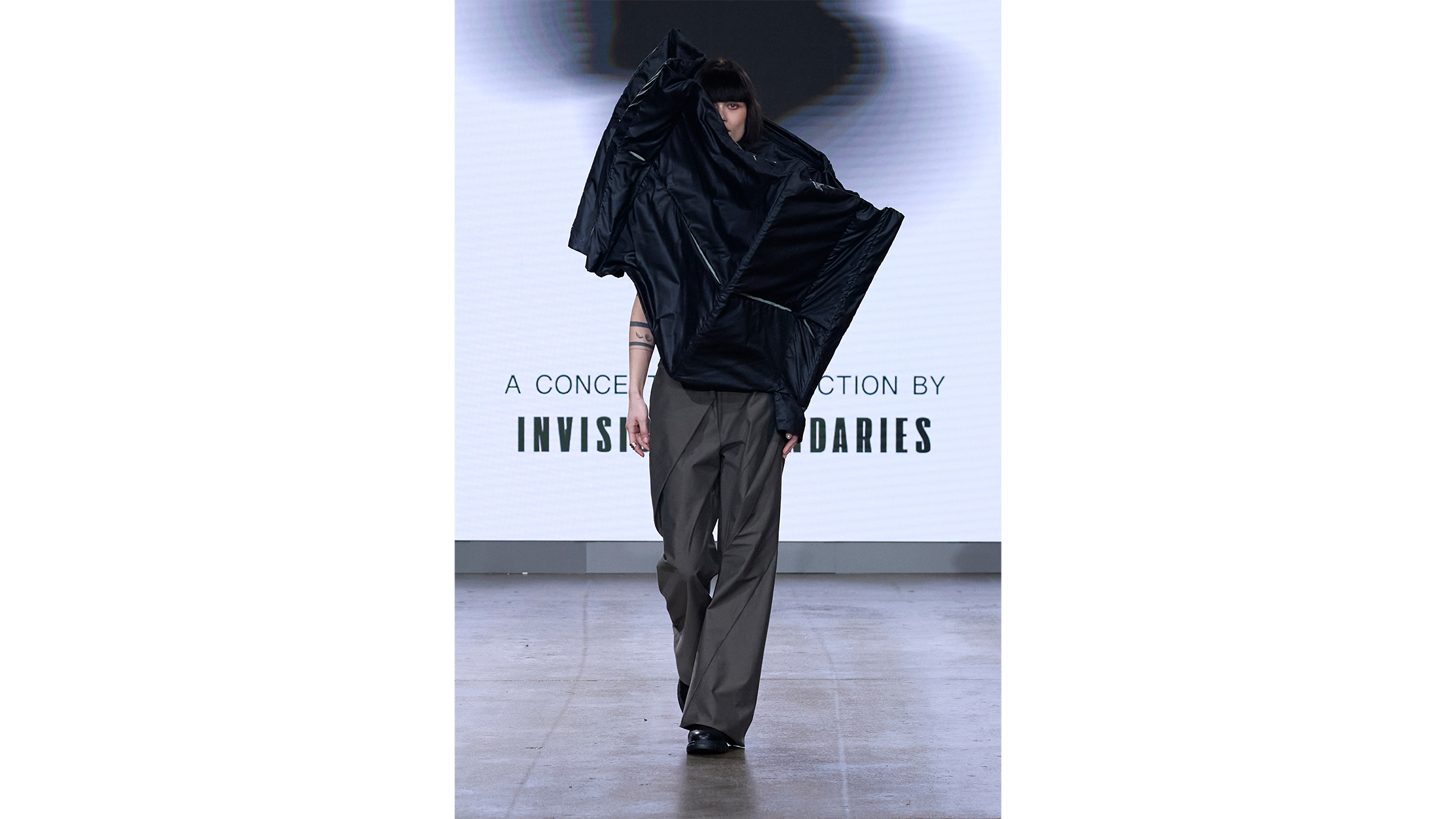
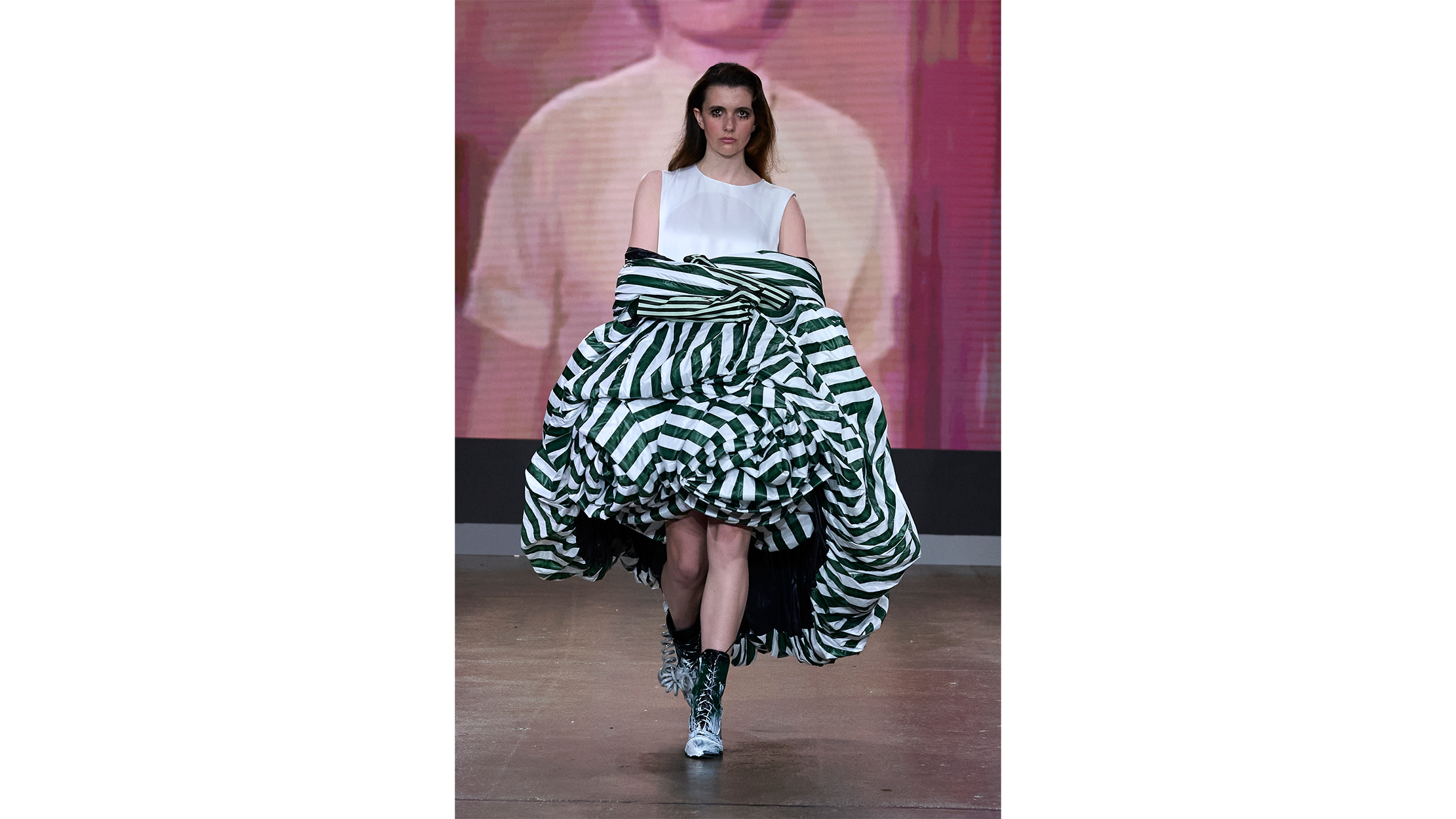
Invisible Boundaries presented a study in architectural restraint that felt like a deep exhale after the previous collections' maximalism. The UK-based label works in the space between emotion and structure, prioritising proportion and construction over decoration, and the runway delivery matched that philosophy. A strapless black mini dress ballooned outward from the body in an origami-like volume, its folds sharp and deliberate, giving the impression that the garment had been sculpted from a single sheet of densely woven fabric. Another look paired wide-leg grey trousers with a black nylon shell that erupted upward and over one shoulder in a dramatic, crumpled mass, part cocoon, part collapsed parachute, an exercise in controlled chaos. These were garments that communicated through spatial presence and gesture, inviting the wearer into a tactile encounter that resisted easy narrative. The restraint was the point: in a schedule crowded with sensation, Invisible Boundaries argued that silence, carefully constructed, can be the most arresting statement of all.
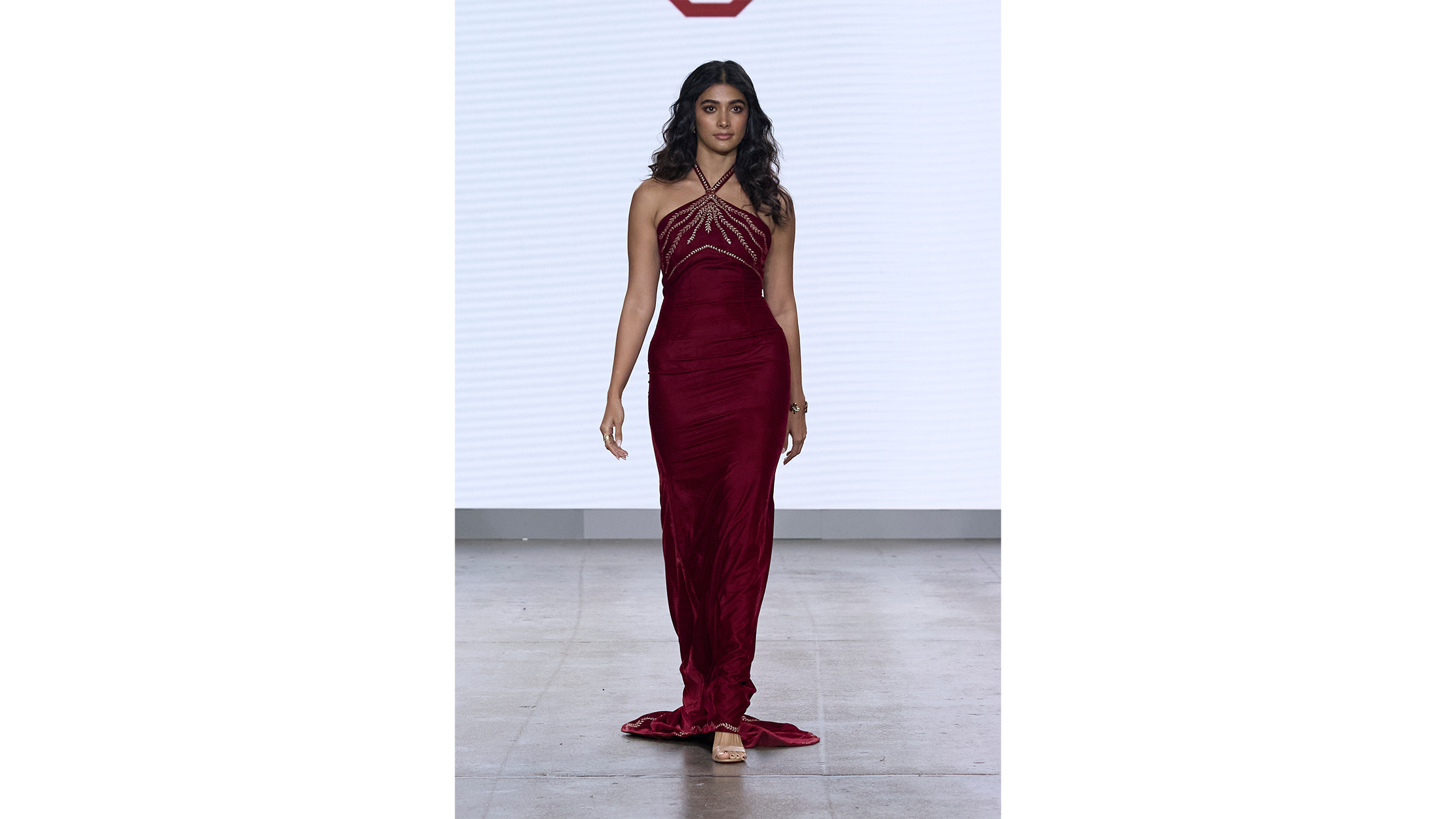
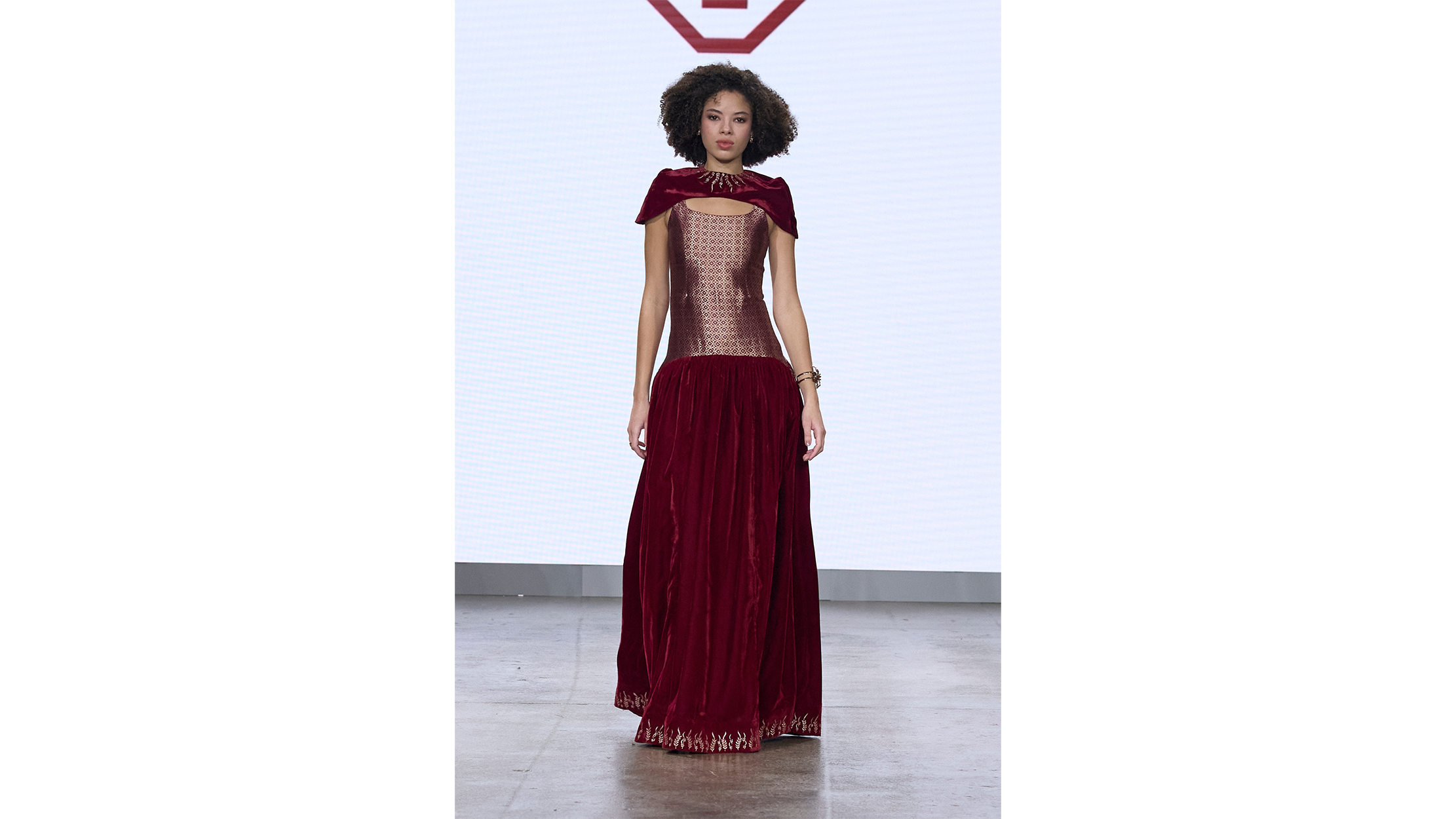
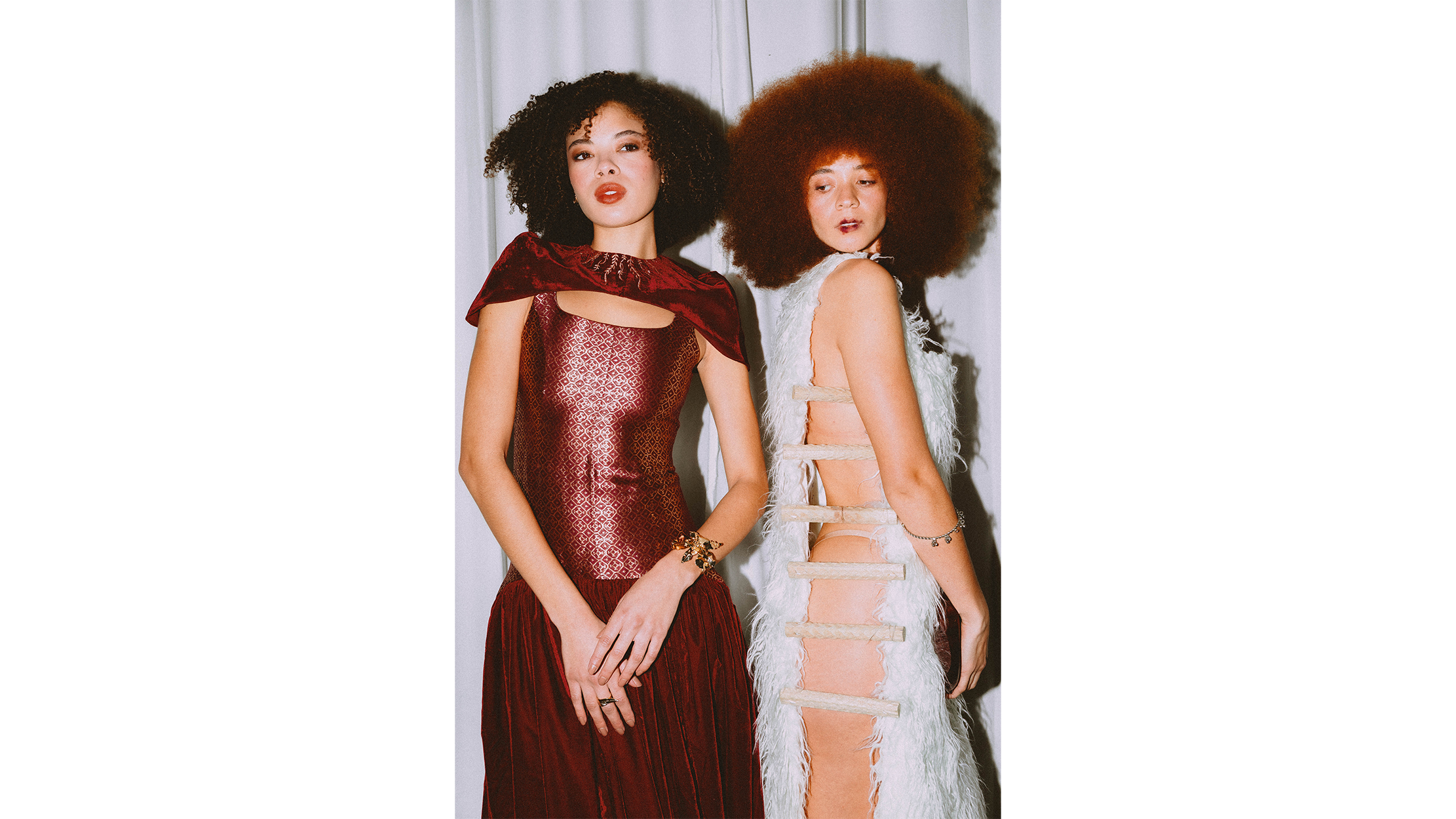
Khushi Kumar brought the runway its most emotionally layered sequence, presenting garments conceived as reimagined heirlooms — pieces that carry the weight of Indian textile heritage while speaking fluently to a contemporary, international audience. Kumar, who trained at Manchester School of Art and honed her practice at Alexander McQueen and Christian Dior, works between Delhi and London, and that dual orientation was visible in every seam. A deep burgundy velvet gown with a brocade bodice and embroidered hem carried the richness of ceremonial Indian dress, yet its clean silhouette and cutaway neckline — a folded velvet capelet revealing the brocade beneath — felt unmistakably modern. A halter neck column dress in the same burgundy silk, its bodice traced with delicate gold leaf-motif embroidery that radiated outward like branches, pooled into a gentle train with quiet drama. Backstage, the interplay between the two looks was even more striking: the brocade and velvet of one standing alongside the feathered, ladder-backed construction of another, a pairing that captured Kumar's instinct for bridging the ceremonial and the avant-garde.
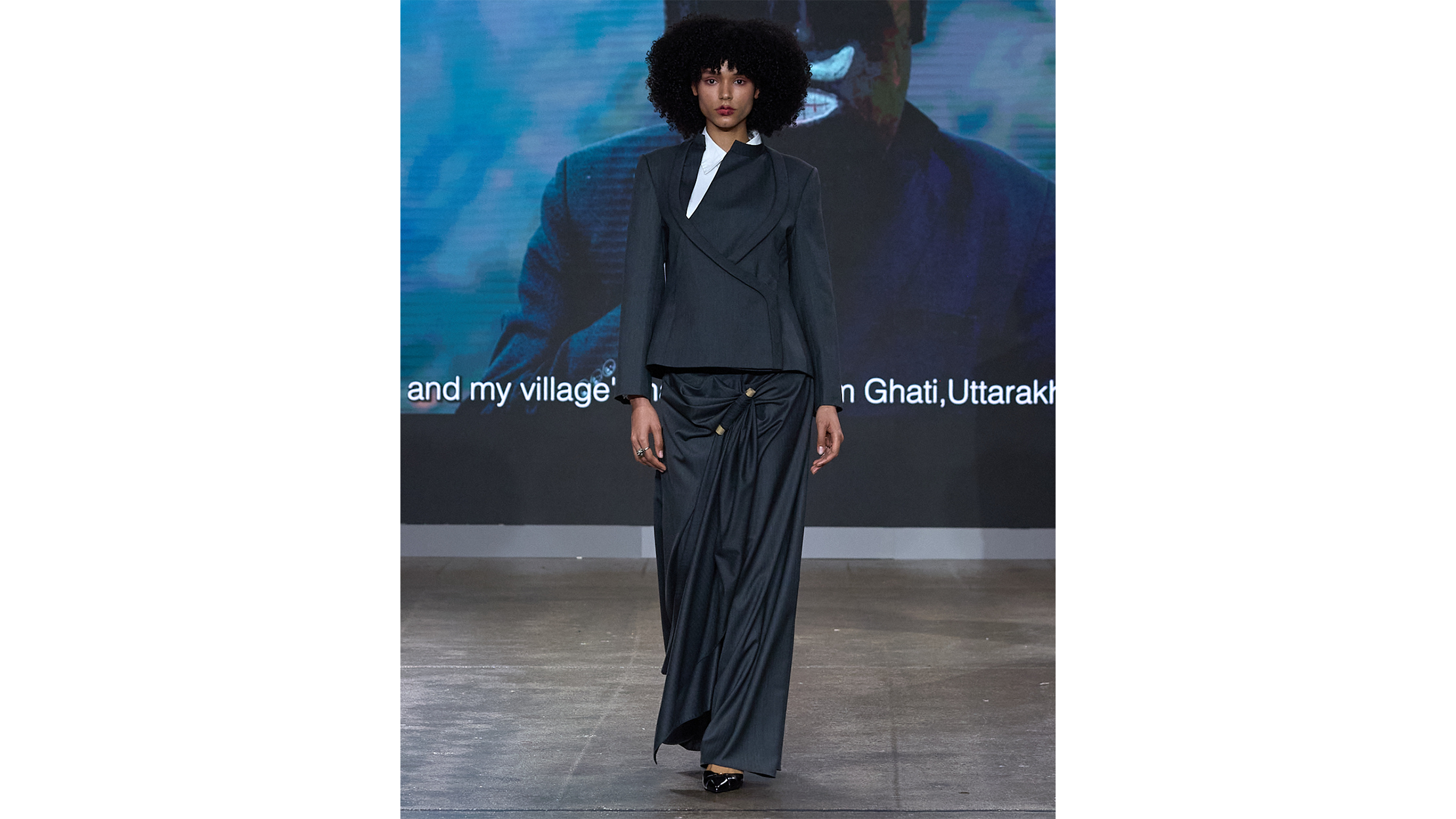
Label Astha Garg, presented by Astha Garg, currently completing her studies at London College of Fashion — offered a quieter proposition, one grounded in material integrity and slow, deliberate process. Working between London and Dehradun, Garg approaches fashion as sensory experience, and her runway looks reflected that philosophy. A dark, asymmetrically cut blazer over a crisp white shirt and a draped, buttoned skirt carried echoes of deconstructed suiting, but the details — the unexpected drape at the hip, the off-kilter lapel, suggested a designer more interested in how fabric falls against a moving body than in any fixed silhouette. The collection's emphasis on responsible sourcing and artisan collaboration was embedded in the garments themselves rather than announced through signage or programme notes, an approach that felt mature for a designer still in her final year of study.
The background projection during her segment referenced from her film based on Urgam Ghati in Uttarakhand— a signal that these clothes are not abstracted from their origins but deliberately tethered to place, memory, and the hands that made them.
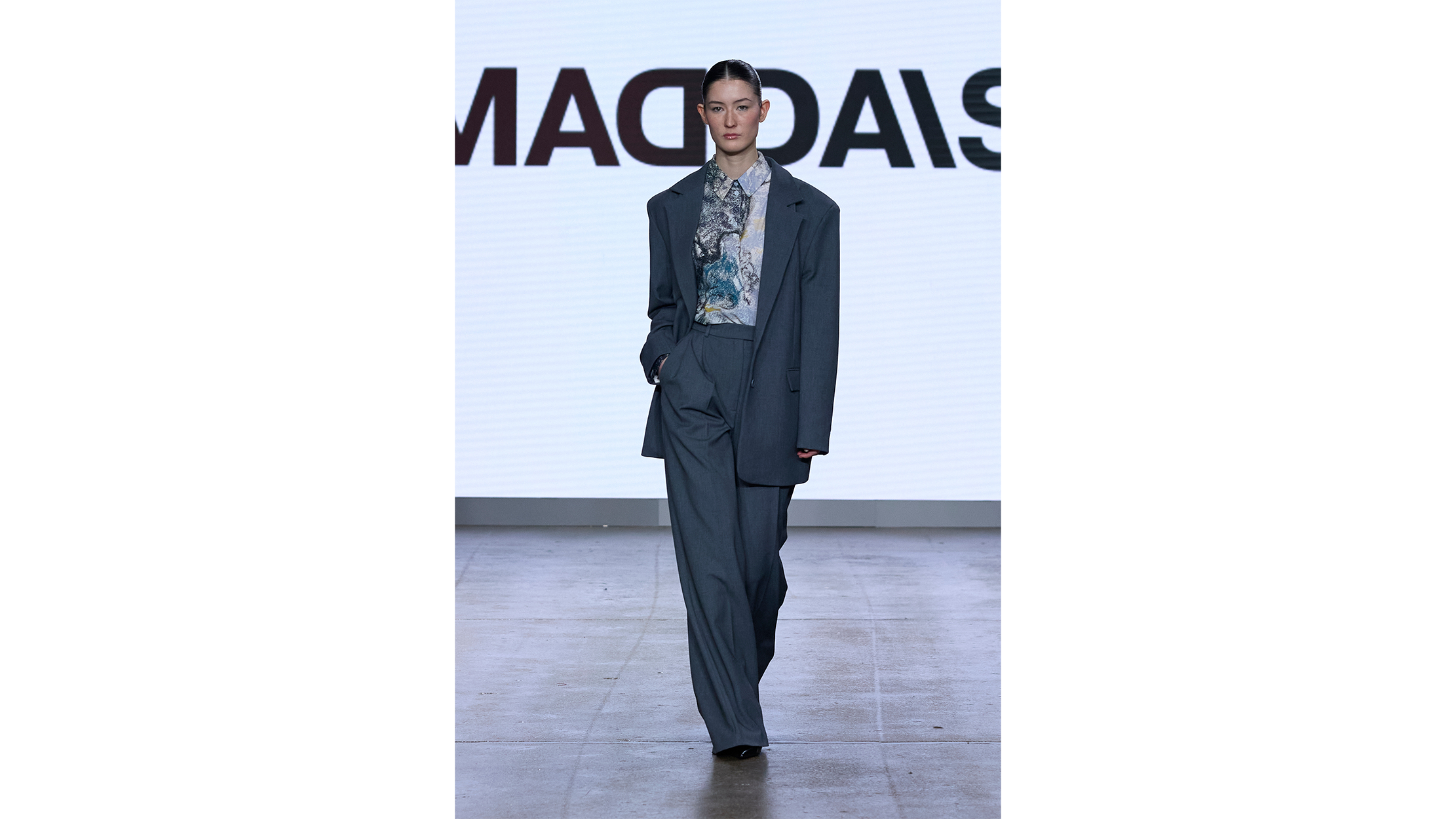
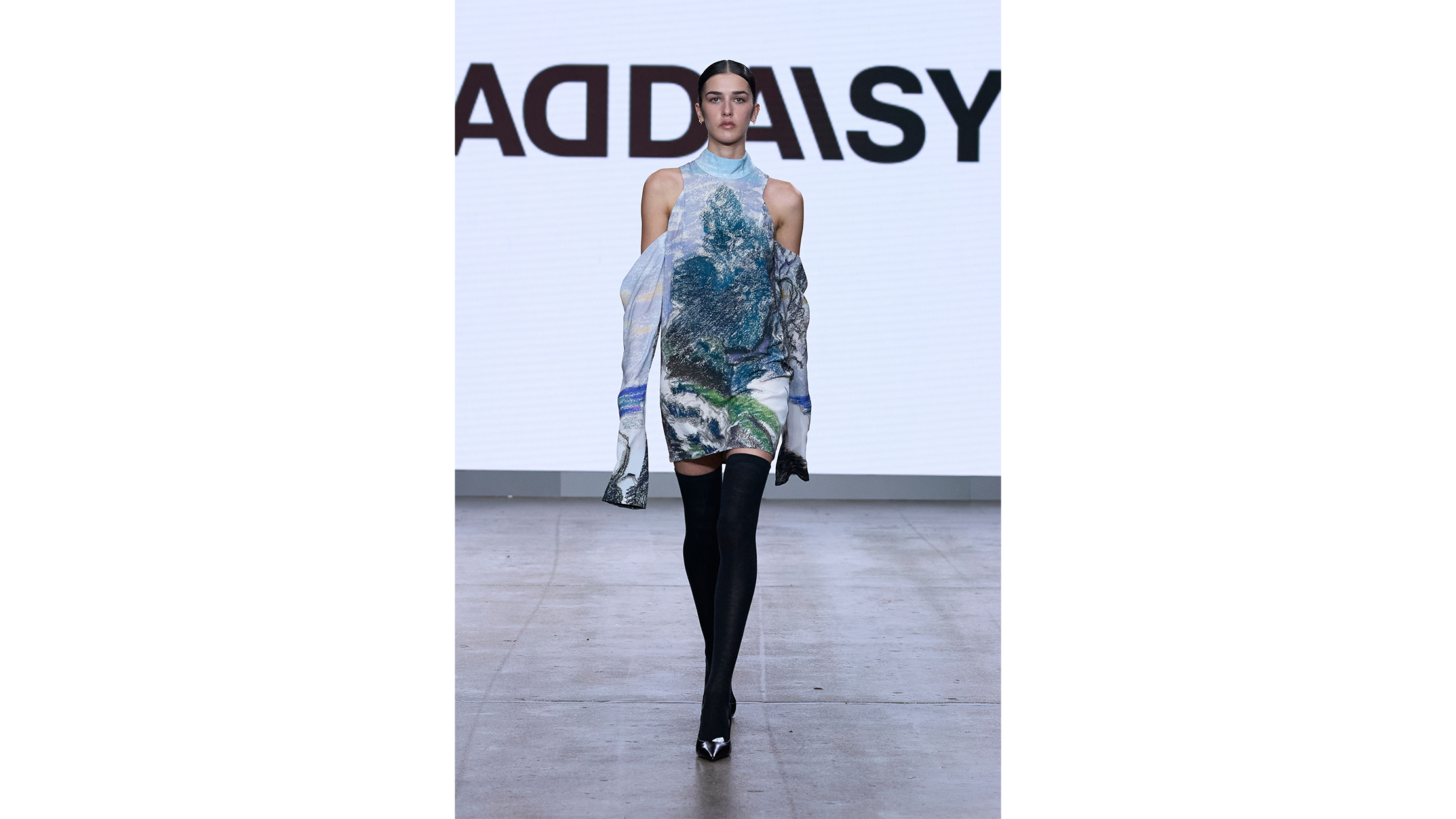
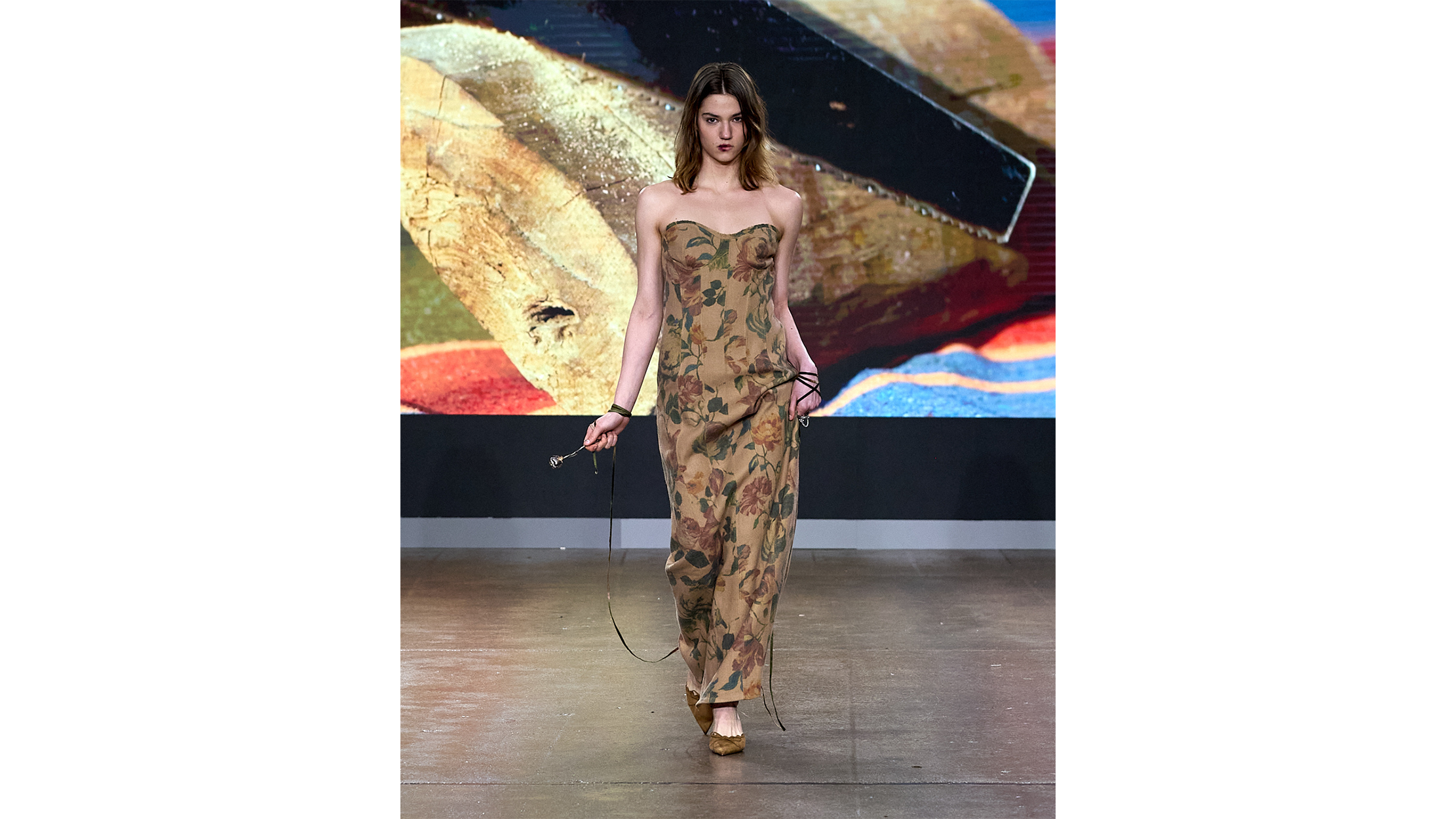
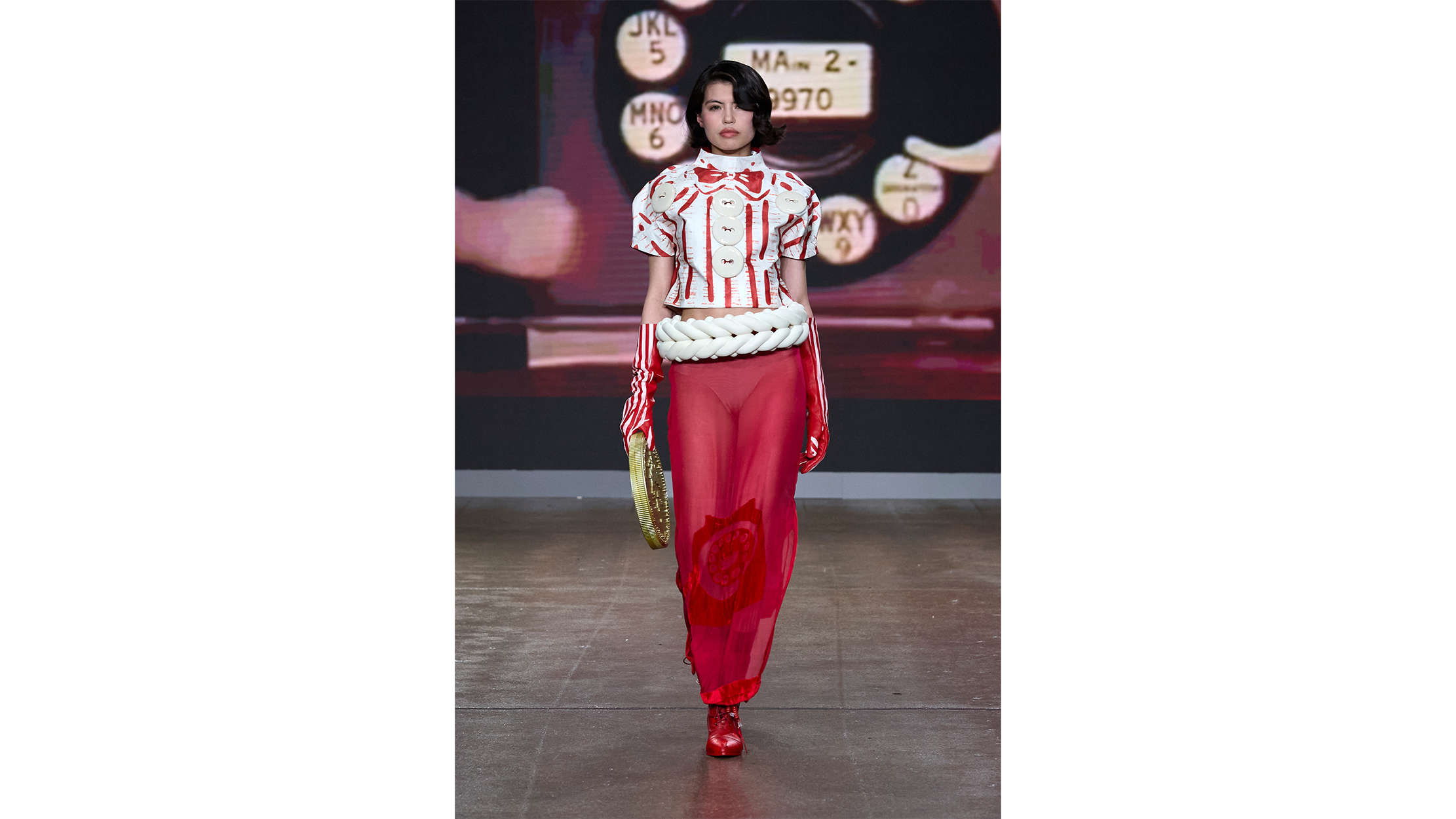
Mad Daisy closed the evening with 'Lumière de Guillaumin,' a collection that translated the light and texture of French Impressionist painter Jean-Baptiste Armand Guillaumin into wearable form — and did so with genuine visual wit. Founded by Dr. Margarita Fedoseev, the brand positions fashion as cultural dialogue, and the AW26 offering made good on that premise. A halterneck mini dress in printed silk carried a landscape directly on the body, mountain, sky, and water rendered in the Impressionist's signature palette of blues, greens, and chalky whites, the cold-shoulder sleeves trailing past the wrists like brushstrokes left unfinished. Elsewhere, a sharply oversized grey suit was paired with a printed silk shirt that smuggled Guillaumin's palette into the vocabulary of urban tailoring. The collection's most playful moment was a cropped jacket in red and white stripes with oversized novelty buttons and a braided waist detail, paired with sheer red trousers and striped opera gloves — a look that felt like a Guillaumin canvas reassembled as Parisian cabaret. And then came a strapless floral column dress in faded botanical print, its long cord trailing from one hand, its palette recalling a pressed flower found between the pages of an old book. Through it all, Mad Daisy argued that art belongs not behind glass but against skin, and that the best way to honour a painter's light is to walk through a room wearing it.
Min-Ji Kim, the Korean-born, London-based knitwear specialist — holding a Master's from London College of Fashion and a Bachelor's from RISD, rounds out the lineup, though her looks were not captured in the images provided for this piece. Her practice centres on textile experimentation, challenging scale, proportion, and material expectation through what she describes as a "surreal yet tender universe" of sculptural silhouettes and bold colour interplay. Her collections dress what she calls "soft warriors" — creative outsiders who occupy space unapologetically, and her inclusion in the Ones To Watch programme suggests Fashion Scout's curatorial eye remains fixed on designers for whom fabric is not just material but medium.
What lingered after the lights came up was not any single garment but a cumulative feeling — that London's role in the global fashion calendar is less about trend-setting than about providing a stage where vastly different cultural narratives can coexist without flattening into a single aesthetic. The samurai codes of a young Armenian designer sharing a runway with the insect-inspired couture of a Spaniard raised by a seamstress, the heritage textiles of an Indian house standing alongside the Impressionist prints of a brand that treats galleries as starting points — this is what Fashion Scout means when it talks about fashion without borders. Not erasure of difference, but the proposition that difference, rigorously expressed, is the thing worth watching.
Photography by Idea PR for LFW.
Article by Aayush Anima Aggarwal, Contributing Editor, PhotoBook Magazine
Tearsheets by Daniel López, Art Director, PhotoBook Magazine
*Images Courtesy of Fashion Scout
RELATED STORIES