FASHION WEEK & THE CITY AW26: EVERY BODY A CATHEDRAL
The gilded screens caught the light first. Before a single model emerged, before the music shifted from ambient hum to deliberate pulse, the interior of St John's Church, Hyde Park announced itself — ornate gold lattice panels glowing against dark marble and weathered stone, the kind of backdrop that makes you understand why churches were built not just for worship but for wonder. The parquet floor, laid in deep chevron, stretched like a runway before it was a runway. Guests filled the nave's 250 seats, their phones already raised, their faces lit by the warm, cathedral-quality glow that filtered through arched windows and pooled in the aisles. It was Thursday evening, 19 February, the opening night of London Fashion Week, and Fashion Week & The City had claimed this nineteenth-century sanctuary for something the official schedule rarely offers: a show where the clothes do not arrive before the people wearing them do.
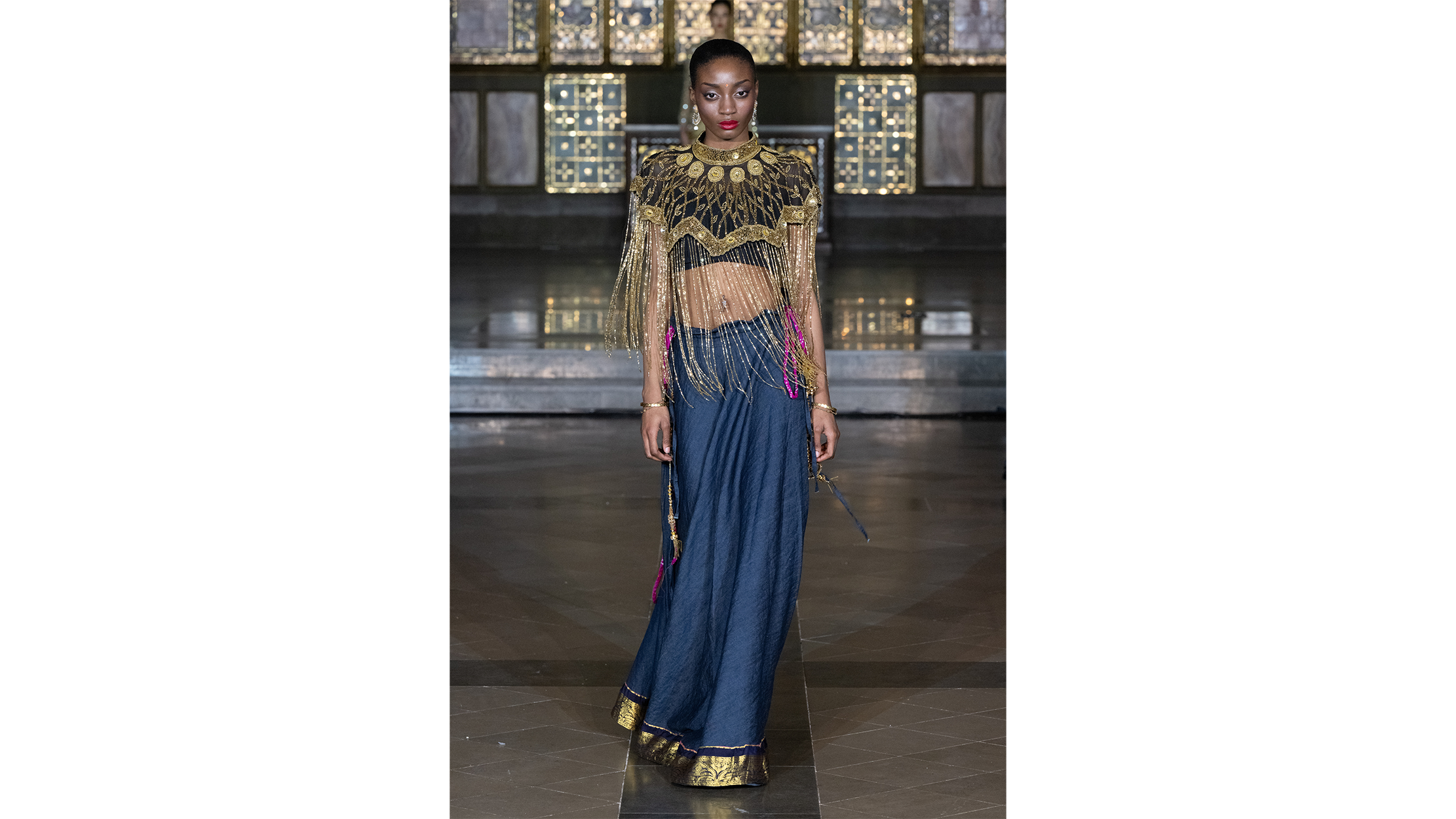
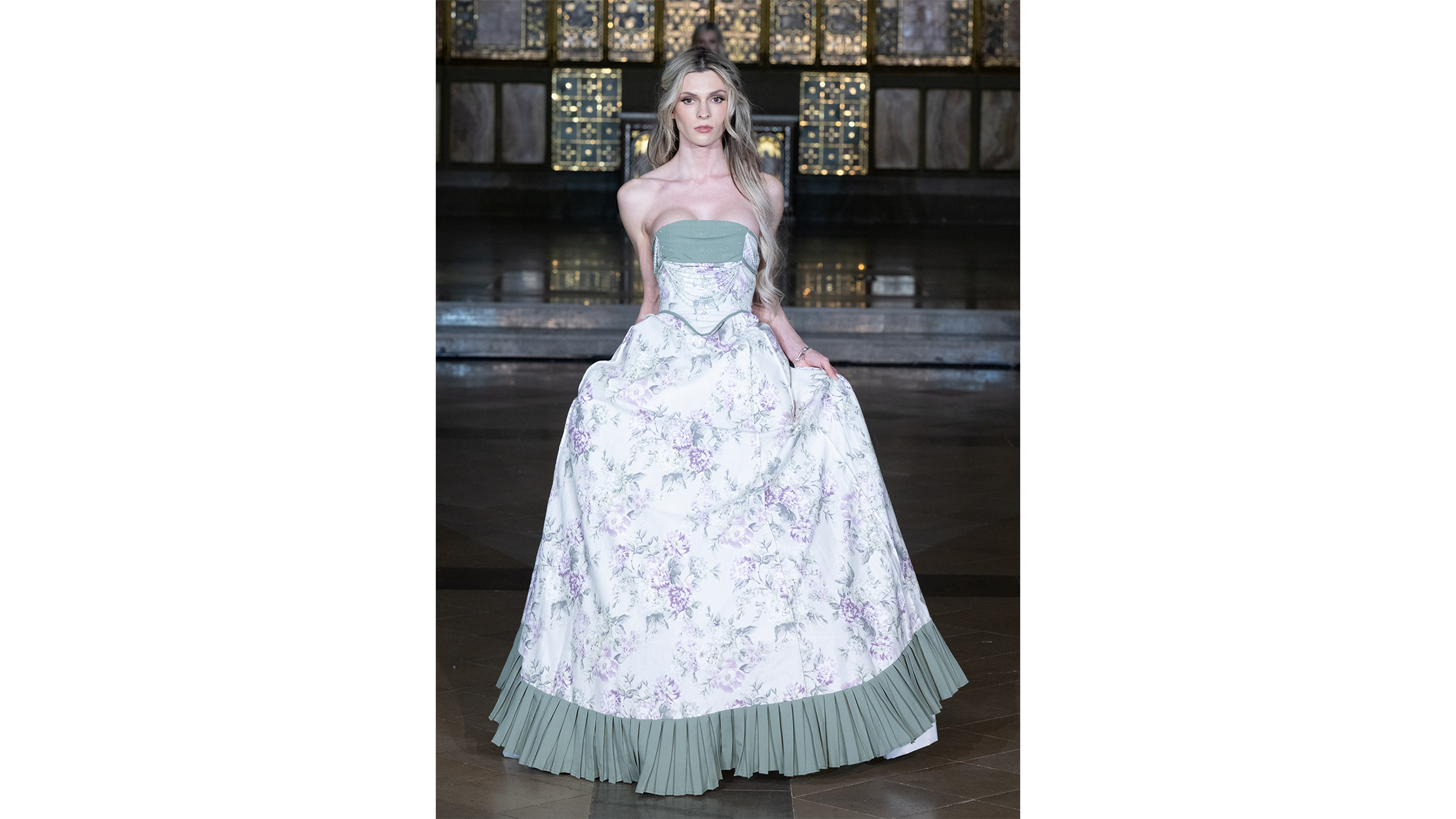
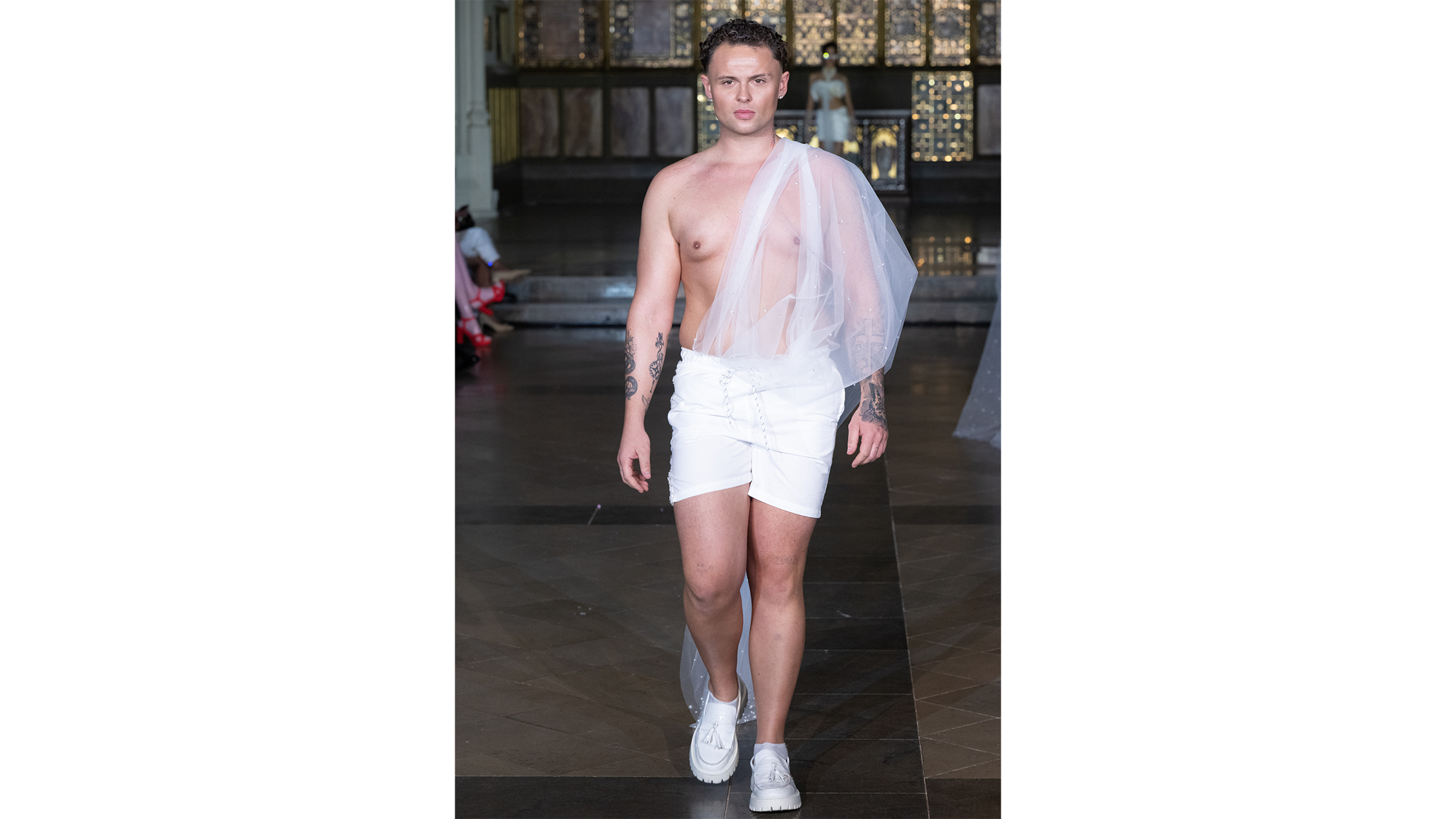
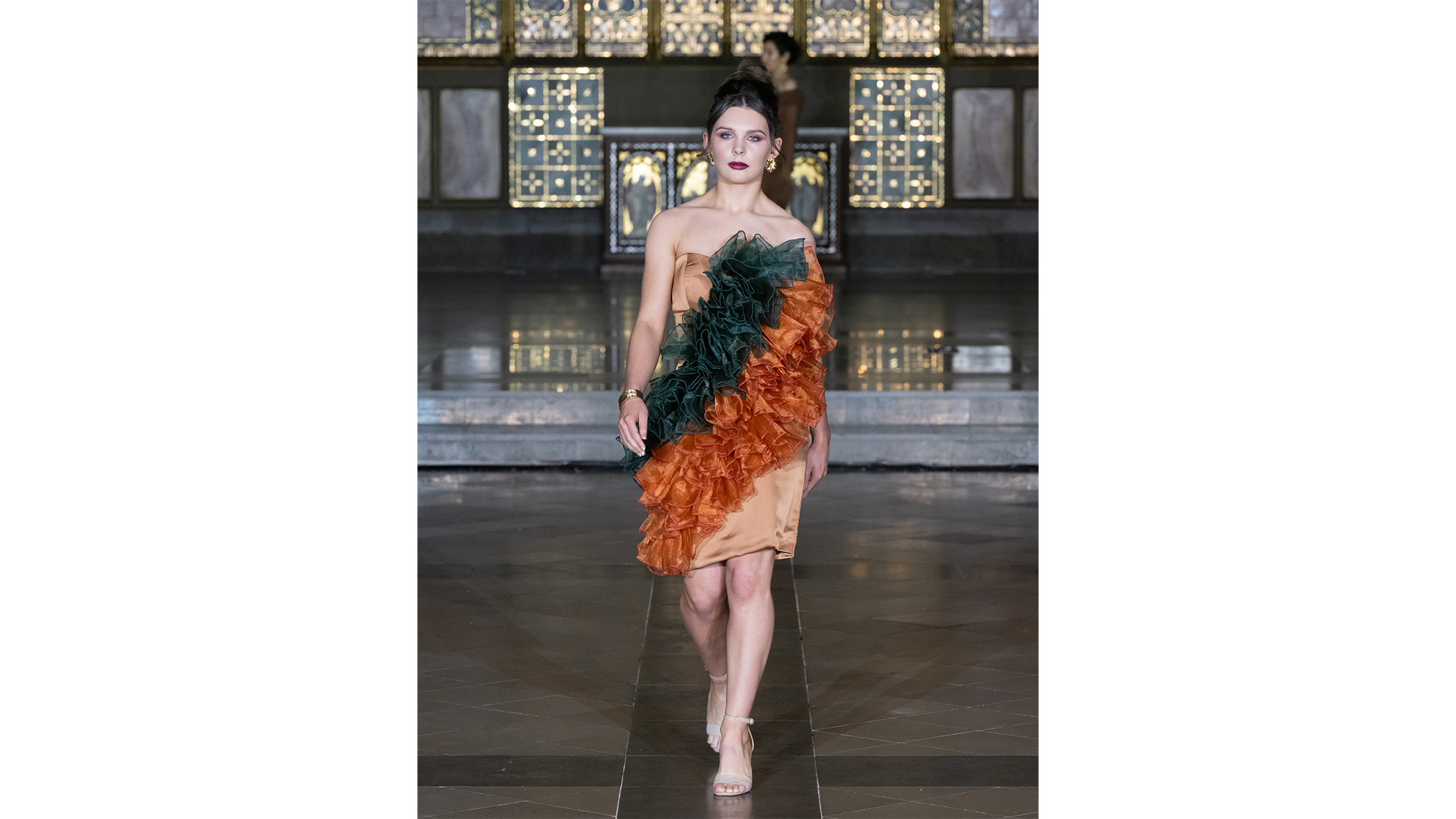
The Spotlight Series has always operated with a particular conviction — that the space between "emerging" and "established" is not a hierarchy but a conversation, and that the runway belongs to whoever has something honest to say. This season, that conviction became visible in the cast before it became visible in the clothes. Over thirty models moved through the space across the evening's multi designer programme, and they moved as though the usual arithmetic of fashion had simply been set aside. A young Black woman in a gold-beaded cape and navy silk draped skirt, the beadwork cascading in fine golden chains across her bare midriff, walked with the quiet precision of someone who knew she was carrying more than fabric. Minutes later, a plus-size model appeared in a floor-length red gown — heavily beaded, the sequins and crystals catching the church's ambient light in cascading diagonal lines — with enormous sculptural organza sleeves that billowed like twin roses at her shoulders. She placed her hands on her hips and held. The room held with her. She returned later in a burnt orange column dress with teal green pleated ruffles at the sleeves and hem, the colour-blocking so bold it seemed to generate its own warmth, and the applause that followed her was not the polite kind. Male models walked in looks that included a sheer pearl-dotted tulle drape worn across the bare torso with white shorts and chunky loafers — bridal vocabulary, stripped of gender and reassembled with a wink. A model in a lavender and sage floral ballgown, strapless, with a pleated green underskirt peeking beneath yards of botanical print, carried the piece with the kind of composed defiance that rewrites the rules of who gets to wear what. And Sangeetha Menon, a 42-year-old Indian model, walked — not as a footnote to diversity, but as its thesis statement. When asked afterwards what brought her to the runway, her answer was disarmingly direct. She wants more diversity, she said. These are not the old times, when only one kind of body deserved the spotlight. The sentence landed in the room like a door being propped open and left that way.
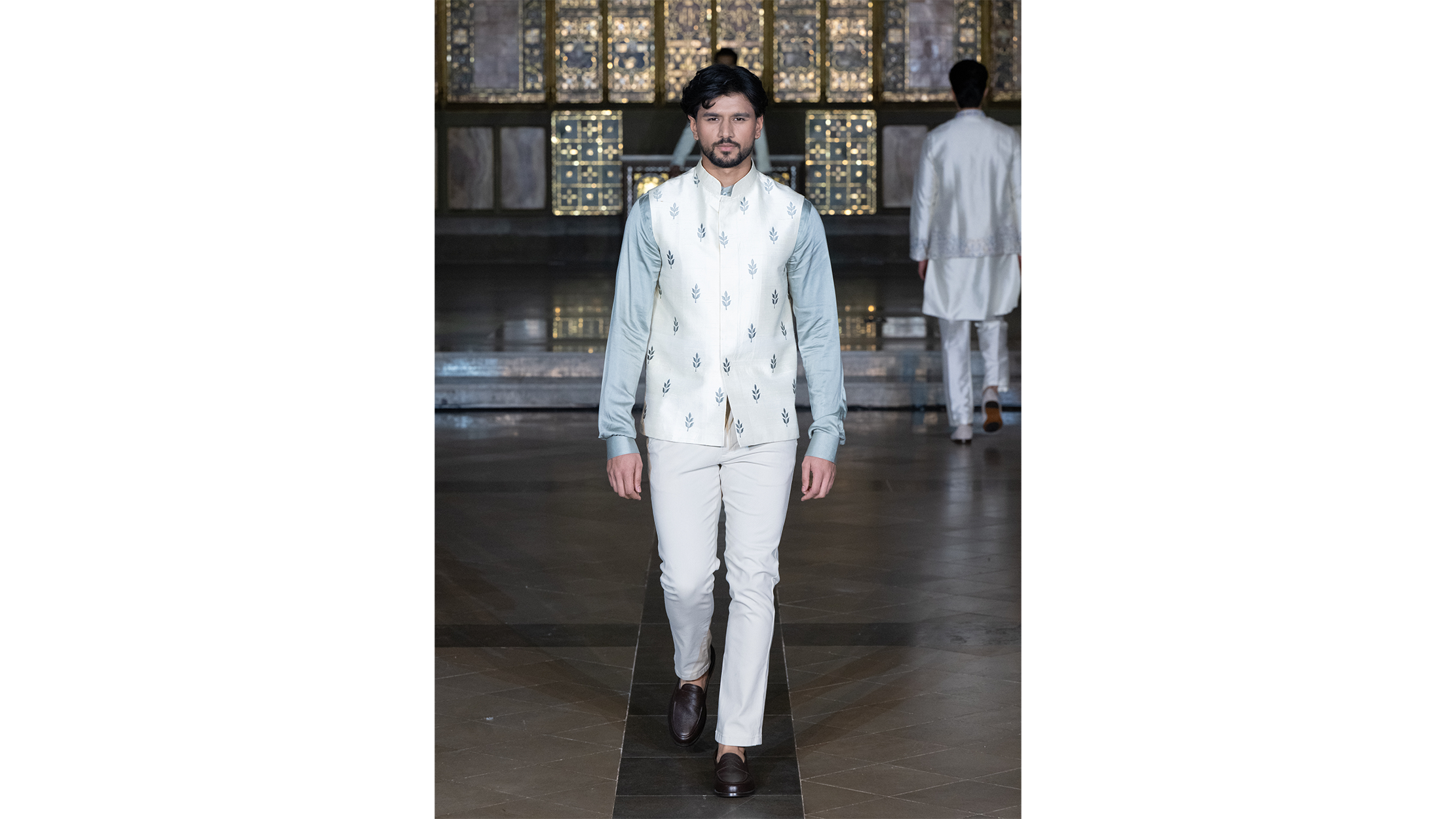
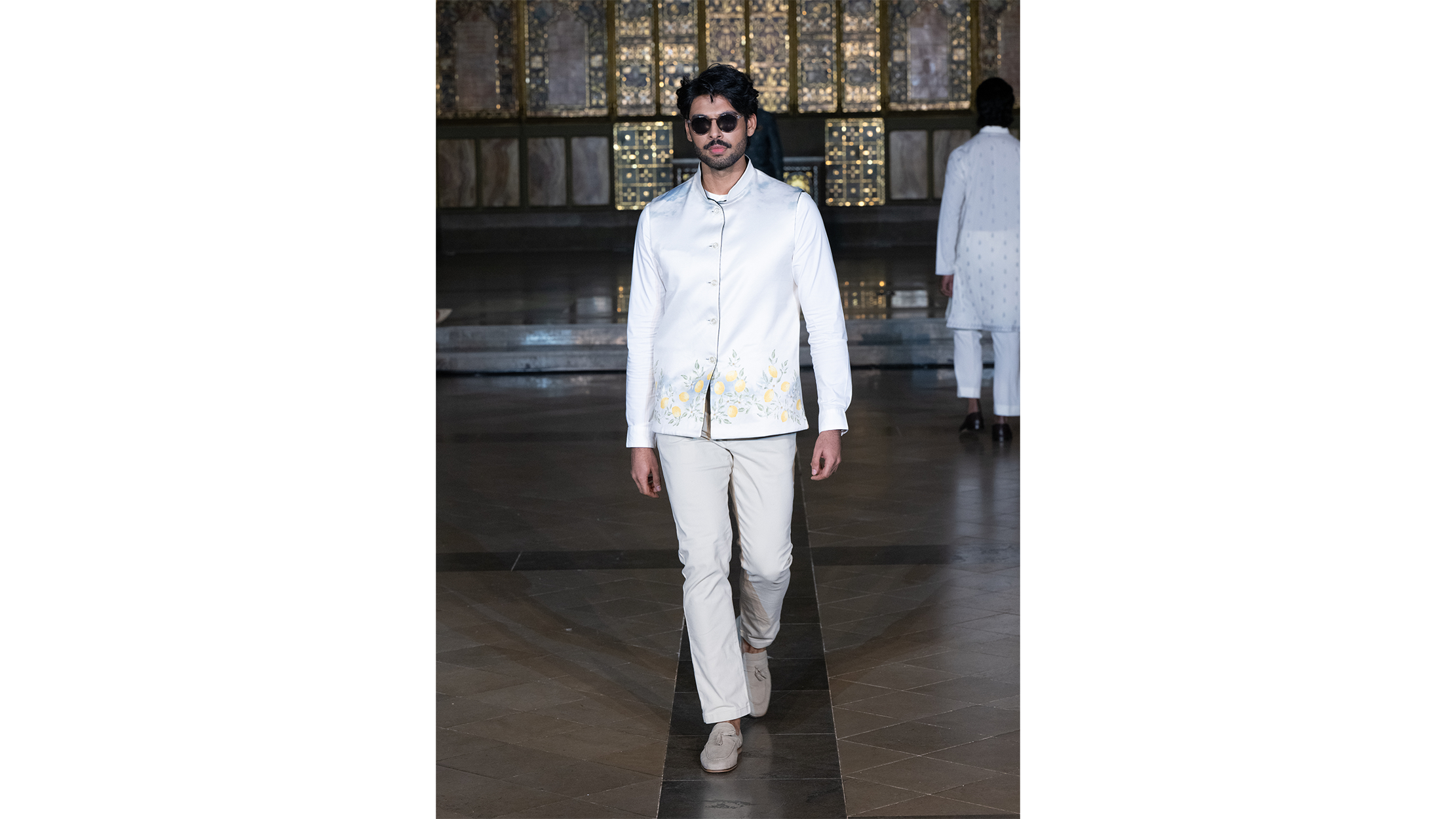
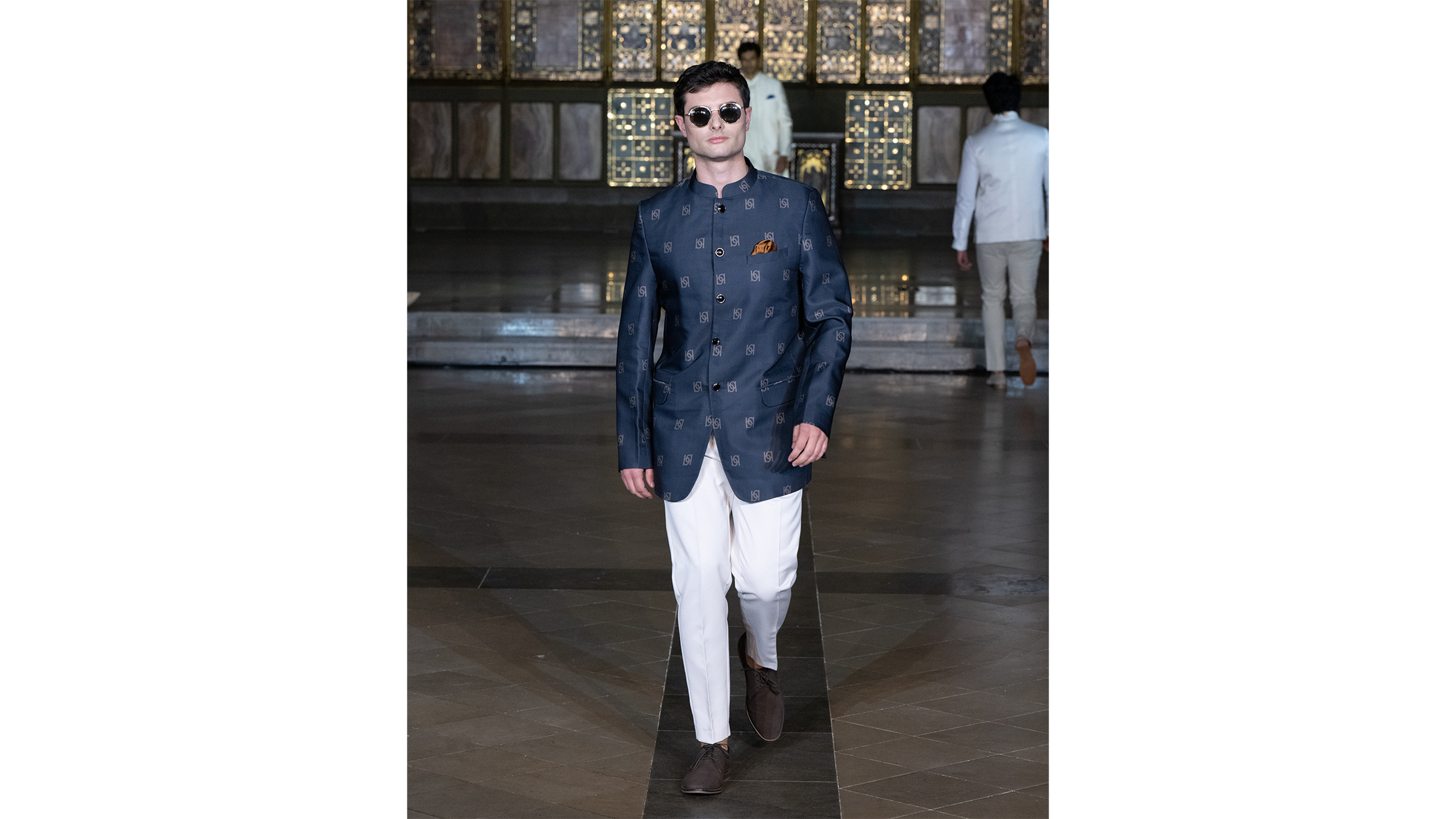
The evening opened with what appeared to be the Paris Runway Official and London School of Trends collections, and the menswear segment delivered one of the show's most quietly radical stretches. A succession of looks rooted in South Asian formalwear — Nehru jackets, kurta sets, Mandarin collars — arrived in fabrics and colourways that felt simultaneously ceremonial and contemporary. An ivory raw-silk kurta layered beneath a matching Nehru jacket, its hem and collar traced with delicate pastel floral embroidery in blue, pink, and gold, moved with the lustrous weight of hand-finished cloth. Behind it came a cream waistcoat printed with a repeating leaf motif in slate grey, worn over a pale blue shirt and cream trousers — the kind of understated tailoring that lets the textile do the talking. Then a white Nehru jacket with hand-painted lemon and citrus botanicals blooming upward from the hem, paired with aviator sunglasses and suede loafers, radiating the insouciance of someone who has figured out that elegance and ease are not opposites. A navy monogrammed jacket followed — the house insignia woven into the fabric in a tone-on-tone repeat — over white trousers and brown lace-ups, a bronze pocket square providing the single note of warmth. Taken together, these pieces did something unusual: they proposed that South Asian menswear is not a niche within fashion but a vocabulary as fluent and adaptable as Savile Row tailoring, capable of crossing continents without abandoning its origins.
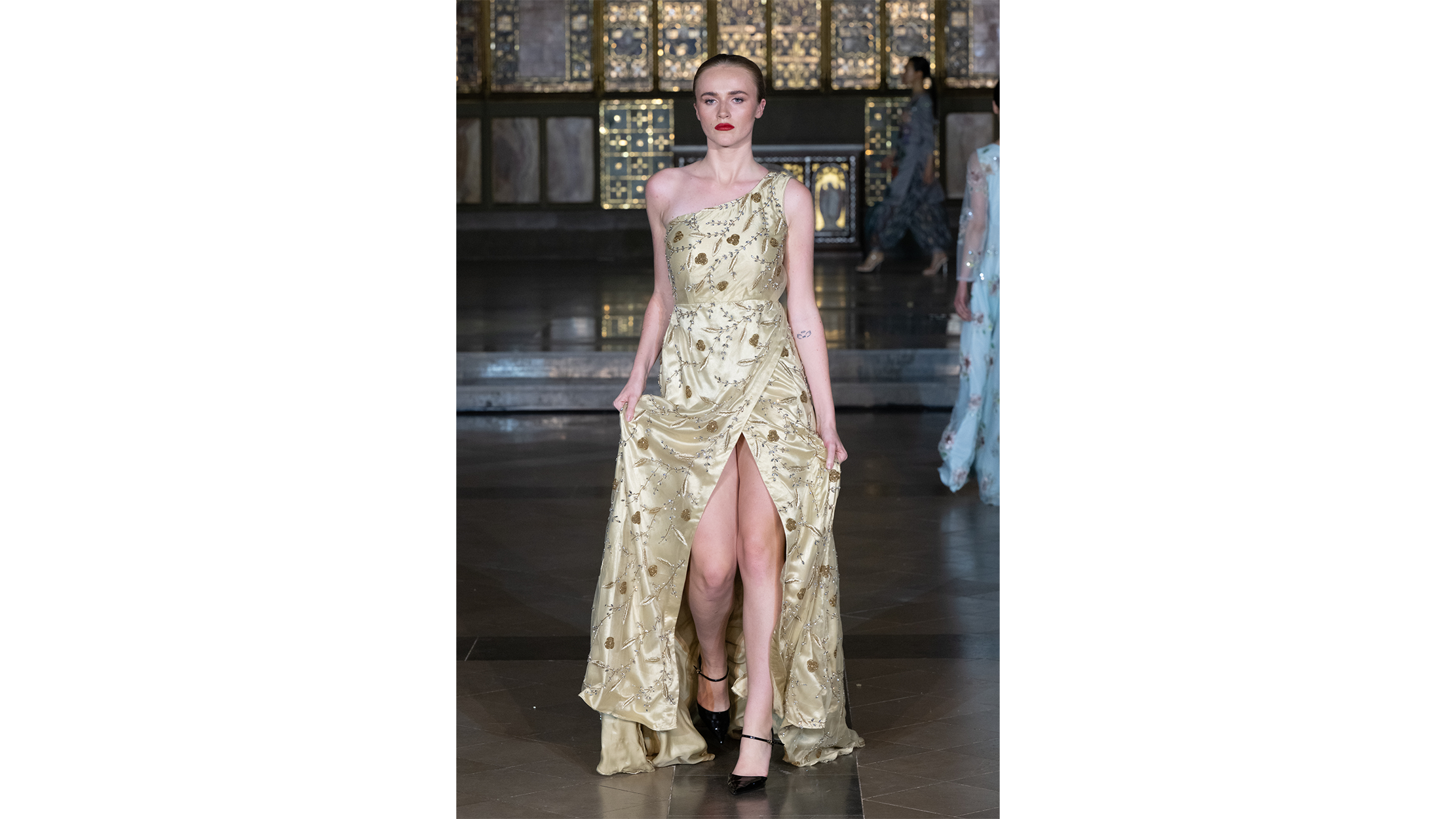
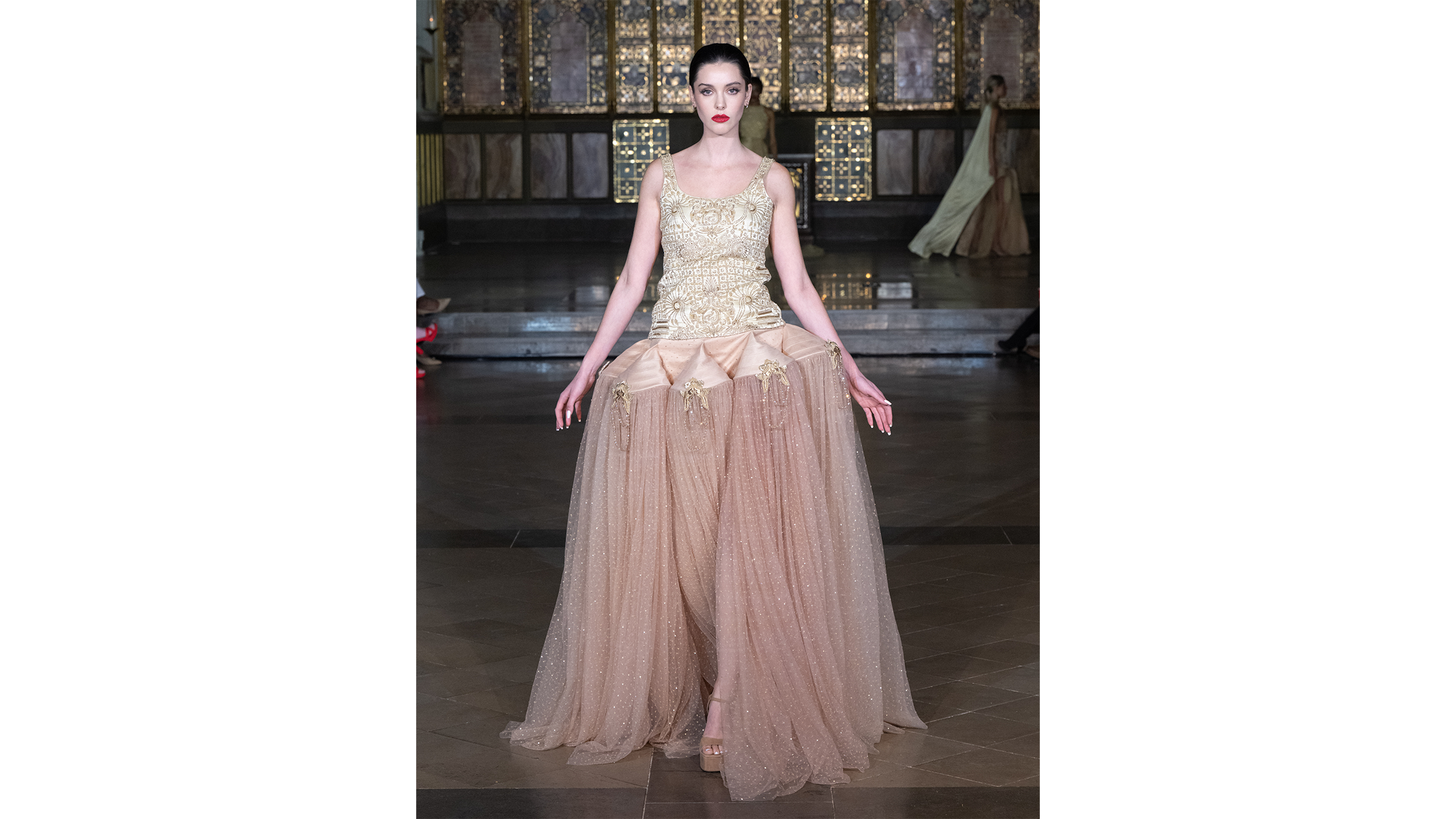
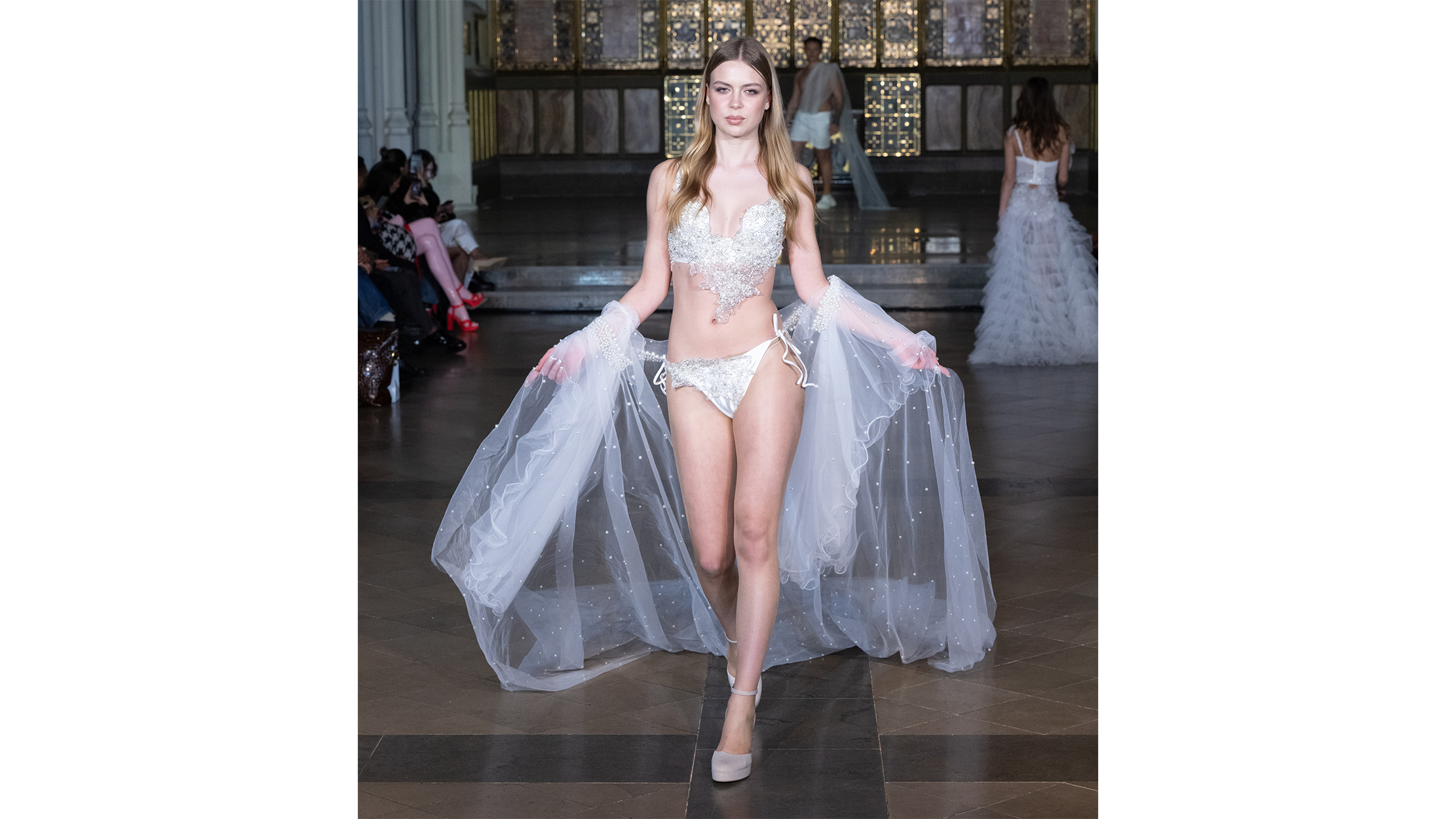
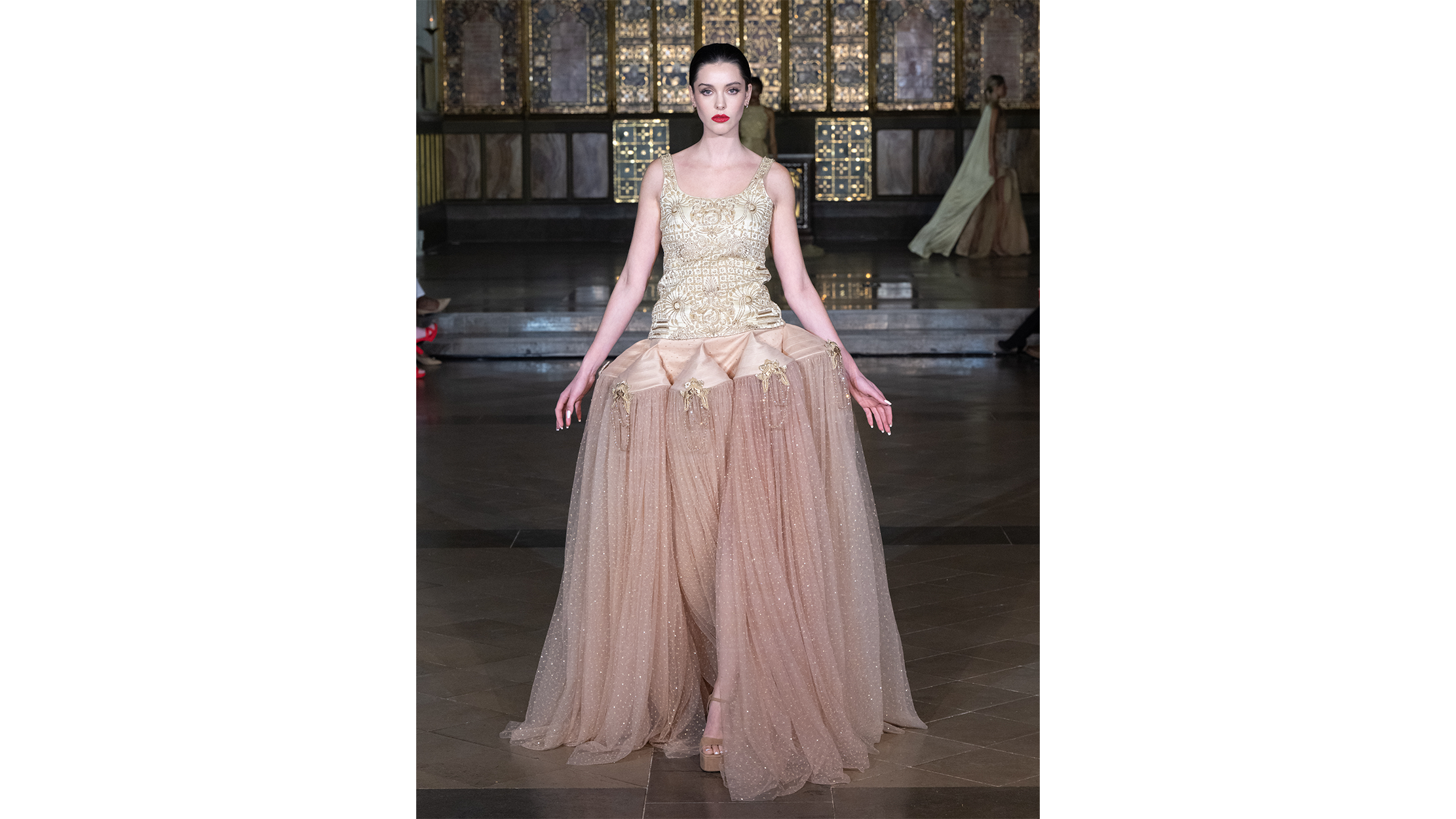
The womenswear that followed moved across a wider emotional register. A gold-embroidered bodice — the beadwork dense, floral, almost Mughal in its intricacy — sat atop a blush tulle skirt that cascaded to the floor, tiny golden bows punctuating the gathering at the hips and the fabric spangled with fine glitter that made each step look like it was scattering light. An East Asian model appeared in a gold-and-green brocade peplum blazer, structured and cinched at the waist, over a floor-length sheer black skirt covered in
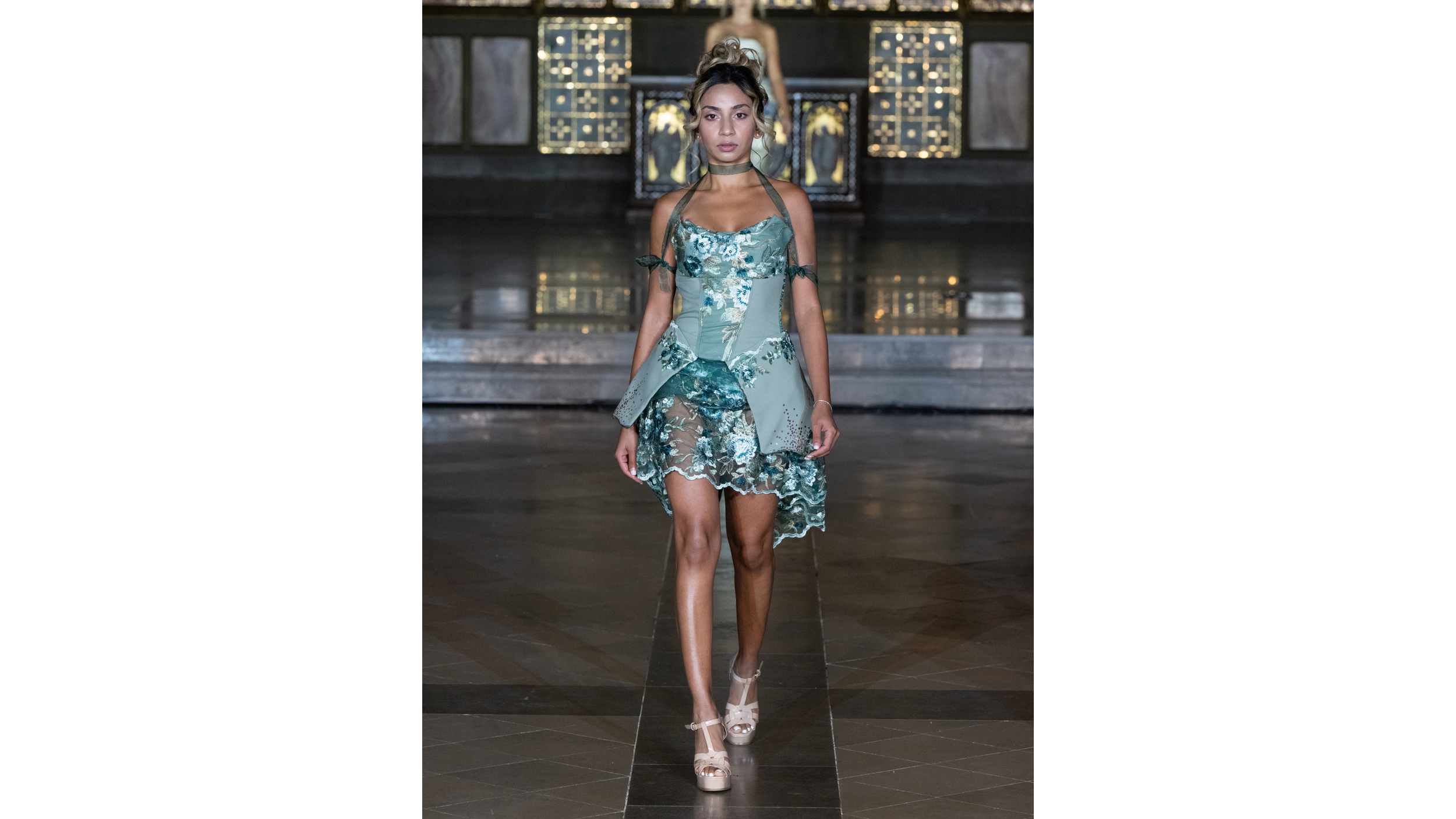
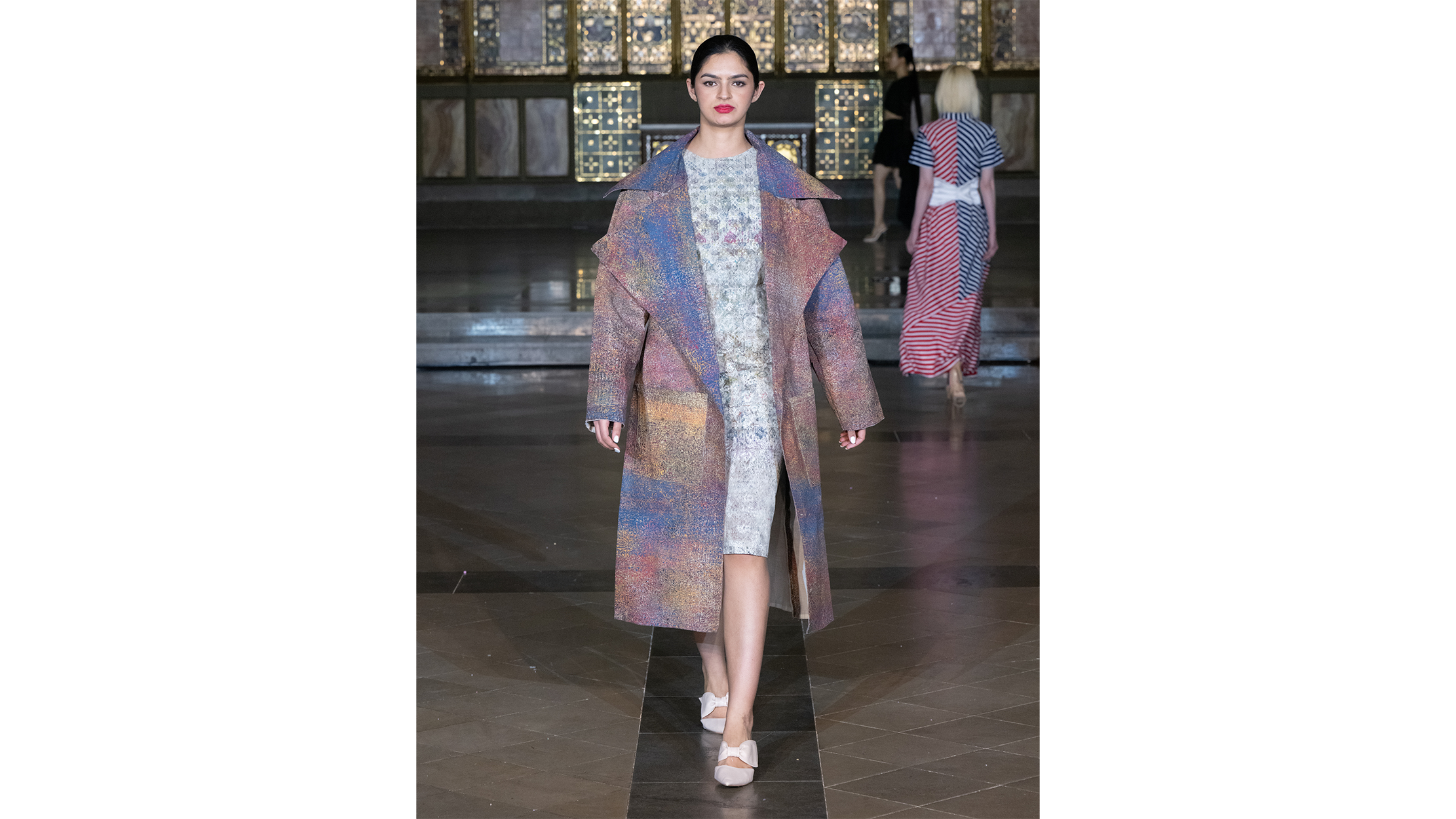
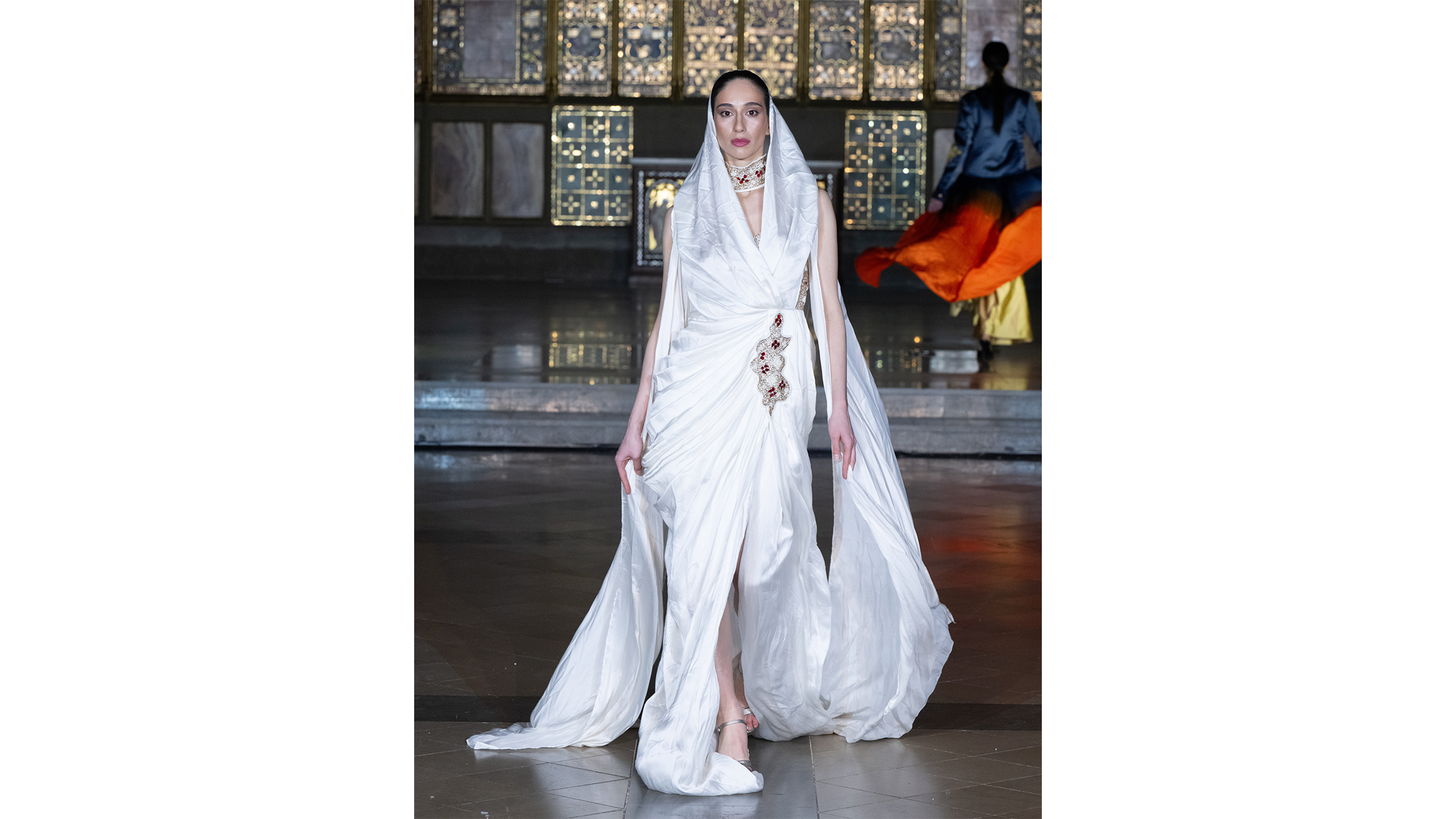
three-dimensional floral appliqué — the transparency of the skirt beneath the formality of the jacket creating a tension that felt like a conversation between revelation and restraint. A deep teal silk gown, belted at the waist and worn with a matching floor-length cape, moved through the church with the gravity of ceremony; silver botanical embroidery at the hemline caught the candlelight and turned the garment's trailing edge into something like a whispered postscript. Behind her, barely in focus, a model in a gold corset and magenta silk skirt offered a glimpse of the chromatic range still to come. A painterly overcoat — its surface a pointillist wash of terracotta, blue, and dusty rose, like a Monet water lily canvas rendered in textile — was worn over a textured shift dress, the whole look landing somewhere between gallery opening and wearable art. A white silk gown draped in the manner of a sari, its fabric pooling and catching air as the model walked, featured a cowled hood and clusters of ruby-coloured embellishment along the bodice and hip — bridal, devotional, unmistakably South Asian in its draping logic yet entirely modern in its silhouette. A sage-green corset mini dress layered floral embroidery over sheer lace at the skirt, its choker neckline and off-shoulder bows lending a botanical tenderness to a look that could easily have read as purely structural.
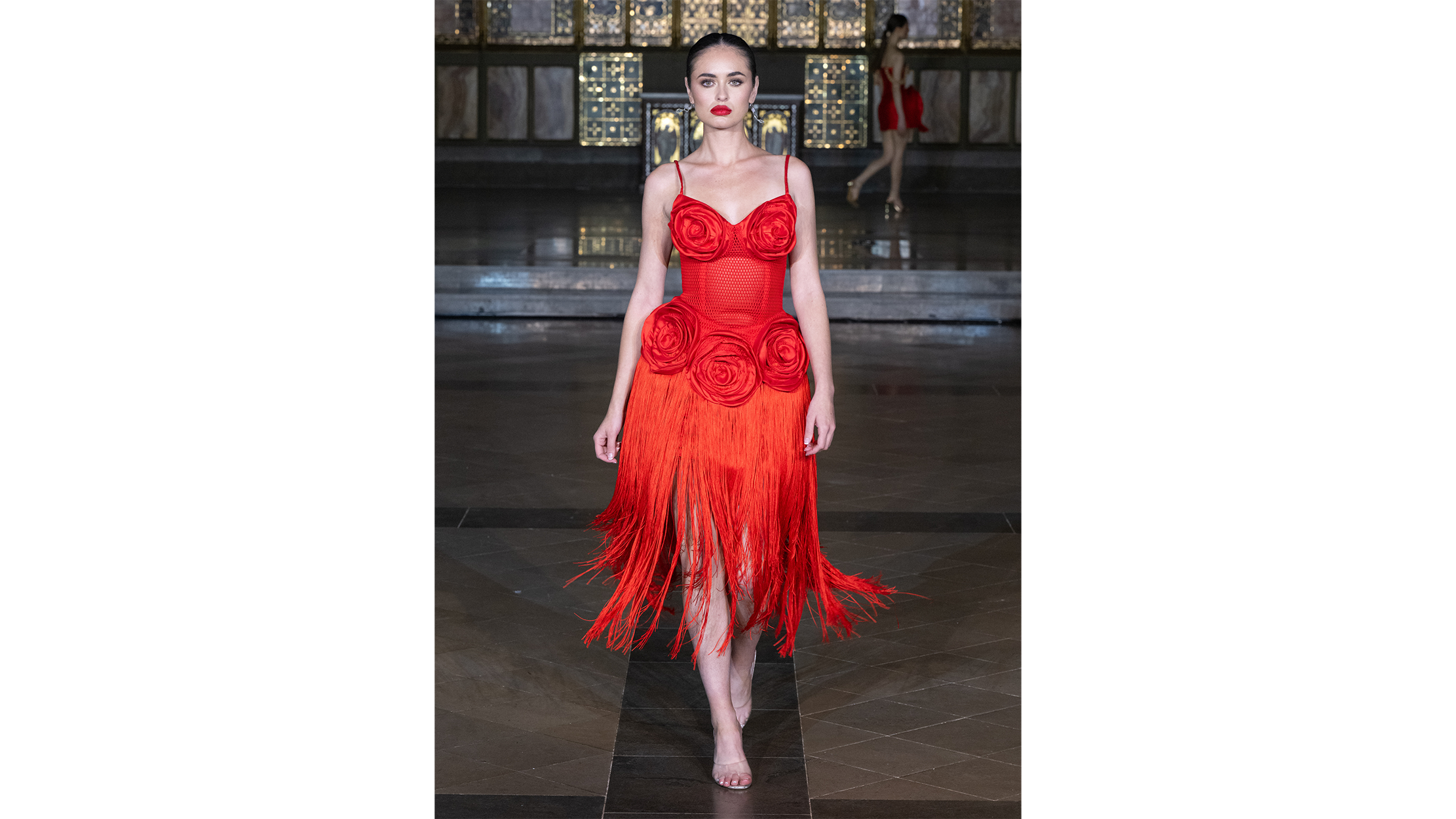
And then, the closer. Bibi Lawrence, the Lagos-based luxury womenswear label founded by creative director Blessing Eleh, took the final slot and used it to present a focused couture edit from Oge Ntoju — an Igbo phrase meaning "a time of abundance and fullness." The collection reads as a meditation on prosperity, growth, and what Eleh's brand calls divine flourishing, channelled through the language of flowers treated not as decoration but as architecture. The red dress that came down the runway — a corseted midi-length piece in vivid, saturated scarlet — was studded with sculptural rosette formations at the bust and hip, each one hand-constructed from fabric that had been rolled, layered, and fixed into three-dimensional bloom. Below the roses, a dense fringe hem fell in long, kinetic strands that swayed and separated with each step, the movement so rhythmic it gave the garment its own breathing pattern. Against the dark stone floor and gilded backdrop of St John's, the red was almost violent in its beauty — a flower that had decided to stop being decorative and start being structural. It was the kind of closing look that doesn't just end a show but reframes everything that preceded it, reminding the audience that the whole evening had been building toward this: a Lagos-born house planting its flag in London, two couture pieces at a time.
Blessing Eleh's path to that runway carries a quiet accumulation of its own. Before founding Bibi Lawrence, she worked as an assistant designer, learning pattern-making and production from the inside out. She taught at Yaba College of Technology, Nigeria's first higher educational institution, before stepping fully into her own creative directorship. The brand has shown at Dallas Fashion Week, Lagos
Bridal Fashion Week, and Accra Fashion Week, building an international reputation for refined sculptural femininity and artisanal surface work. The London presentation marks a strategic expansion into the UK market — the beginning, the brand has signalled, of a deeper engagement that may eventually include a London atelier and a growing bespoke clientele. Oge Ntoju translates as a season of fullness, and in the context of Bibi Lawrence's trajectory from Lagos to Hyde Park, the name reads less like a collection title and more like a prophecy being quietly fulfilled.
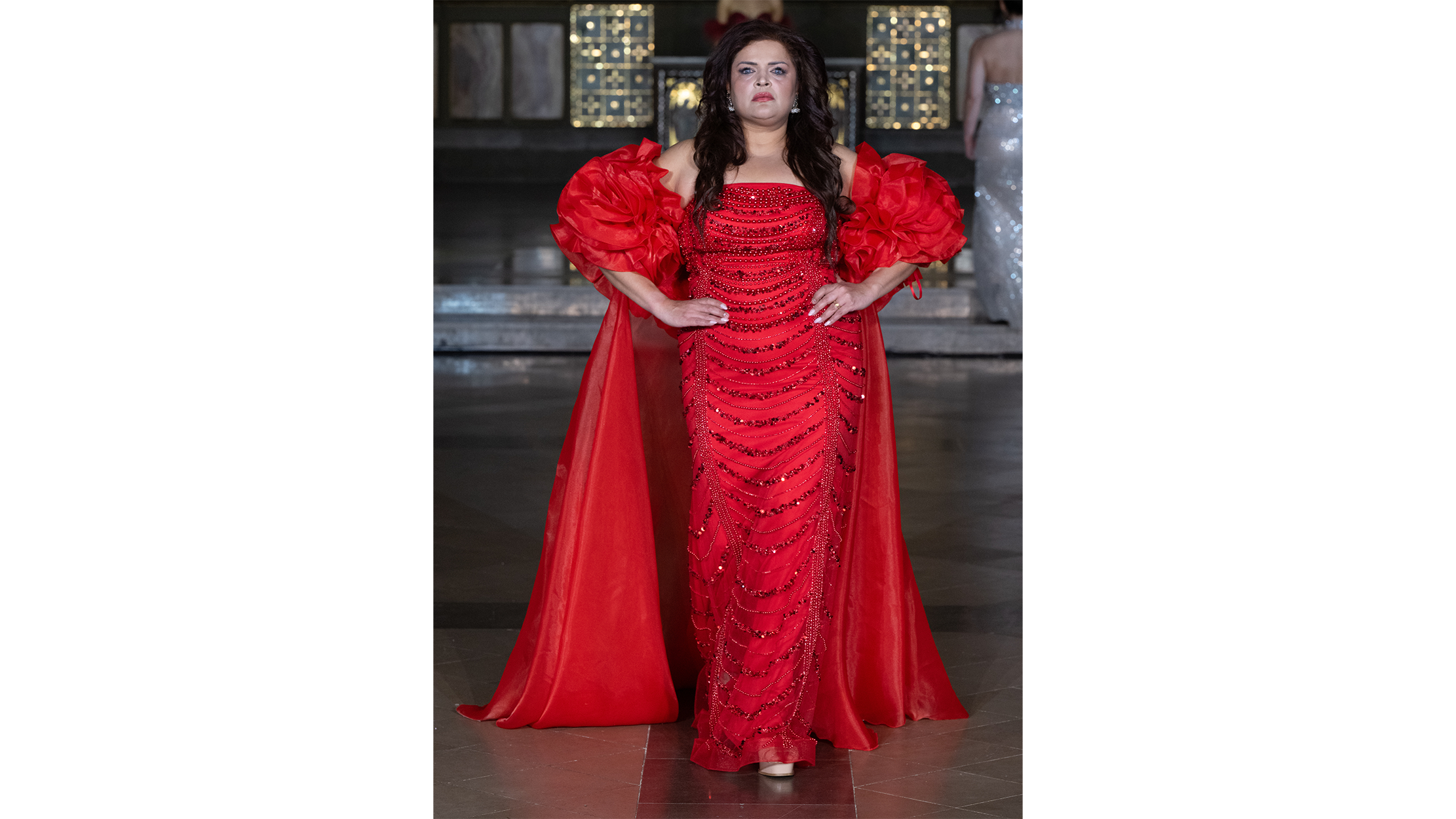
As the final fringe settled and the applause lifted toward the vaulted ceiling, what remained was not any single garment but a cumulative image: the plus-size model's hands planted on her hips in that red beaded gown; the male model in bridal tulle walking with unaffected ease; the South Asian menswear that refused to explain itself as exotic; Sangeetha Menon's face, composed and certain, carrying the weight of a statement that shouldn't still need making but does. Fashion Week & The City has positioned itself as a platform for designers crossing into the British and European markets, but what it staged inside St John's Church was something more elemental than market access. It was proof — delivered in silk, in raffia, in hand-painted orchids and hand-stitched beading and sheer black floral appliqué — that the most radical gesture a runway can make in 2026 is not a silhouette or a fabric innovation but a refusal to edit the world down to a single acceptable shape. The garments were extraordinary. But the bodies that carried them were the collection's true material, and every one of them earned its place in the light.
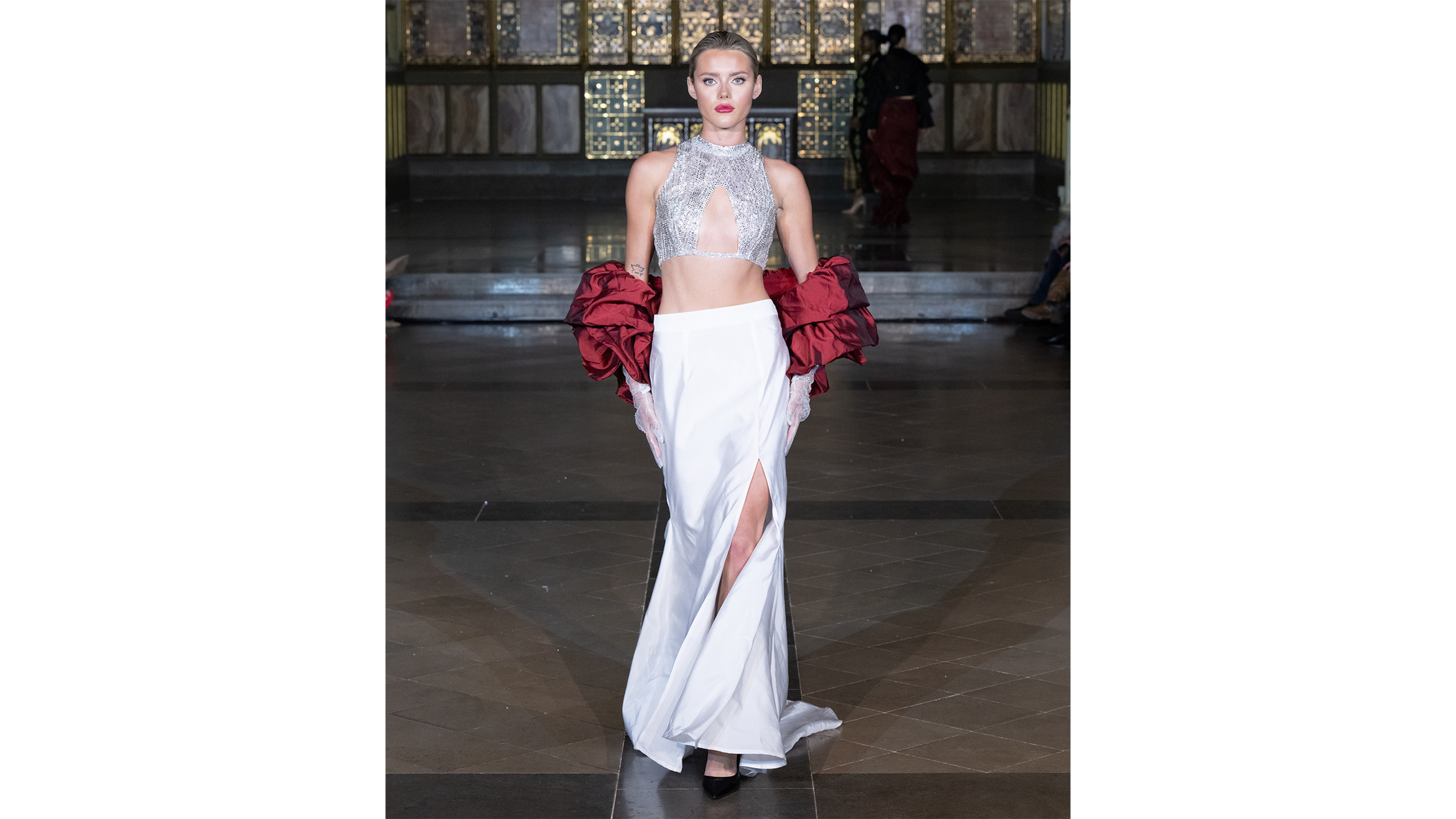
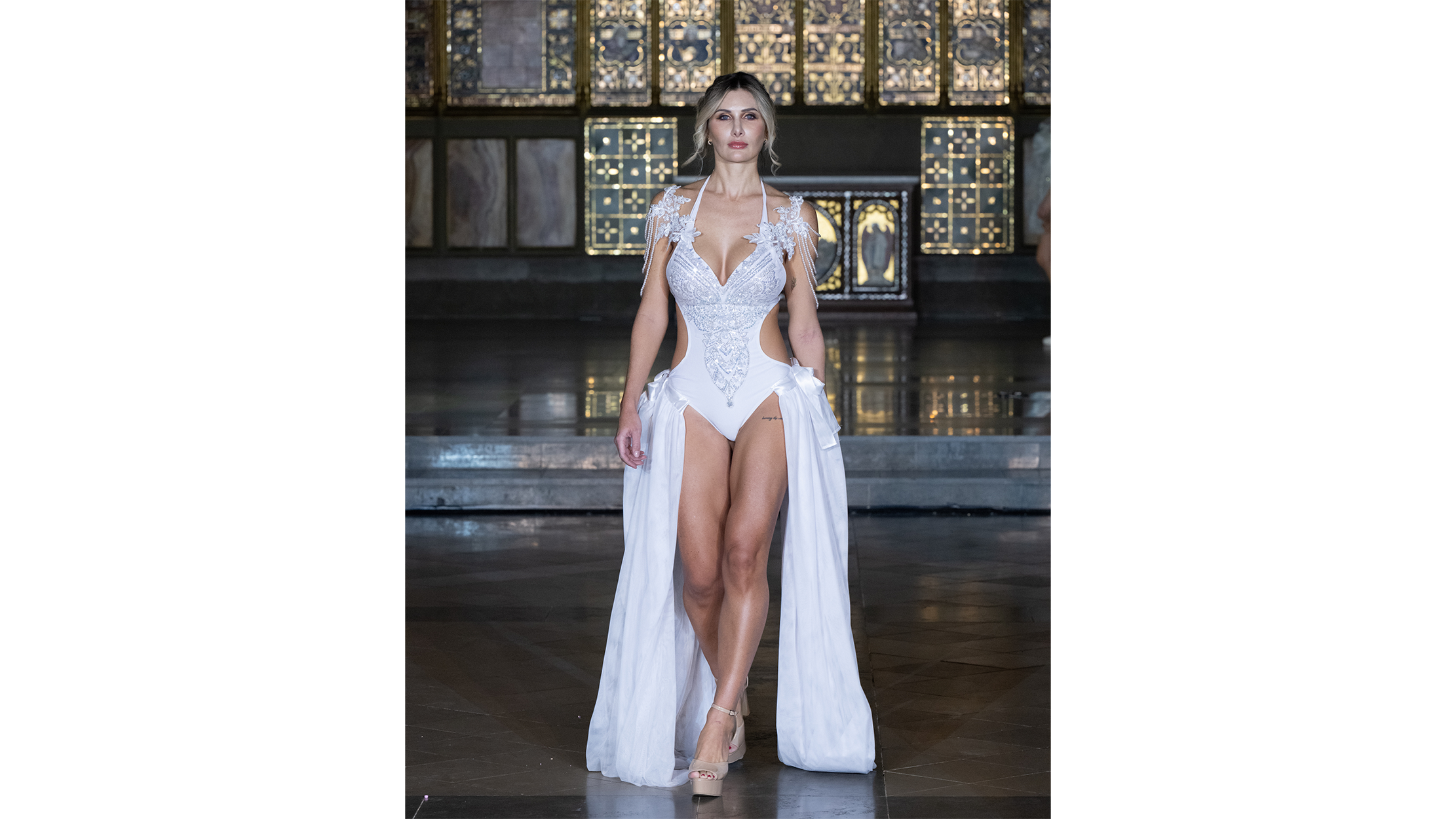
Fashion Week & The City's Spotlight Series was presented at St John's Church, Hyde Park, on 19 February 2026. Production by Fashion Week & The City. Photography by Mark Gonpoint. Lead makeup by Julia Voron; lead hair by Viktoriya Vradii. PR by i.deapr.
Article by Aayush Anima Aggarwal, Contributing Editor, PhotoBook Magazine
Tearsheets by Daniel López, Art Director, PhotoBook Magazine
*Images Courtesy of Fashion Week & The City
RELATED STORIES