GENARO RIVAS AW26: THE WEIGHT OF WHAT SHATTERS
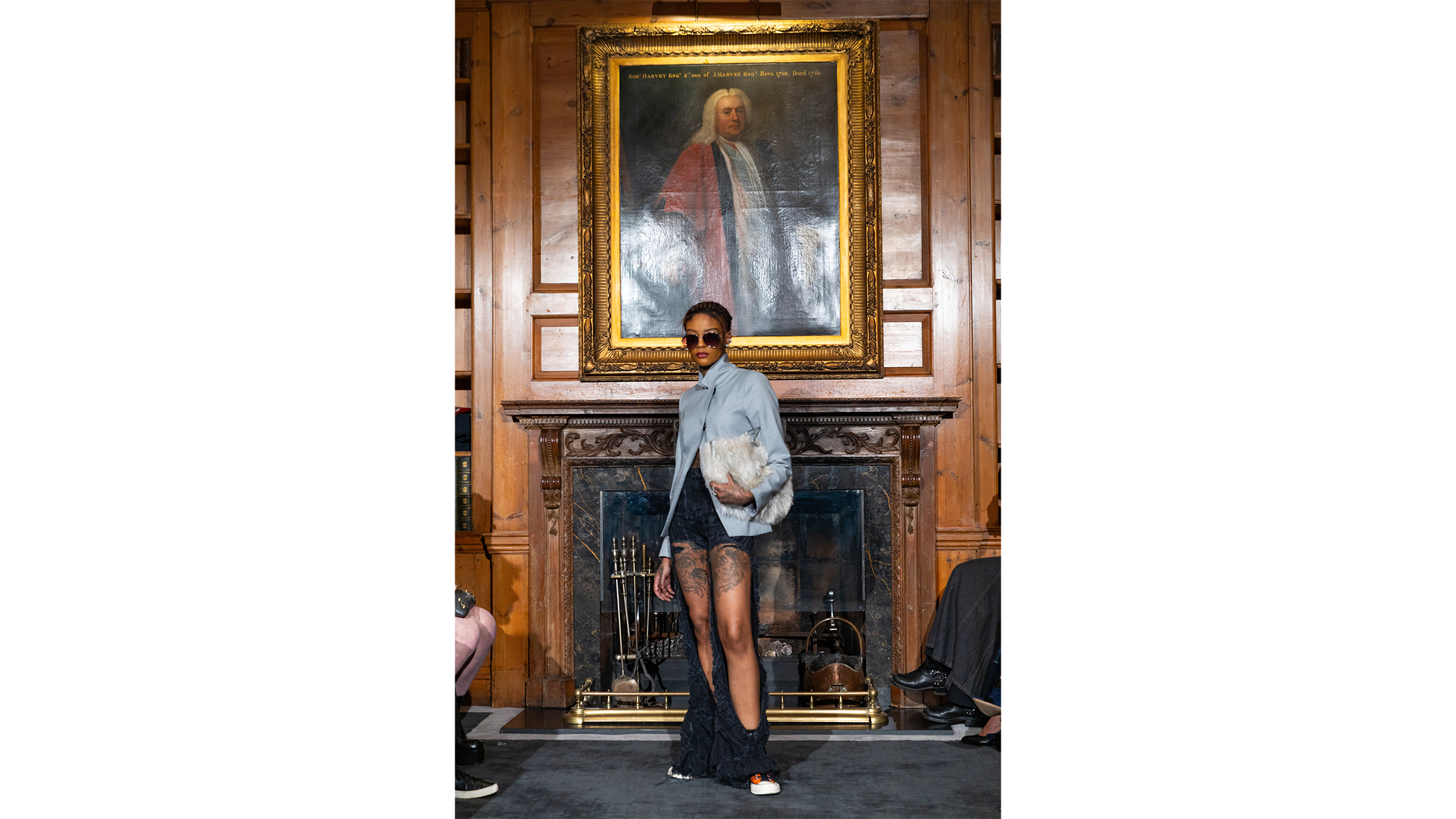
The oil portraits watched with the particular indifference of the long dead. In a wood-panelled library somewhere in London's institutional heart — all brass fenders and marble mantlepieces, gilt frames holding the powdered likenesses of the Harvey family across centuries, Genaro Rivas staged an act of beautiful destruction. The room was intimate to the point of claustrophobia, guests pressed knee-to-knee along its edges, the carpet-muffled runway no wider than a corridor. It was the kind of setting where you could hear fabric move. And when the first look emerged beneath those ancestral gazes, you understood immediately that this was a conversation between power and fragility, between the establishment's composed surface and the jagged reality of breaking through it.
The collection is called "A Glass to Break," and its origin story carries the quiet poetry that has come to define Rivas's creative process. In Berlin, months before the first pattern was cut, he photographed a glass pane scarred by a bullet's impact — the web of fractures radiating outward like frozen lightning. Weeks later, walking with his astrologer through the city, he found shattered glass scattered across the ground. Two encounters with breakage, neither violent in the moment of witnessing, both heavy with accumulated meaning. For a self-taught Peruvian designer who became the first from his country to show at London Fashion Week — who built his practice from nothing in a city that rewards lineage and institutional access, who developed a methodology for fair wages in artisan collaborations during his MA at the London College of Fashion — the metaphor needed no explanation. The glass ceiling is not a cliché when you have spent years pressing your hands against it.
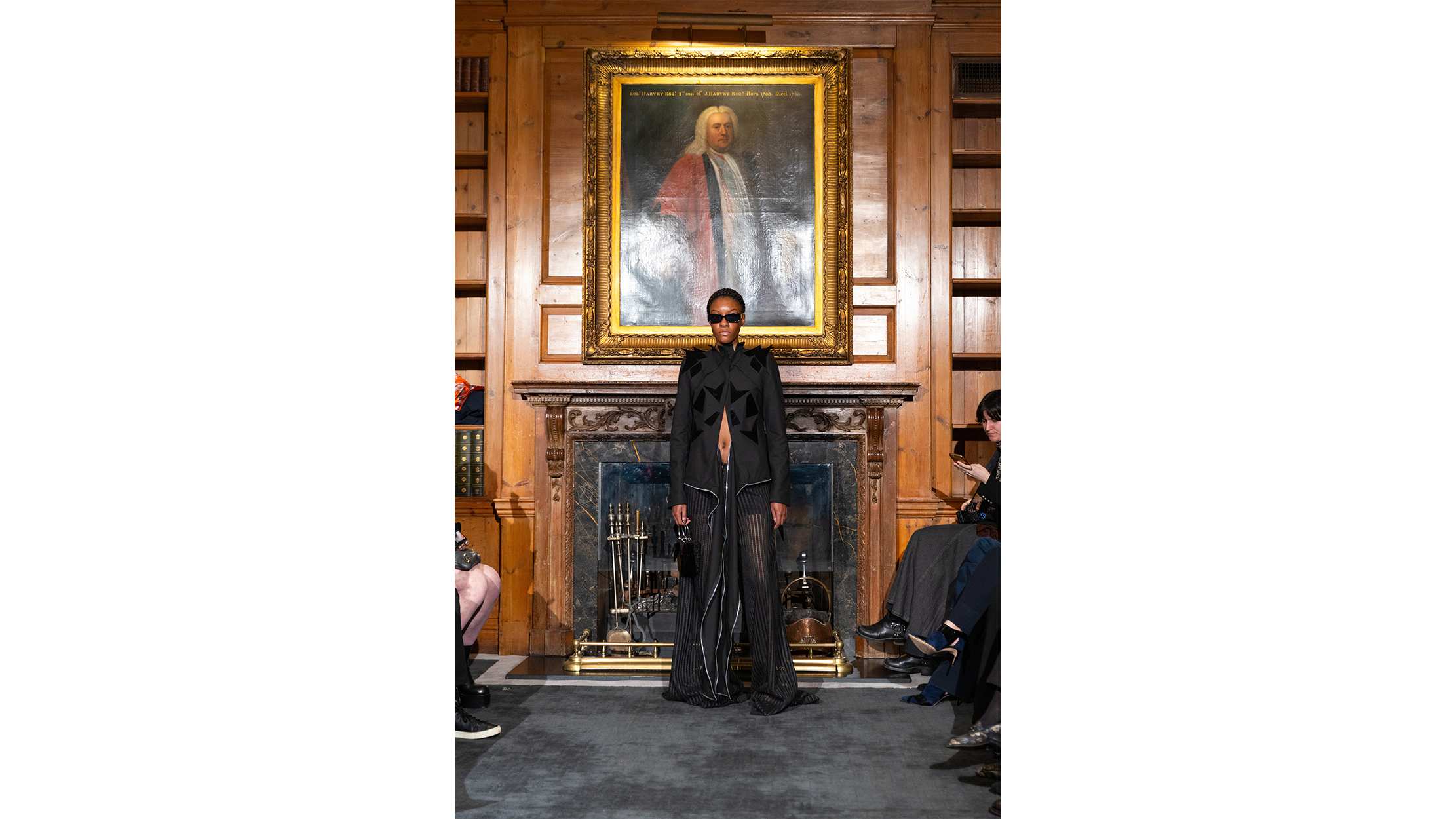
Twenty-six looks moved through that library, predominantly womenswear with selective menswear silhouettes, and each carried the tension between rupture and reconstruction. The tailoring was architectural, exaggerated in its proportions, sleeves extending dramatically beyond the wrist, shoulders asserting themselves against the room's low ceilings, jackets that seemed to have been pulled apart and reassembled with forensic intention. From within these structured forms, bursts of fabric emerged like wounds that had chosen not to heal quietly, the garments becoming simultaneously emotional and structural. One gown stood beneath the Harvey portrait as if challenging it directly: its bodice a cascade of shattered acrylic shards in black, crimson, and translucent panels over gossamer tulle, each fragment catching the warm light differently, the model's braided crown lending the whole image the quality of a Renaissance warrior painted by someone who understood couture. The base pooled into black organza at the floor, a dark tide receiving what the fractures had released. It was the kind of piece that makes a room hold its breath — not because it is beautiful, though it is, but because it feels like watching someone refuse to be invisible.
Another standout arrived in the language of restraint made dangerous. Strips of what appeared to be plant-based leather, cut into long, sinuous ribbons, were mapped across a sheer bodysuit to trace the body's architecture, part anatomical drawing, part cage, part liberation. A sculptural headpiece of fanned leather fronds erupted from the neck, obscuring the model's face entirely, so that the garment itself became the identity. The effect was startling against the room's Georgian civility: something between body horror and high ceremony, a figure from a myth the old world had tried to suppress walking calmly through its drawing room. Rivas has always understood that the distance between armour and adornment is a matter of perspective, and here that understanding was absolute.
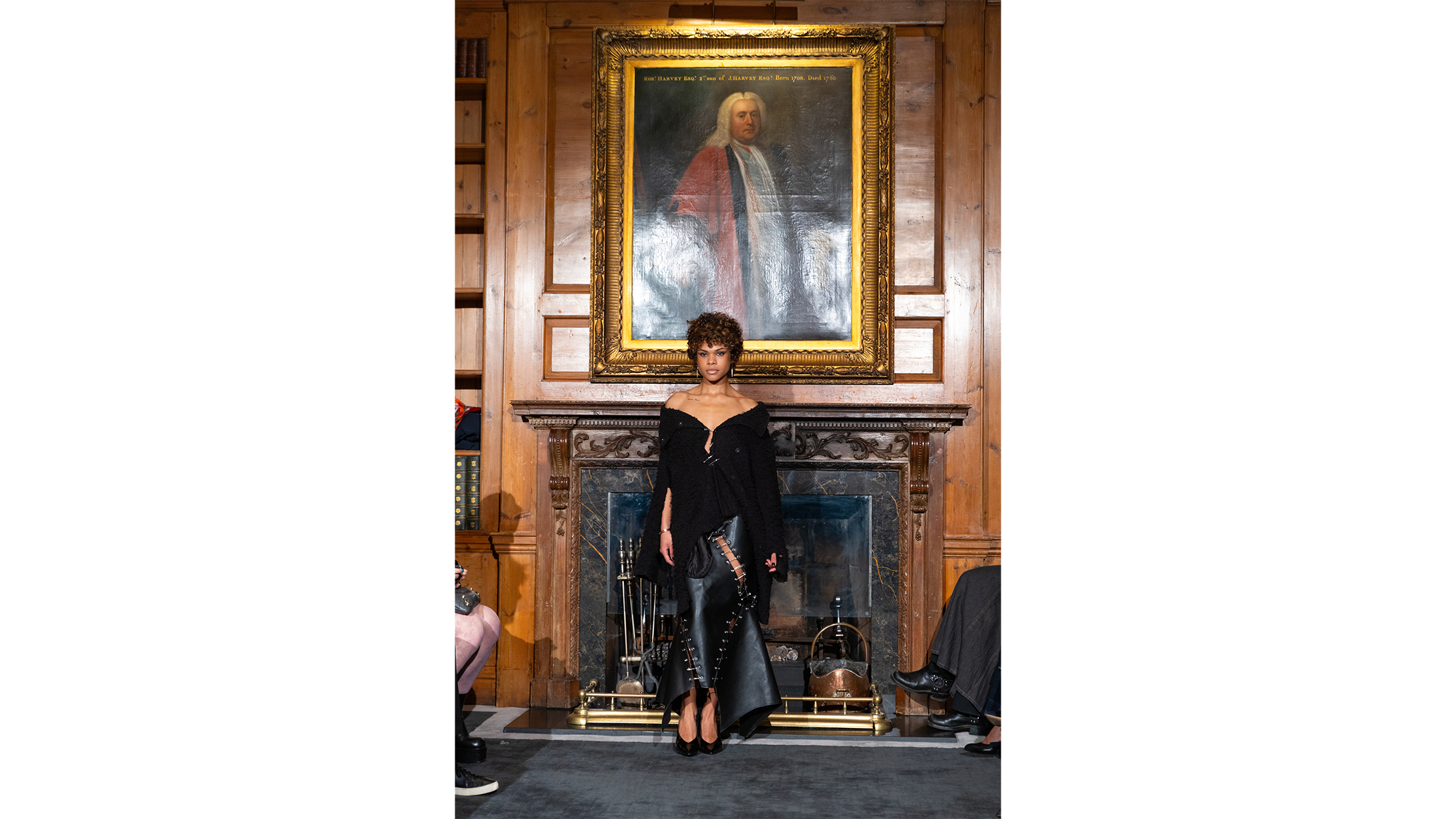
What distinguished this collection from spectacle alone was its material conscience. Rivas has built his practice around the conviction that fashion must carry purpose beyond aesthetics — his very first show in Lima raised funds for a children's hospital; his "Tejedores por la Esperanza" project collaborated with hand weavers in San Juan de Lurigancho — and "A Glass to Break" extended that philosophy into
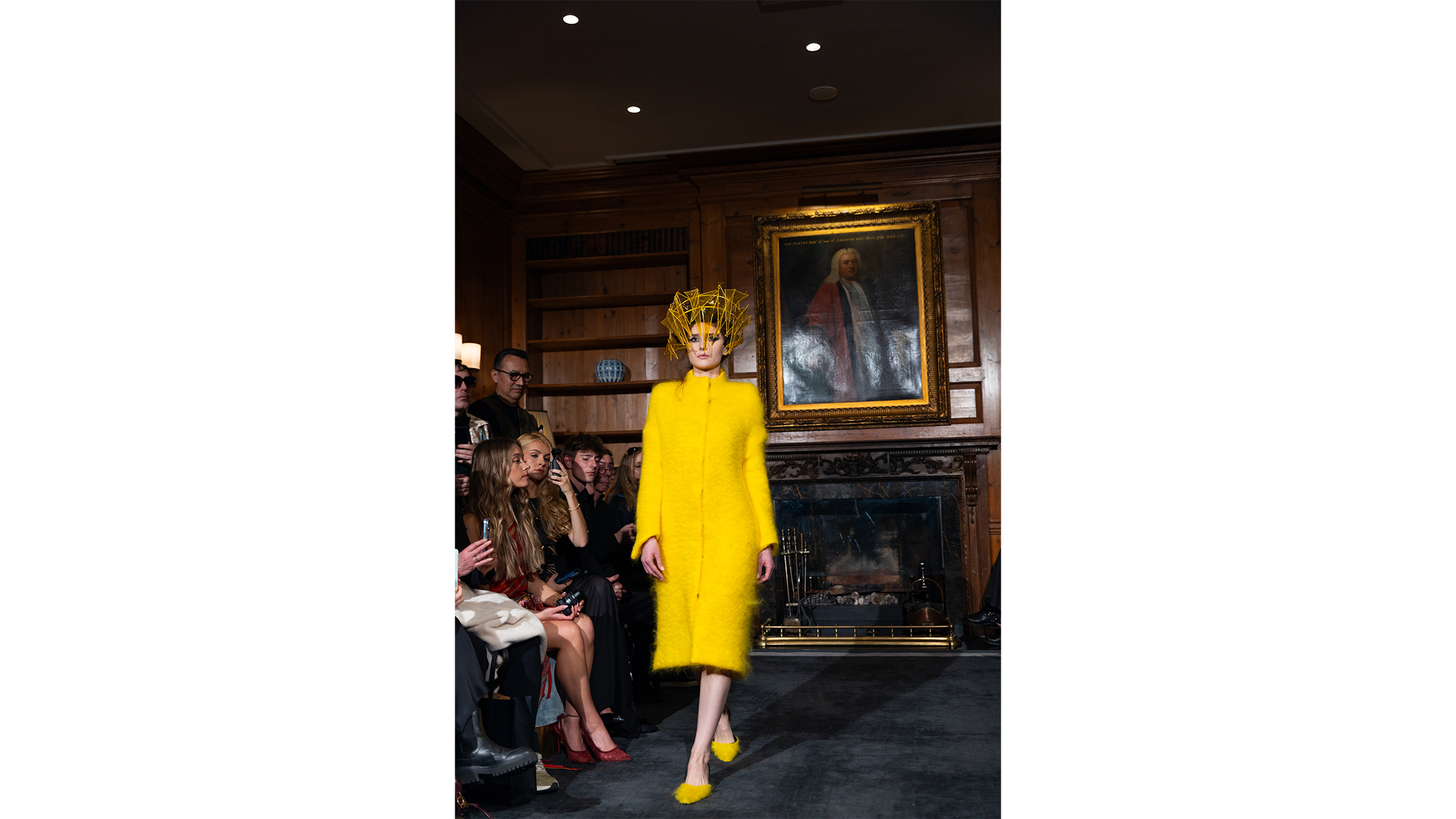
genuinely innovative territory. Printed silks and mohair met biomaterials developed with three forward thinking partners. Ponda, a pioneering biomaterials company whose regenerative textiles are made from plants that actively restore wetlands, provided BioPuff wadding insulation throughout the collection, appearing in both lightweight layering pieces and padded jackets. Those padded jackets combined reclaimed ocean-sourced nylon with plant-based bio fur engineered by Savian by BioFluff, the Paris and New York-based material science company whose Savian fibre featured in six looks. The most arresting of these was a canary-yellow coat of extraordinary tactile richness, its fuzzy, mohair-like surface so vivid against the dark wood panelling that it seemed to generate its own light, matched with yellow fur-trimmed mules and crowned by a geometric gold wire headpiece handcrafted by milliner Roberta Cucuzza. It was a solar flare walking through a gentleman's study, a jolt of unapologetic joy in a collection that otherwise operated in shadow and severity. Meanwhile, sculptural dresses crafted in Banofi's plant-based leather alternative pushed the boundaries of what sustainable materials can achieve at the level of avant-garde design. One look paired Banofi leather in an asymmetric, hardware-pierced skirt with a slouchy off shoulder black knit — the combination raw, elegant, and entirely new.
The accessories marked a first for Rivas on the runway, and they earned their debut. All headpieces, co designed with Cucuzza and handcrafted in her studio, operated as sculptural extensions of the collection's shattered-yet-rising spirit, some integrating biomaterials, others built from acrylic and wire, each one unique. Hair direction by Richard Philipart kept things either severely sleek or crowned in braids that recalled ancient ritual, while lead makeup by Manuel de Castro amplified the emotional register of each silhouette: darkened eyes, strong brows, faces that looked ready for confrontation. Sustainable denim experimentation wove through the collection too, an ongoing commitment from a designer who has consistently treated responsible textile development not as a marketing strategy but as a structural principle of how garments should come into being.
This was Rivas's sixth consecutive London Fashion Week appearance, and his most complete. Past collections, from "Beautiful James" through "Aerion," "Marvel Hill," "Alchemy of Ashes," "A Feast for Crows," and "A Golden Shroud" — have traced a clear arc from joyful colour explorations rooted in Peruvian textile heritage through increasingly dark, narrative-driven work engaging with death, mythology, and transformation. "A Glass to Break" felt like the moment where all those threads converged: the technical confidence, the storytelling ambition, the material innovation, and the deeply personal stakes of a designer who has always understood that his presence on this stage is itself a form of breaking glass. The collection navigated the space between beauty and force, delicacy and rawness, classicism and modern rebellion, and it did so without flinching.
In the end, the glass that Rivas breaks is not just the ceiling above him. It is the pane between the viewer and the feeling — that invisible partition that keeps fashion polite, contained, admired from a distance. When those shattered acrylic shards caught the library's lamplight and threw it back in fractured patterns across the faces of the front row, the metaphor became physical. Breakage, Rivas seemed to say, is not the end of something. It is the light getting in. It is the moment when the invisible barrier finally admits that it was never stronger than the person standing on the other side.
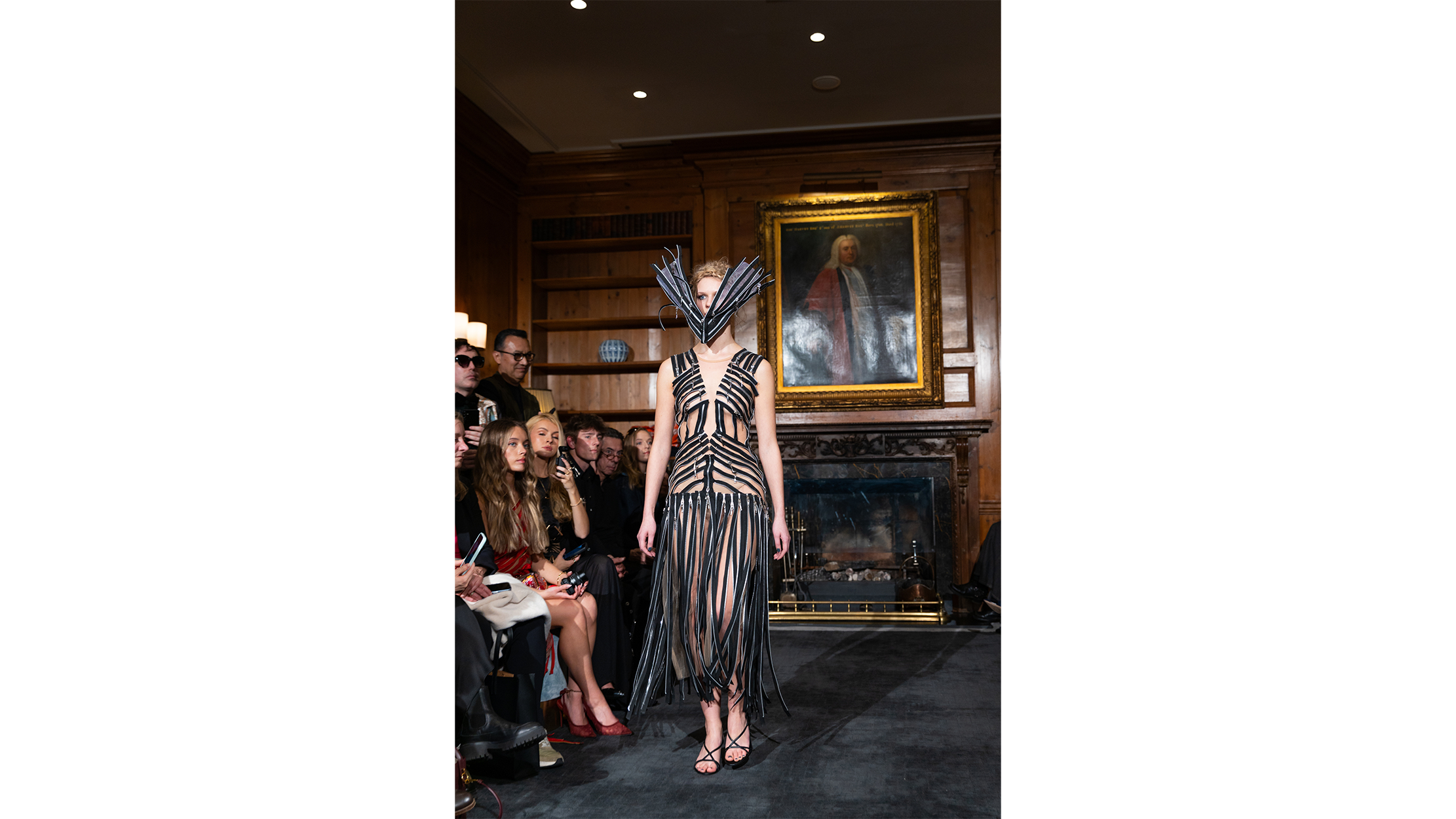
Photography by Milly Wee for LFW.
Article by Aayush Anima Aggarwal, Contributing Editor, PhotoBook Magazine
Tearsheets by Daniel López, Art Director, PhotoBook Magazine
*Images Courtesy of Genaro Rivas
RELATED STORIES