ART HEARTS FASHION AW26: FOURTEEN VOICES IN A CATHEDRAL OF LIGHT
The gilded mosaics caught the runway lights and threw them back in fragments — gold, amber, a dozen shades of honey — as if the building itself were breathing. The venue, a neo-Gothic hall in central London with vaulted ceilings and marble panelling that belongs more to prayer than to fashion, lent every look that crossed its polished floor the gravity of a procession. Guests lined the nave in tight rows, phones raised like votive candles, their faces half-lit by the ornate screens behind the runway. It was the kind of space that makes you whisper, which is perhaps why, when the first model appeared, the silence felt earned rather than imposed.
Art Hearts Fashion's return to London Fashion Week for Autumn/Winter 2026 brought fourteen designers from across the Americas and Europe into this single, luminous room. Founded in 2010 by Erik Rosete, the platform has spent over a decade building a circuit — New York, Los Angeles, Miami, Shanghai — that functions less as a traditional fashion house and more as a rotating gallery of global design voices. The London edition, staged across two evenings in late February, carried that curatorial ethos into a setting that amplified it. Against the hall's ecclesiastical grandeur, the collections became something close to offerings: individual, idiosyncratic, sometimes clashing, always unmistakably alive.
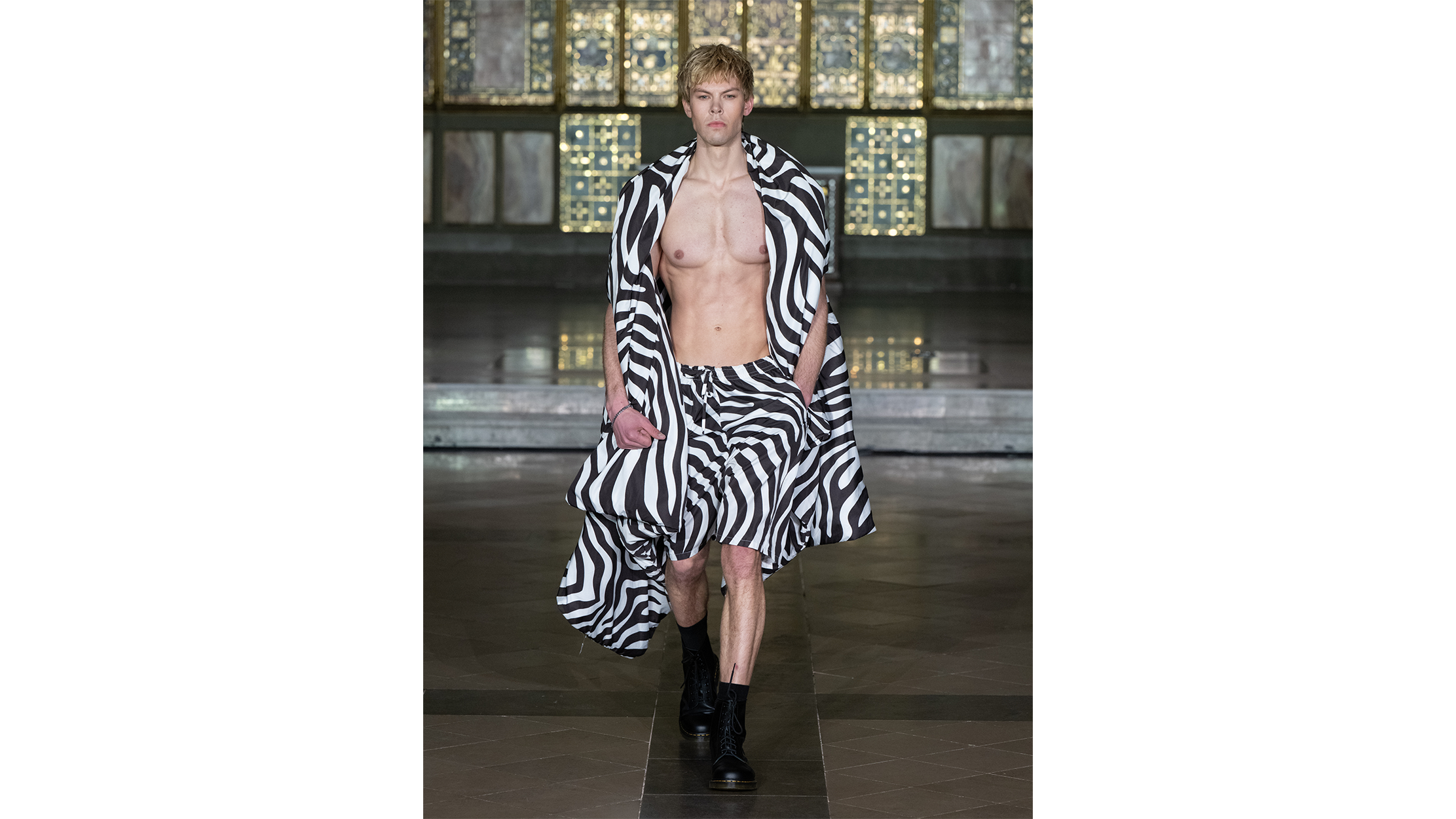
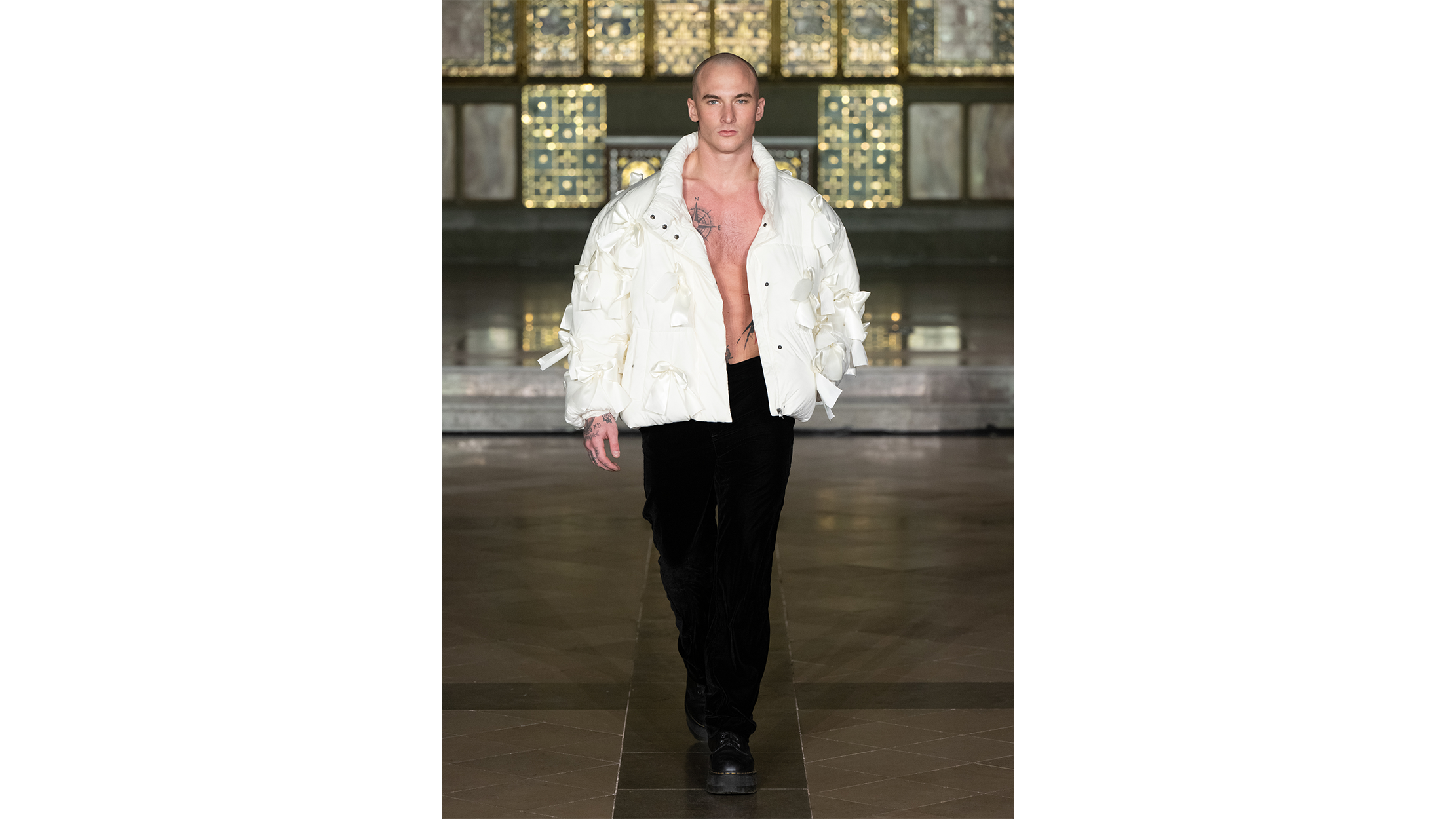
The show opened with menswear that played roughness against refinement. An oversized white puffer jacket, worn open over bare skin and black velvet trousers, was covered in fabric bows — knotted, scattered, almost haphazard across the quilted surface, as though someone had tried to gift-wrap armour. The bows caught the light differently from the jacket's matte shell, their satin sheen flickering as the model moved. It was a piece that demanded you reconcile two instincts: the desire for warmth and the desire for ornament. Later, a model walked in a full zebra-print ensemble — a voluminous cape draped across the shoulders and falling past the knees, paired with matching drawstring shorts — that turned the bold graphic into something almost sculptural, the black-and-white stripes distorting and curving with the weight of the fabric as he strode. The effect was less "animal print" and more optical event, the pattern shifting with each step as if the textile had its own kinetic energy.
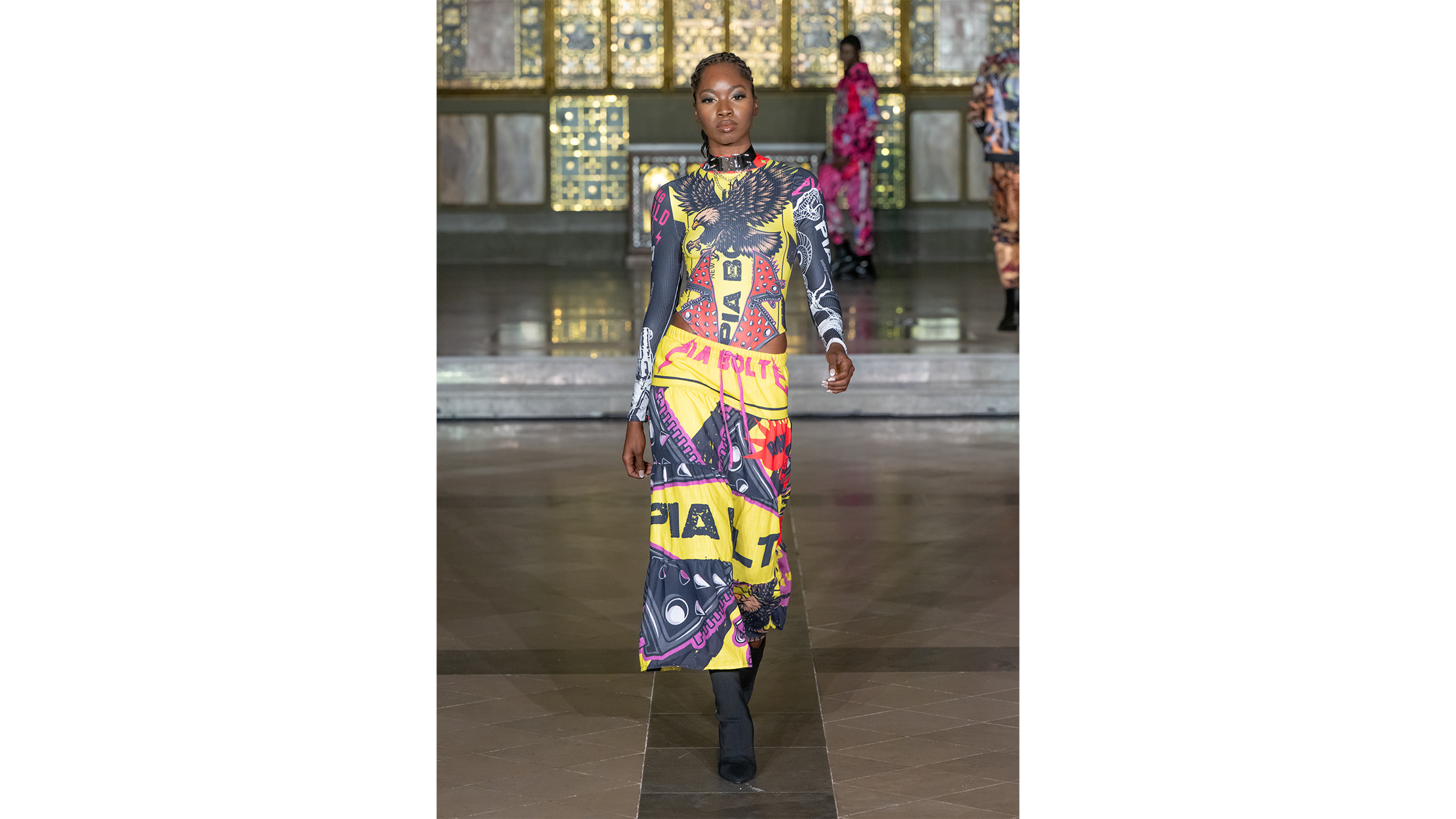
Pia Bolte's contributions were impossible to miss. A sleeveless maxi dress carried the German designer's name directly into the print — the words "PIA BOLTE" and "DANGER" rendered in bold block lettering alongside peace signs, graphic illustrations, and splashes of red and pink, the whole surface reading like a broadsheet pulled apart and reassembled as evening wear. The garment moved with a surprising lightness despite its visual density, the hemline sweeping across the dark floor as the model walked between rows of onlookers in the nave. A second Bolte look amplified the volume: a fitted long-sleeve top and midi skirt in electric yellow, charcoal, and magenta, anchored by a sprawling eagle motif across the chest. The print work was layered and almost aggressive in its saturation, pulling from punk poster aesthetics and tattoo flash art in equal measure. Worn with a slim metal collar and black boots, it turned the model into a walking manifesto — the clothing not merely worn but declared.
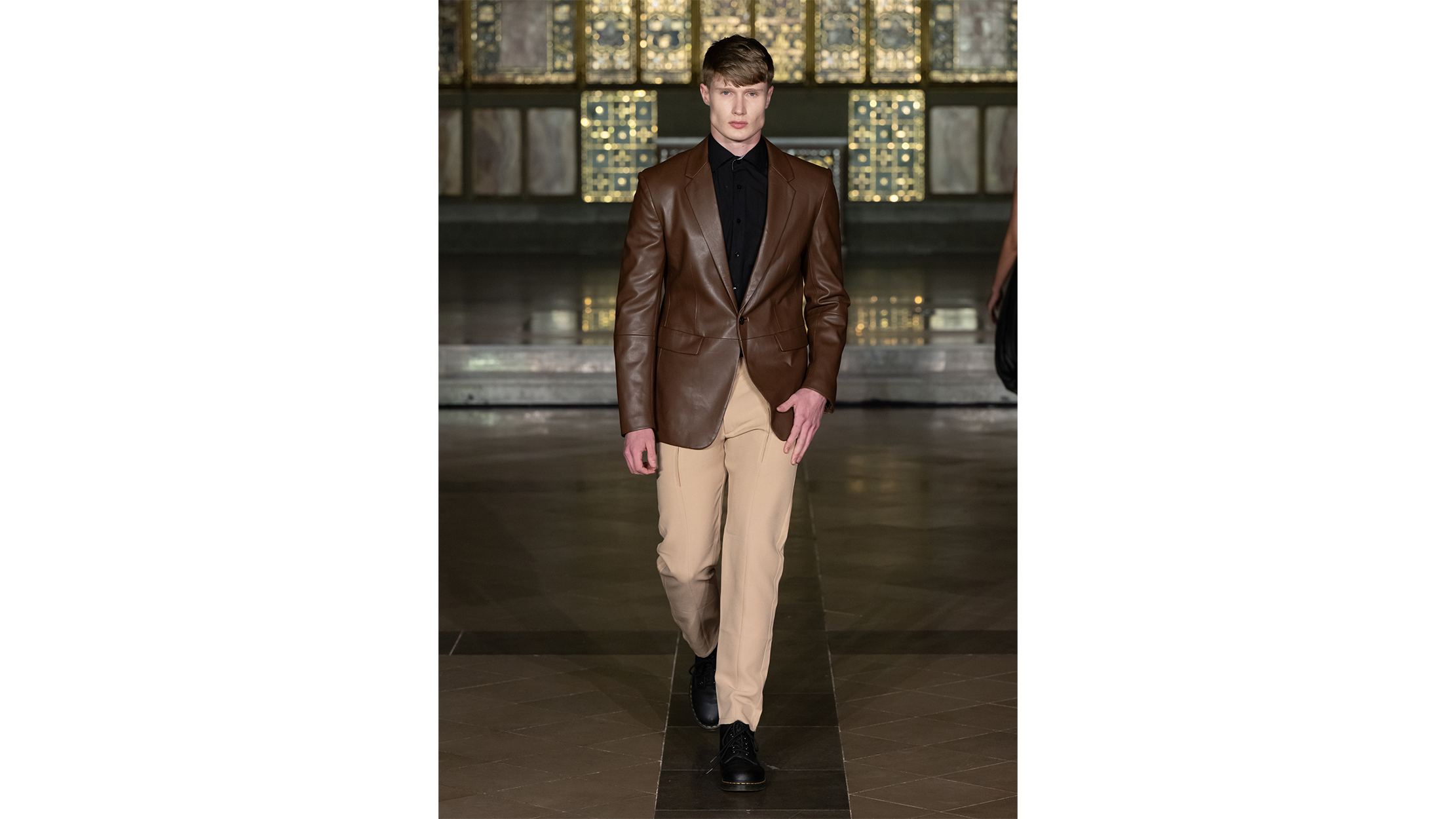
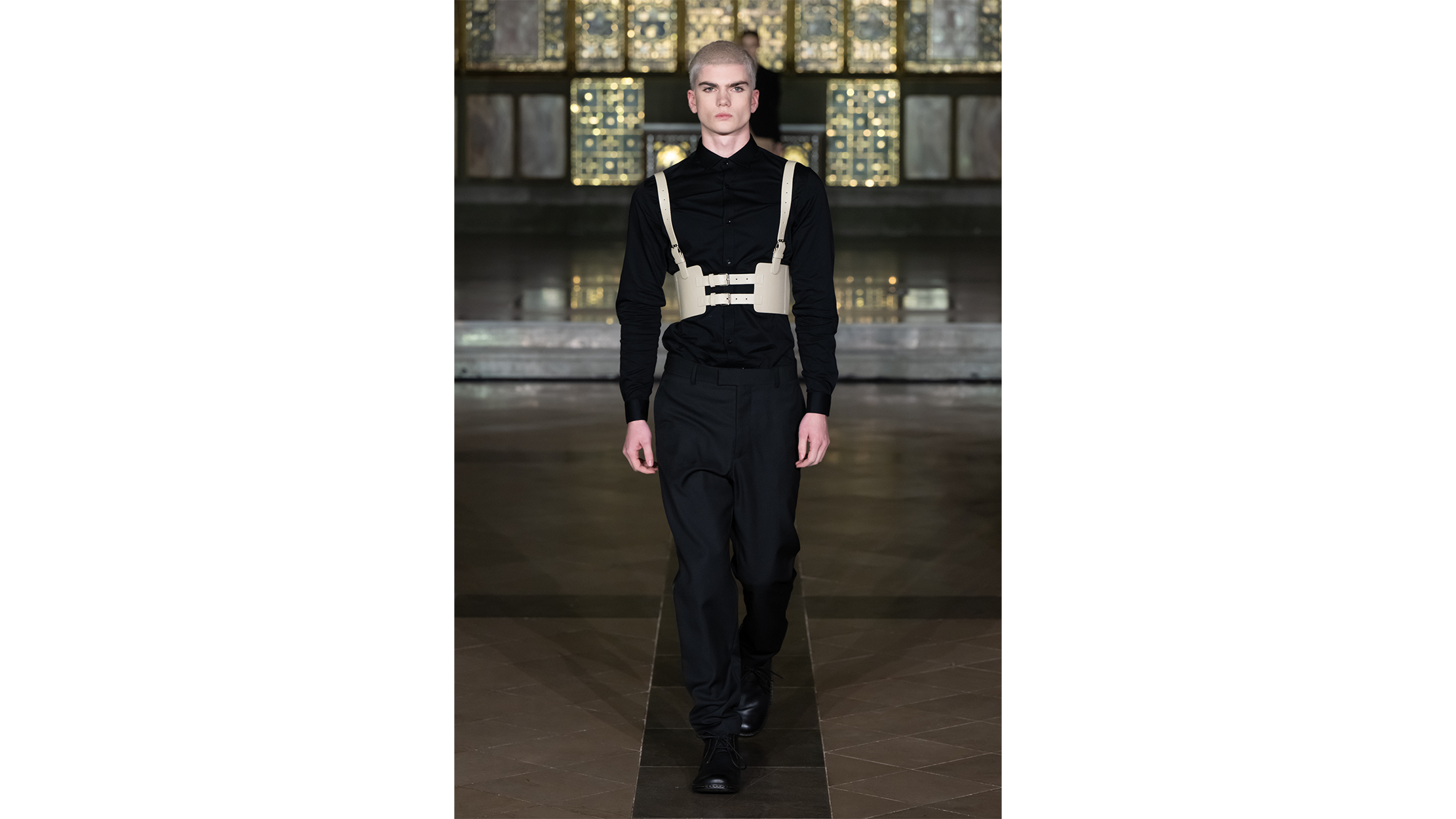
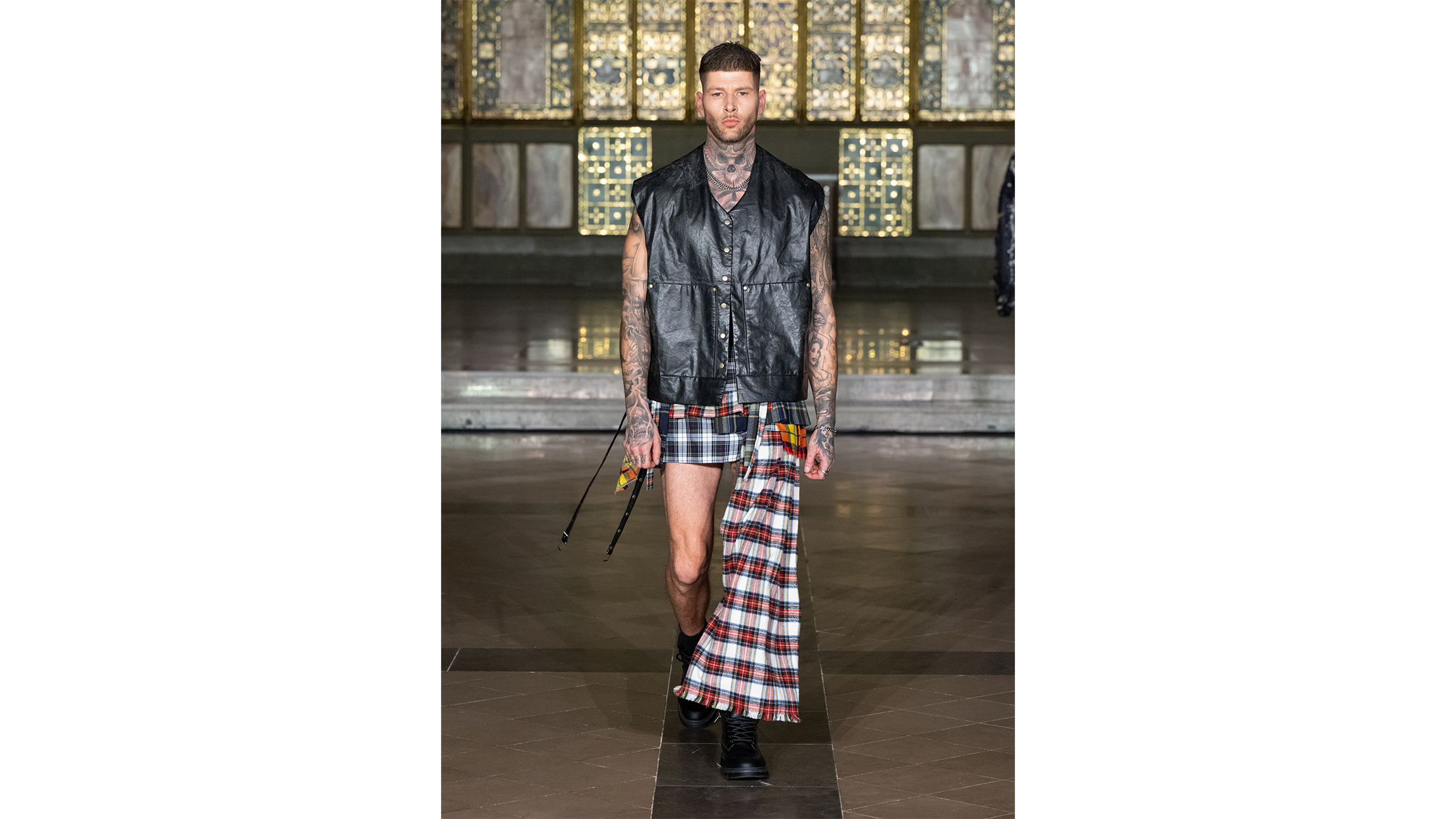
The menswear continued to unsettle expectations. A sleeveless black leather vest, its surface creased and worn-looking, was paired with deconstructed tartan shorts and a long panel of mixed-plaid fabric trailing from the waist — Stewart, Dress Gordon, and a muted cream check all stitched together, the raw frayed edges visible even from the middle rows. The effect was Highland heritage put through a punk shredder, the tartans refusing to coordinate, refusing to resolve into a single identity. Elsewhere, a model in head-to toe black — button-down shirt, tailored trousers, lace-up boots — wore a pale leather harness across the chest, its straps and buckles sitting flush against the dark fabric like a functional corset reimagined for a man's frame. The piece sat somewhere between military rigging and couture accessory, its cream leather immaculate against the inky backdrop. And in one of the show's quieter menswear moments, a rich chocolate-brown leather blazer was cut with the clean lines of classic Savile Row tailoring, worn over a black shirt and sand-coloured trousers — a look that didn't need to shout, its luxury carried entirely in the weight and sheen of the hide.
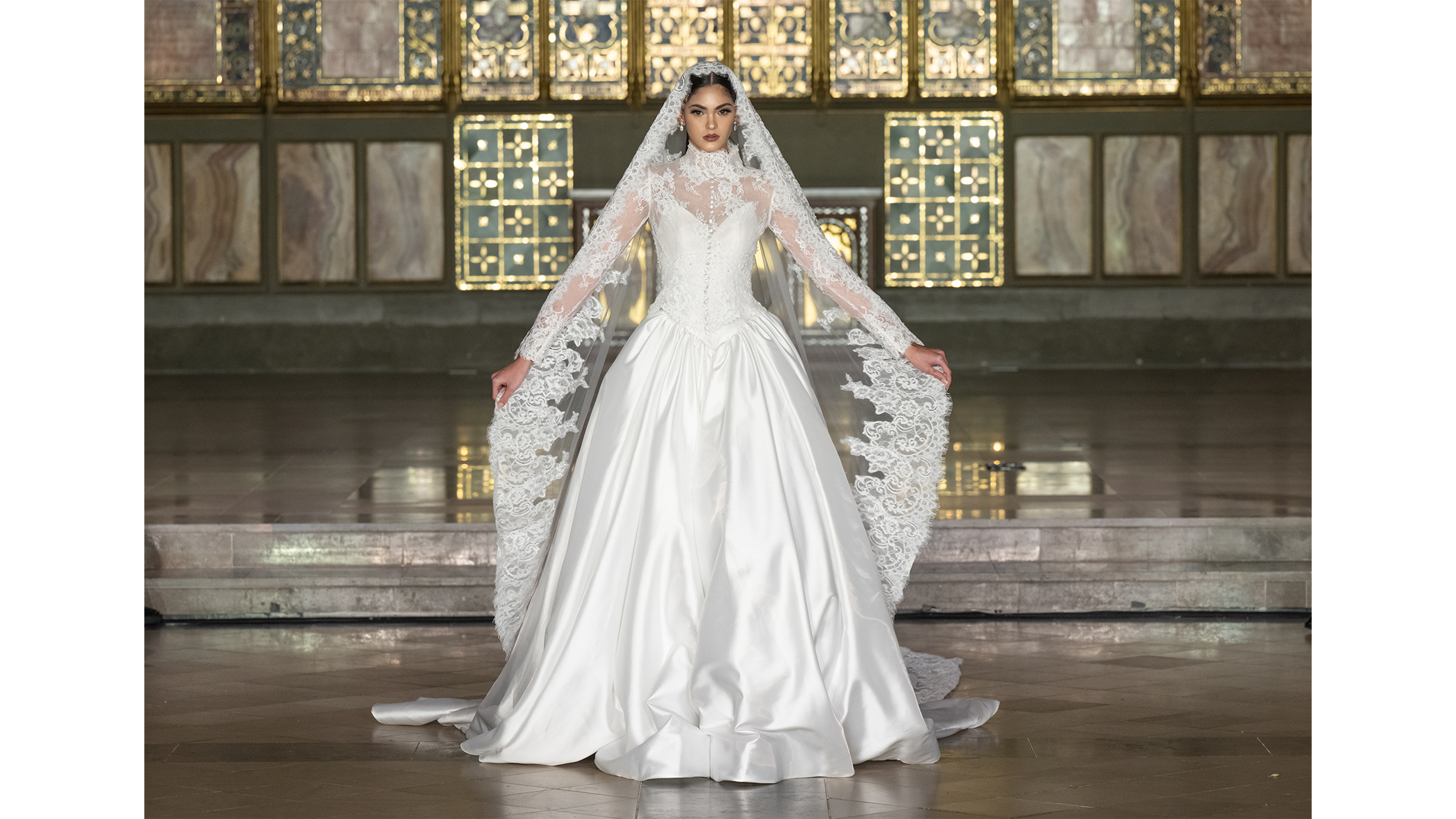
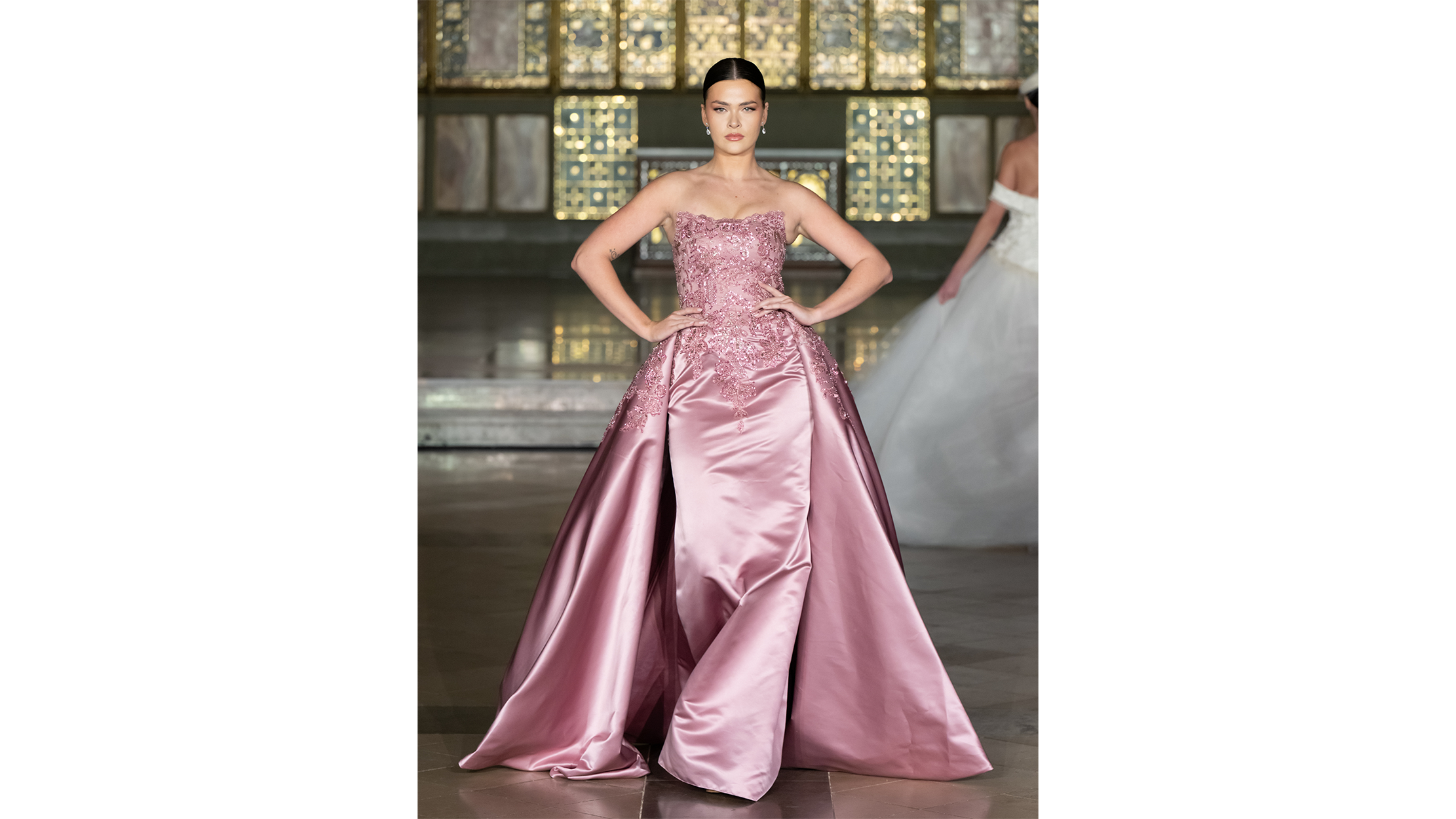
Then the mood shifted, and the gowns arrived. A strapless dusty-rose number in heavy duchess satin featured a bodice dense with lace appliqué and sequin embroidery that cascaded downward past the waist, dissolving into the skirt's luminous surface. The satin caught every angle of light, pooling from blush to mauve in its folds, and the model stood with her hands at her hips as if daring the fabric to upstage her. A bridal gown followed — ivory satin with a full, sweeping skirt and a high-neck lace bodice whose sleeves extended into a cathedral-length veil trimmed in matching floral lace. Against the mosaic panels of the venue, the look dissolved the boundary between fashion and architecture, the veil's scalloped edges echoing the arched windows behind it. It was the kind of entrance that stops a room twice: once for the spectacle, and once for the craft.
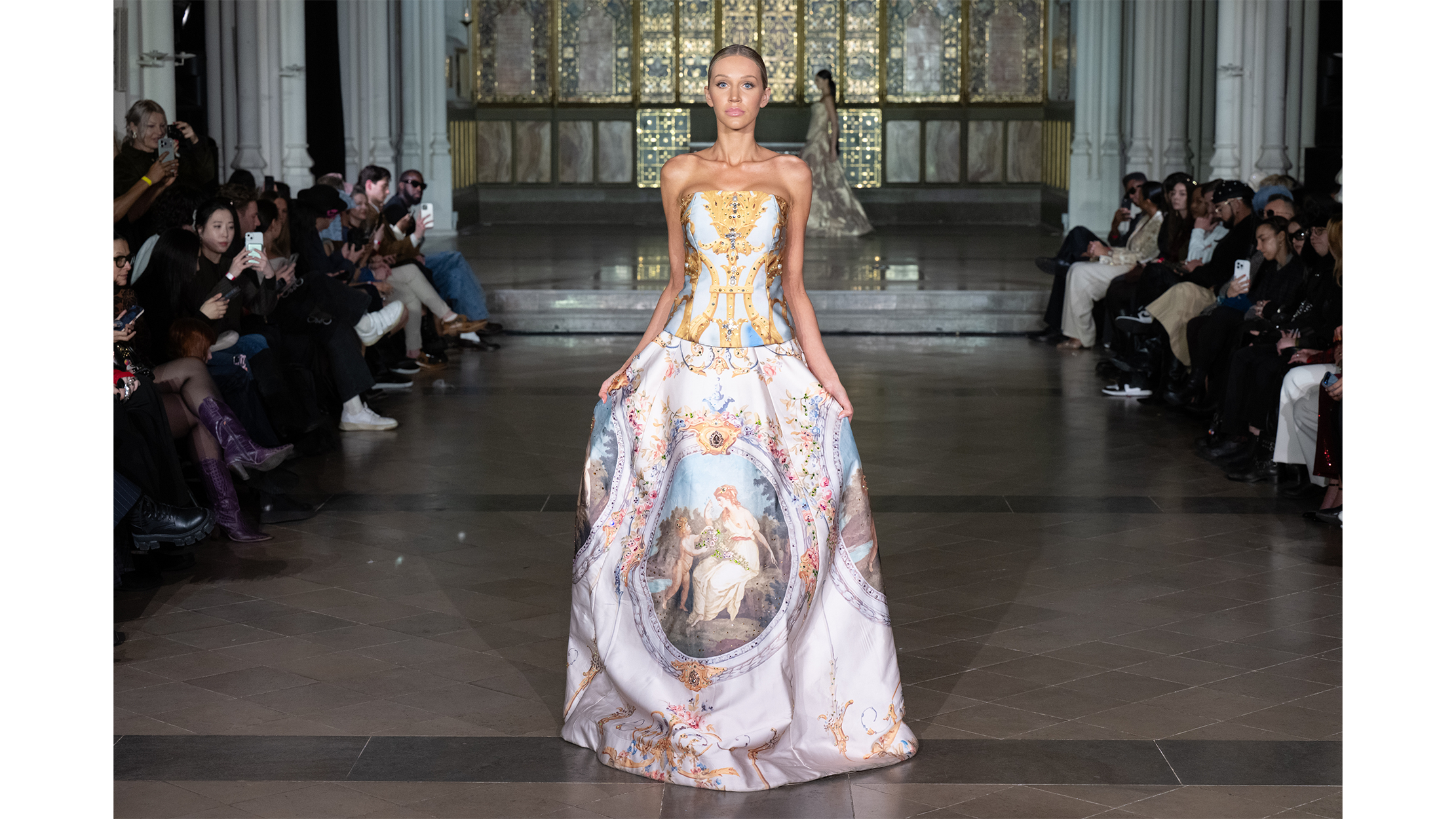
One gown rewrote the entire vocabulary of the evening. A strapless ball gown carried a printed design that reproduced Rococo ceiling paintings — pastoral scenes set within trompe l'oeil cartouches, surrounded by painted roses and gilded scrollwork, the bodice structured with what appeared to be a golden corset rendered in relief. Standing in the nave, the model wearing it became a living Fragonard, a walking fragment of a Versailles ceiling, the printed pastoral scene at the skirt's centre — a reclining figure in a garden — blurring the line between garment and gallery. It was a piece that rewarded close looking: what from a distance appeared to be embroidery revealed itself, up close, as extraordinary print engineering, the depth and texture of the "gold" achieved entirely through colour and placement on fabric.
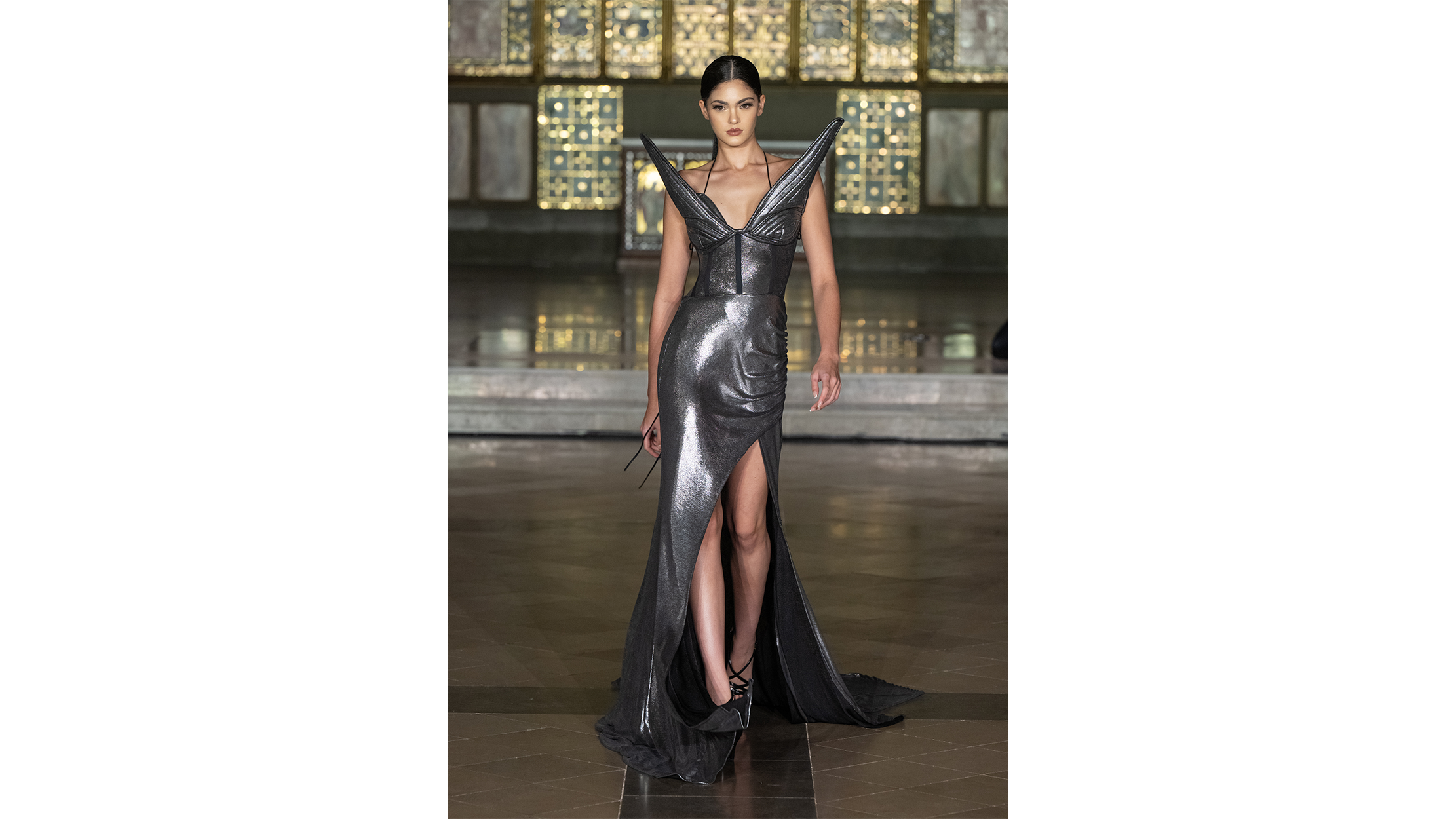
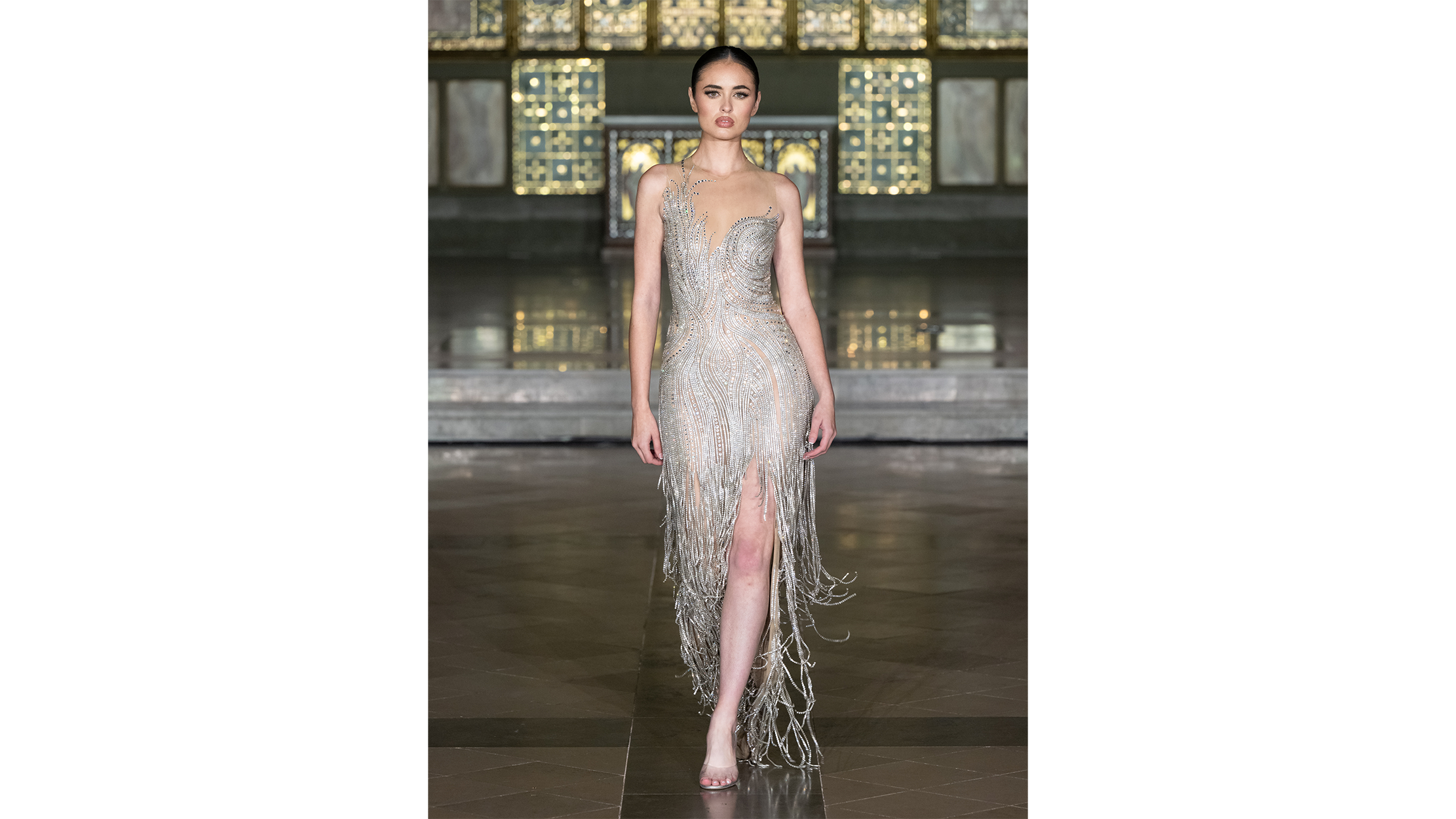
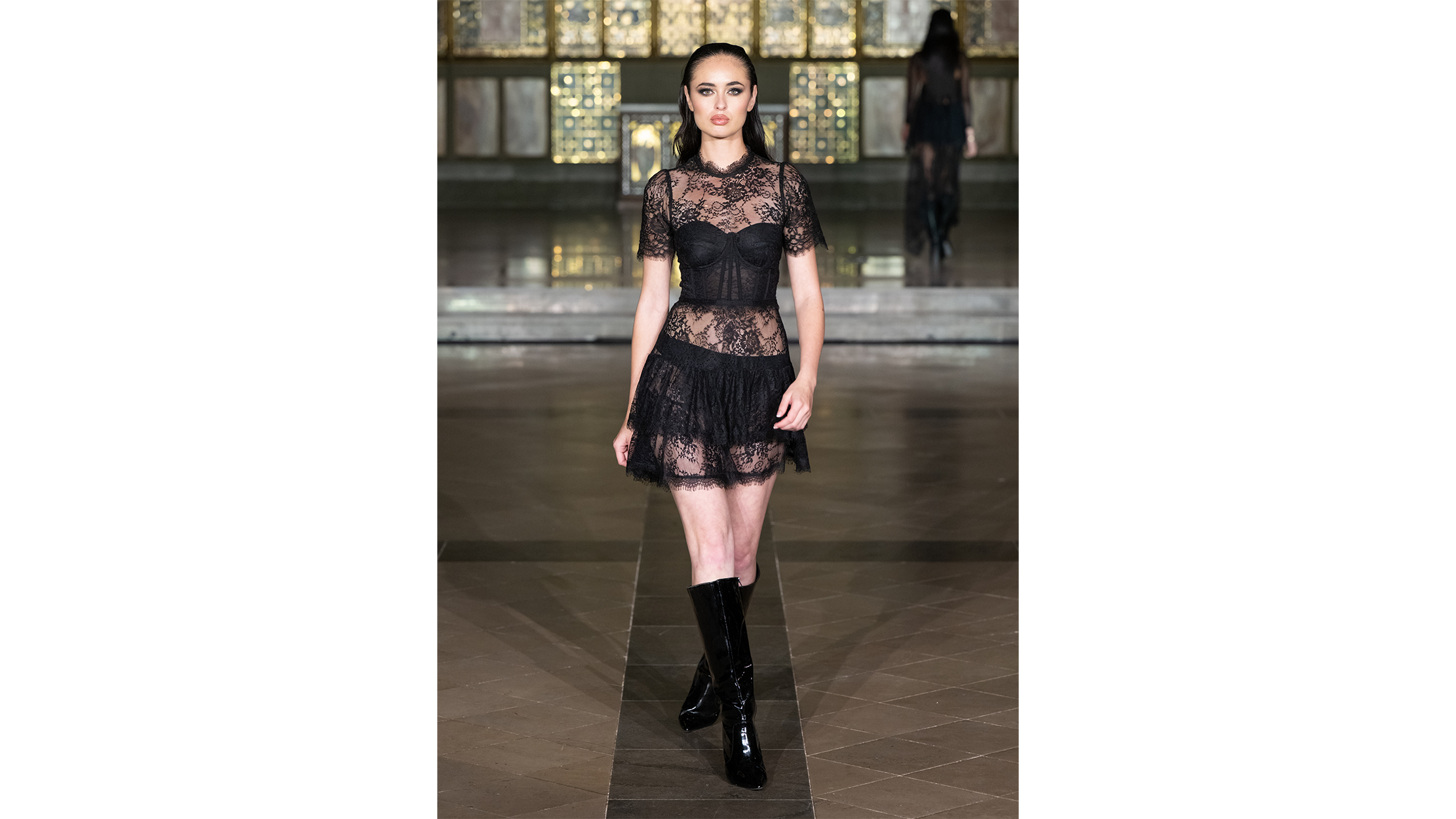
A silver beaded gown caught the venue's amber light and fractured it. The dress — strapless, body skimming, with a deep plunge — was covered in swirling lines of tiny beads and crystals that followed the body's contours like topographic lines on a map. Below the knee, the beading dissolved into long, loose fringe that swayed with each step, catching light in filaments, the hemline disintegrating into something between liquid and air. A gunmetal metallic gown took a more confrontational approach: the fabric, slick and reflective as mercury, was cut into a column with a high thigh slit, while the shoulders rose into dramatic pointed fins — winged, almost, sculptural extensions that framed the face and turned the wearer into something between femme fatale and sci-fi monarch. A black Chantilly lace dress offered the opposite register — intimate, allusive, its sheer fabric layered over a structured bustier, the tiered skirt falling just above the knee, paired with glossy patent boots that gave the look a night-out edge that cut through the lace's romanticism.
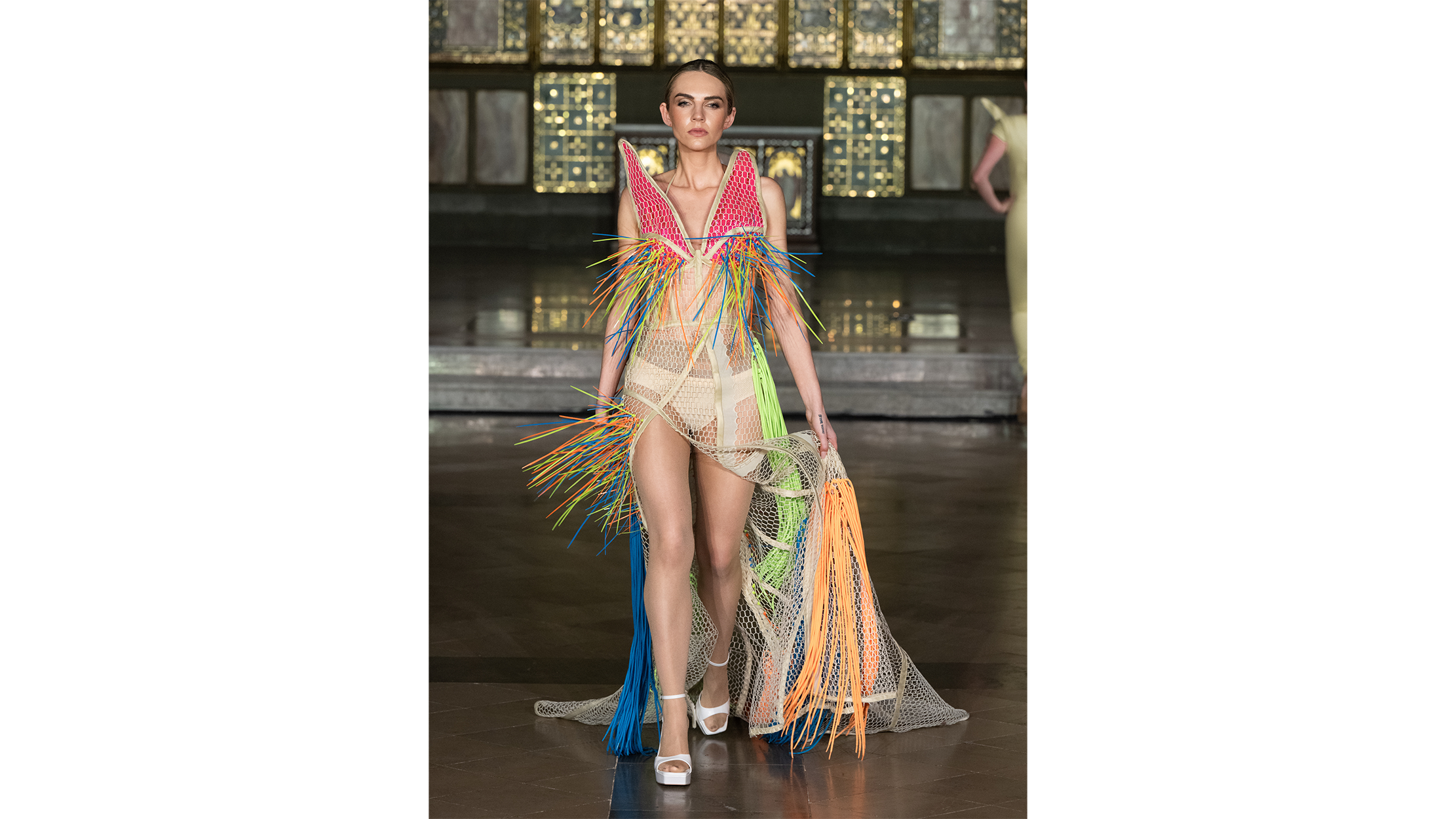
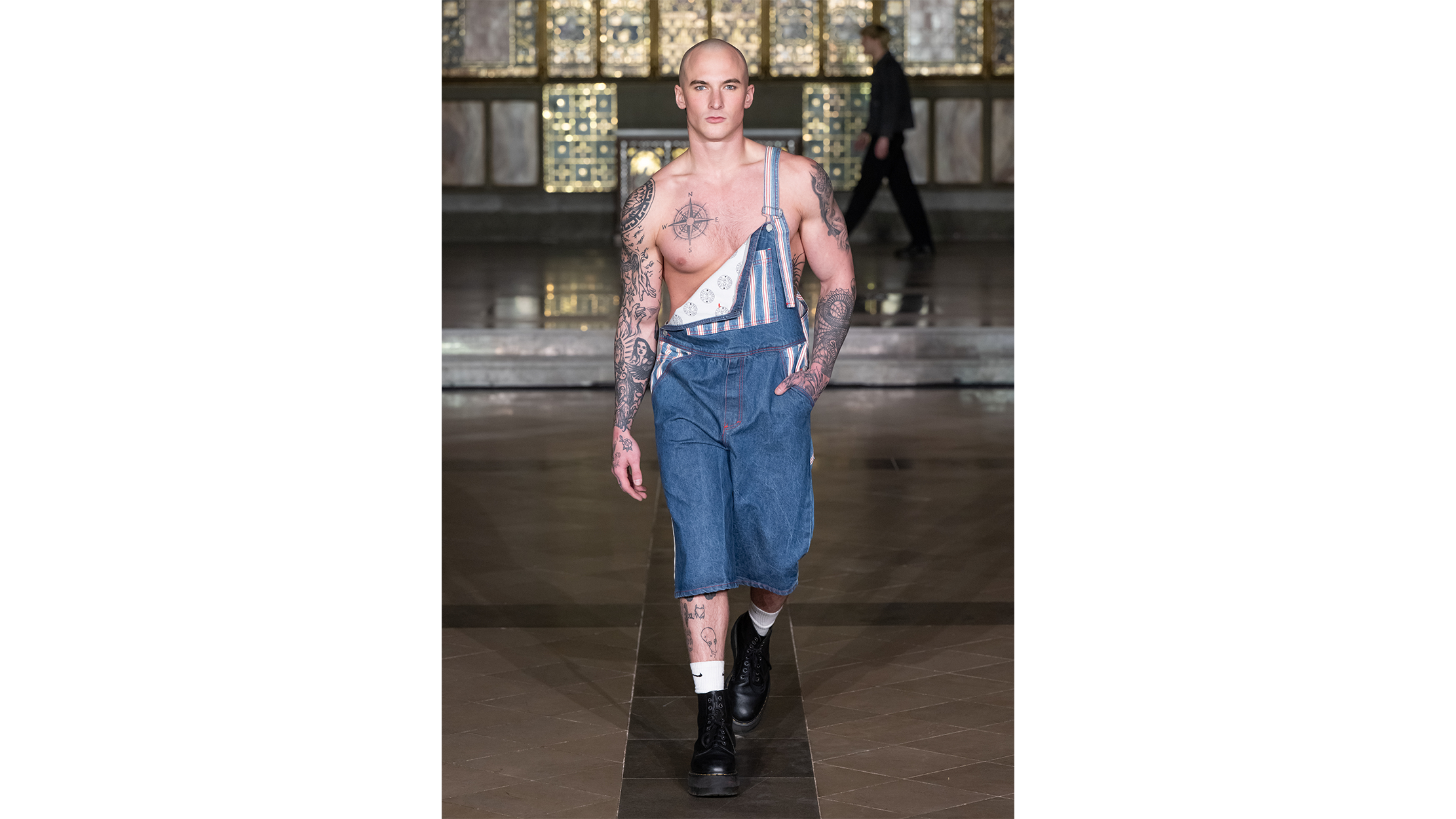
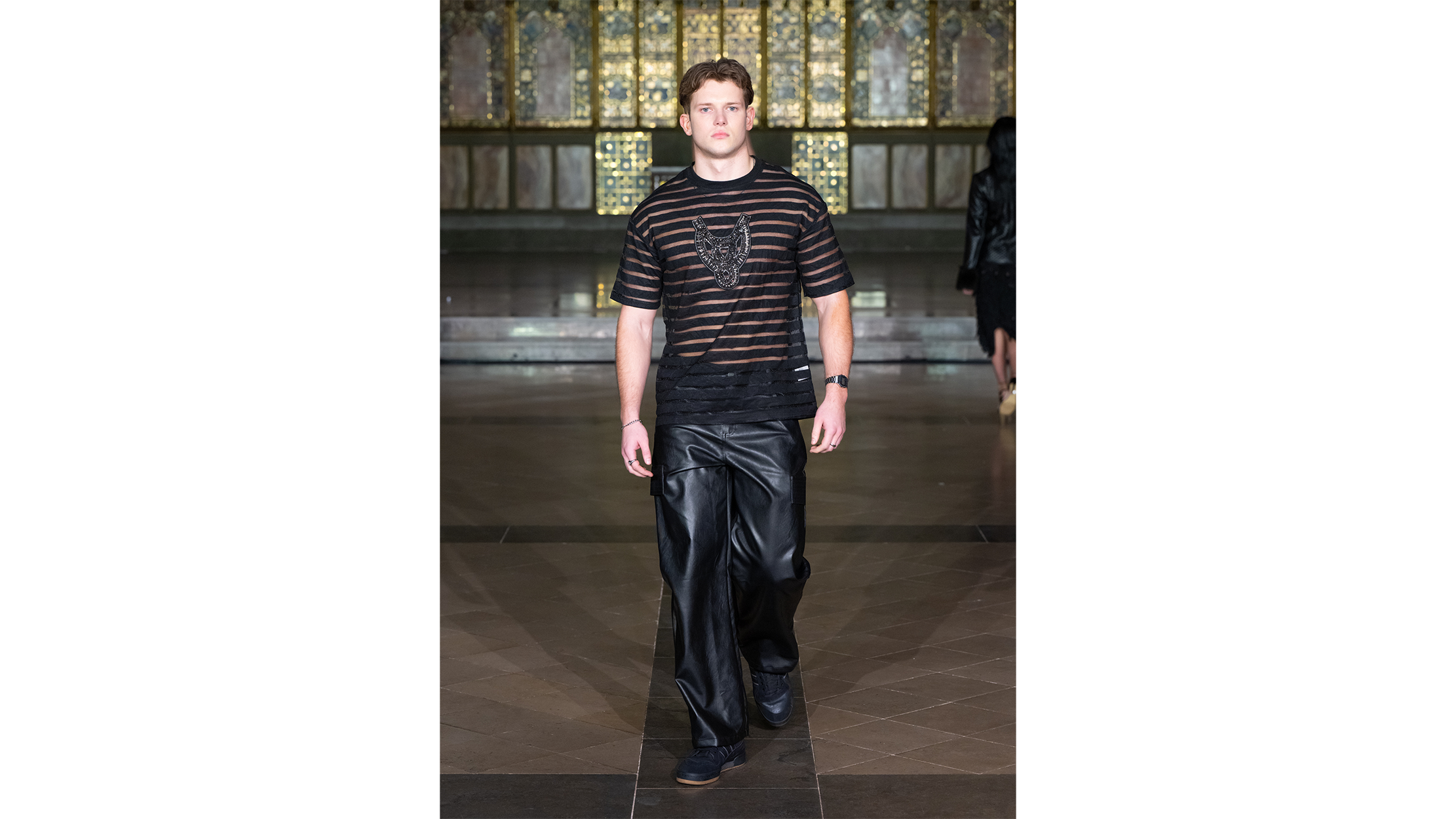
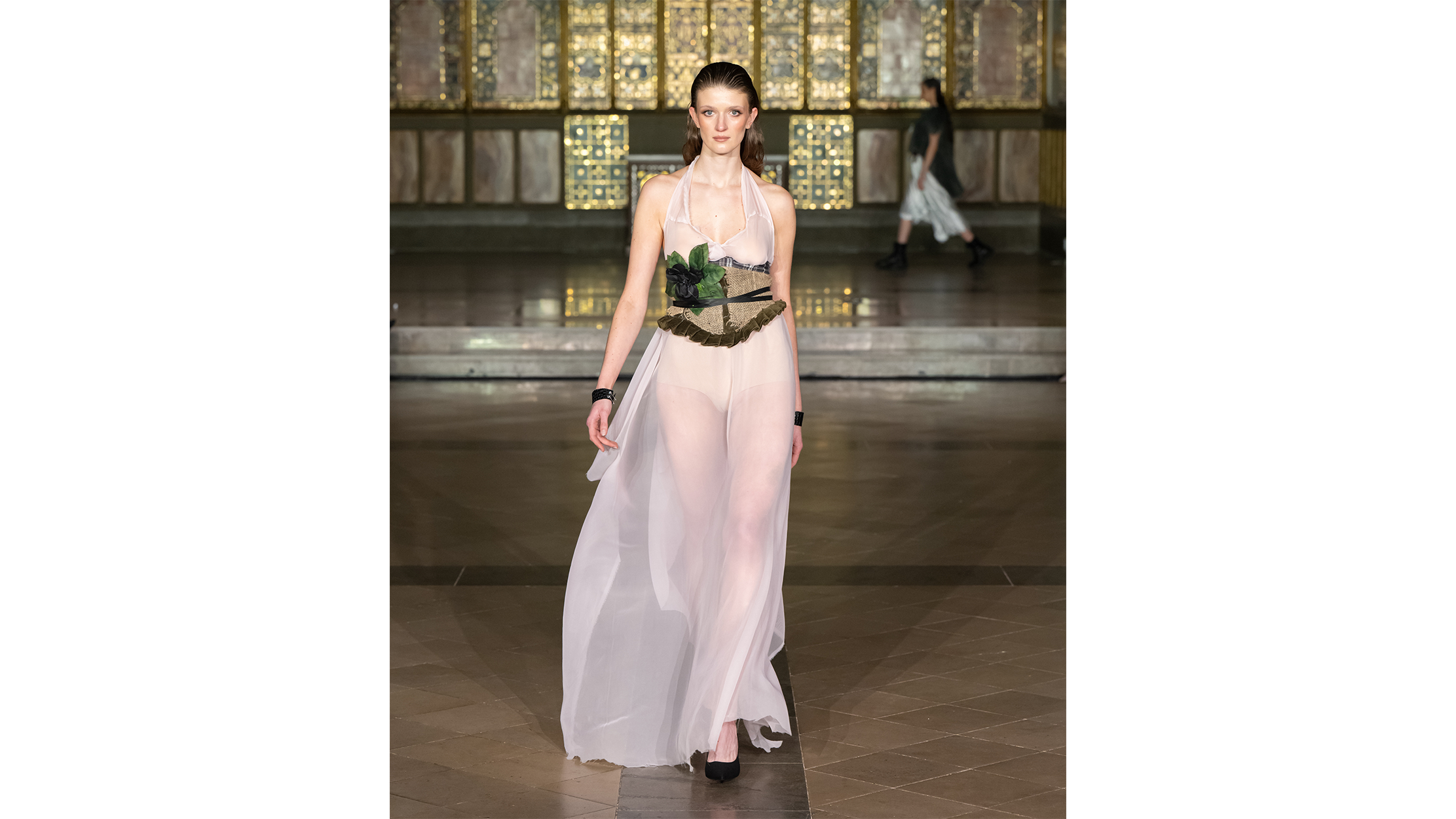
Not everything on the runway fit neatly into categories of pretty or polished, and the show was better for it. A sheer chiffon halter gown in the palest blush was cinched at the waist with a belt made from what appeared to be burlap and tartan — rough, organic textures meeting gossamer fabric — with an oversized dark fabric flower sitting at the centre like a corsage from another century. A pair of denim dungarees, one strap hanging loose, was worn over bare skin with contrast red stitching and ticking-stripe lining visible where the bib folded down, the wide-leg cropped silhouette recalling workwear with a wink. And a mesh dress constructed from an open-weave net in cream was threaded with neon spikes of fringe — hot pink, electric blue, lime green, tangerine — that jutted outward from the body like sea anemone tendrils, the whole thing looking like it had been pulled from a reef and set walking. A sheer black-striped tee, its horizontal bands alternating opaque and transparent across the torso, carried a heavy embellished horseshoe-shaped appliqué at the chest — worn with wide-leg black leather cargo trousers, the look married transparency and toughness in a way that felt both casual and deliberate.
What Art Hearts Fashion does, at its best, is refuse the tyranny of a single aesthetic thesis. There was no unified colour story here, no singular silhouette to trace from first look to last. Instead, the two evenings offered something rarer: the friction of fourteen distinct creative visions sharing a runway and a room, their work colliding and conversing across the polished floor of a London hall that has seen centuries of congregation. The Rococo ball gown existed in the same programme as the neon-spiked net dress. The leather harness and the bridal veil breathed the same air. And in that juxtaposition — deliberate, unresolved, occasionally chaotic — the show found something that more curated presentations sometimes lose: the genuine unruliness of people making things because they have something to say, regardless of whether the person sitting beside them is saying something entirely different.
Photography by Markgonpaint, for LFW.
Article by Aayush Anima Aggarwal, Contributing Editor, PhotoBook Magazine
Tearsheets by Daniel López, Art Director, PhotoBook Magazine
*Images Courtesy of Art Hearts Fashion
RELATED STORIES