Constructivism, Reimagined: Jaheem Clark’s FIT MFA Collection
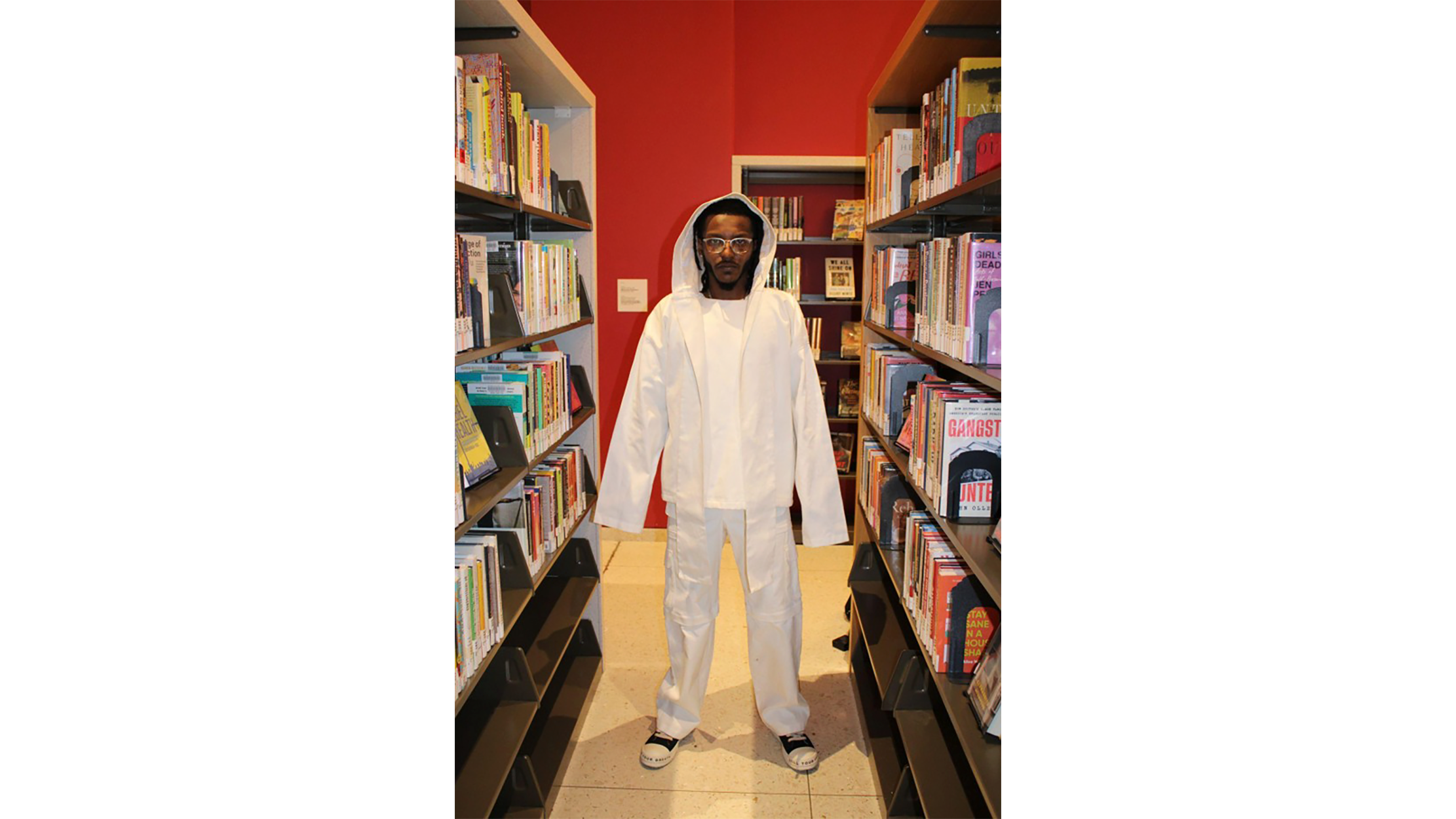
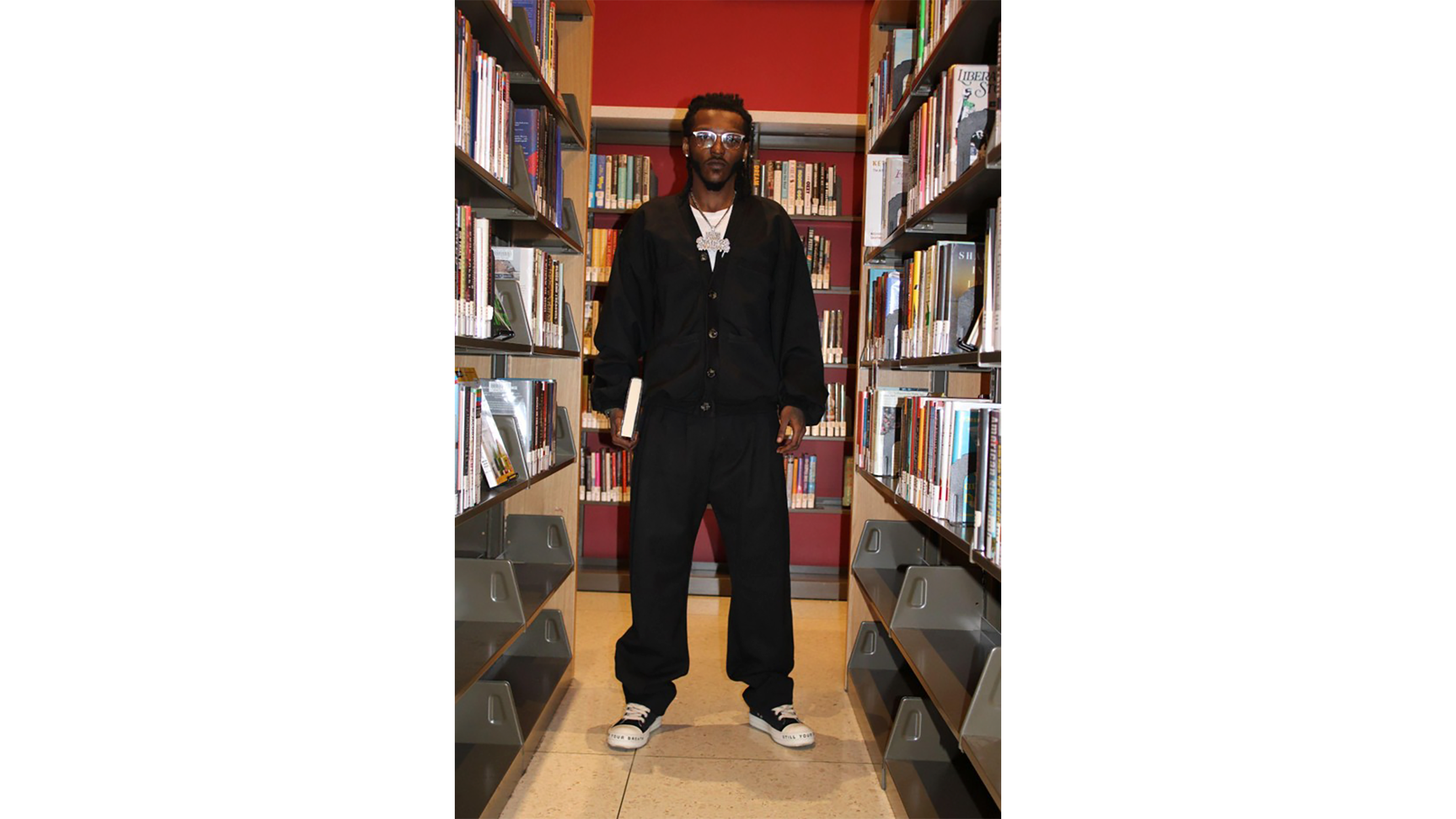
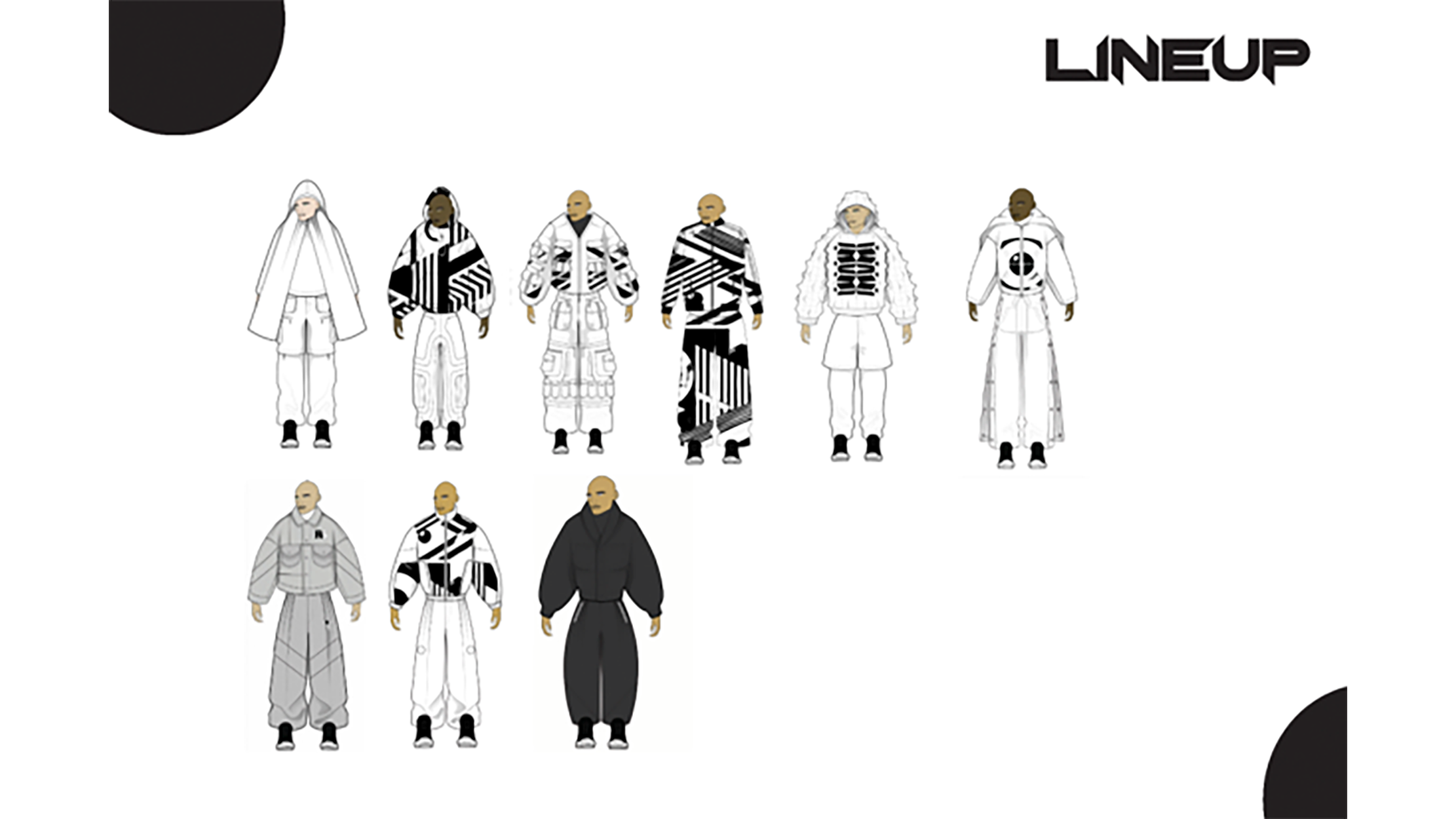
A garment can be more than a finished silhouette; it can be a system of parts in constant negotiation with one another. In My Constructivist Form, FIT MFA graduate Jaheem Clark approaches menswear through this architectural lens, drawing on Vorticism and Constructivism to reconsider how clothing is built, assembled, and experienced on the body. Geometric fragmentation becomes the collection’s organizing principle, with traditional tailoring reconstructed through angular panels, overlapping planes, and deliberate asymmetry. A tightly controlled palette of black, white, and gray shifts the emphasis to the interplay of texture, proportion, and material, while suiting, denim, and technical outerwear fabrics ground the designs in everyday function. Guided by his “Built to Win” philosophy, which centers on development, flexibility, and resilience, Clark brings sportswear and tailoring into conversation, exploring how garments can adapt to the demands of modern life without losing their sense of identity. The result is an investigation into the possibilities of reconstruction, where precision meets movement and abstraction takes on a wearable form.
What was the starting point for your MFA collection, and what initially made you want to explore that idea through fashion?
The starting point for my collection was my research on Vorticism and Constructivism, particularly their approaches to geometry, structure, and rethinking form. These concepts complemented my design methodology and encouraged me to reconsider traditional clothing construction. I wanted to explore how breaking down and rebuilding a garment could reflect modern life. At the same time, I researched the coexistence of tailoring and sportswear. Combining the two allowed me to balance structure with movement and functionality with style. This became the foundation of My Constructivist Form.
How did your research evolve as you moved from an idea into an actual collection?
My research began with how Constructivism and Vorticism address geometry, structure, and form. By studying these artists, I began to understand how to manipulate shape and translate those ideas into clothing. I moved from looking at the artwork to considering the relationships between shapes, surfaces, and layers within a garment. I then developed drawings, patterns, and prototypes to test those relationships. Testing construction, fit, and proportion helped me refine the ideas into wearable pieces. Through this process, I began approaching clothes as three-dimensional compositions that interact with the body.
What role do your personal experiences play in your design practice, and how much of yourself do you see reflected in this collection?
My personal experiences are reflected in Built to Win, my design philosophy, which embodies development, flexibility, and resilience. The perseverance, discipline, and work ethic of my friends and close family continue to motivate me and form part of the foundation of My Constructivist Form. These values shaped my aim to create clothing that represents modern life. I considered how people move between social, professional, and personal contexts without changing who they are. This led me to design clothing that responds to the wearer’s body, surroundings, and identity. I see myself reflected in that balance of flexibility, structure, and expression.
How did you translate the central concepts into silhouette, material, color, construction, or textile development?
My Constructivist Form explores structure, fragmentation, and precision through a disciplined monochromatic palette. I translated these concepts into traditional menswear silhouettes by breaking them into geometric panels, sharp lines, and layered planes. These elements create movement through contrast, balancing structured tailoring with fluid drape. I selected outerwear textiles, cotton shirting, suiting, and denim for both practical and aesthetic reasons. Within the monochromatic palette, matte and slightly reflective surfaces allowed texture, proportion, and construction to take center stage. Each look balances minimalism with architectural form, highlighting the tension between control and disruption.
Was there a particular garment, technique, material, or look that became especially important to your overall story? Why?
The technique of dissecting garments into geometric panels and reassembling them became especially important to the collection. Inspired by my research on Vorticism, I approached a garment as a composition of parts rather than a single, continuous shape. I layered and altered these parts to create depth and movement. This method also allowed me to control proportion more deliberately. Overlapping planes and asymmetry helped me explore the sense of multiple viewpoints within one garment. The technique became central to the story because it connected my research on fragmentation and reconstruction directly to the clothing’s construction.
What do you hope viewers take away from your work beyond the clothes themselves?
I hope viewers see how clothing can express identity while responding to the demands of everyday life. My aim was to reflect how people move through different environments while maintaining a sense of who they are. I approached each garment as part of a system that interacts with the body, movement, and surroundings. Through structure, geometry, and utility, I wanted to communicate resilience and flexibility. I also hope the collection encourages viewers to consider fashion as both a practical necessity and a medium for expressing ideas. Beyond the clothes, the work reflects the possibility of adapting and developing while retaining a clear identity.
Was there anything about the process of developing your thesis collection that challenged an assumption you initially had about your own design practice?
Developing this collection challenged my approach to thinking about garments as single, continuous shapes. My research encouraged me to consider the relationships between separate panels, surfaces, and layers instead. Translating these ideas into patterns required me to test how a three-dimensional composition would work on the body. I made several prototypes to evaluate construction, fit, and proportion. Each repetition helped me reconsider and improve the original design. The process reinforced that testing is part of developing an idea, rather than simply confirming it.
How has your time at FIT changed or expanded the way you think about fashion and your role as a designer?
My time at FIT, from my associate’s degree through my master’s, expanded both my technical skills and my understanding of my role as a designer. I developed my approach to menswear and womenswear ready-to-wear while learning to connect research, construction, and visual storytelling. Professor Jun Hong’s commitment to construction and craftsmanship encouraged me to improve the quality of my clothing and refine my technical abilities. Professor Cathleen Sheehan’s guidance in professional development strengthened my understanding of how to establish Romano Studios. Professor Lee, Isabelle Webster, Joseph Costa, Danielle Elsener, and Alex also contributed to my growth through presenting, patternmaking, visual storytelling, and textile history. Together, these experiences helped me think about fashion through the clothing itself, the ideas it communicates, and the brand I am building.
What do you think makes your design perspective distinctly your own, and how has that perspective evolved throughout your MFA?
My design perspective is grounded in “Built to Win,” a philosophy of development, flexibility, and resilience. I express these values through the combination of sportswear, tailoring, and geometric abstraction. Throughout my MFA, I developed this approach by treating garments as interconnected systems of structure, movement, and utility. Working within a monochromatic palette helped me focus more closely on texture, construction, and silhouette. This allowed me to establish a clearer visual language centered on contrast and purposeful design. My perspective evolved into a more deliberate balance between conceptual ideas and wearability.
As you move beyond FIT and begin the next chapter of your career, what do you want to carry forward from these collections, and what are you excited to explore next?
I want to carry forward the balance between concept and wearability that I developed through this collection. Research, experimentation, and testing will remain central to my design process. I am interested in continuing to explore how sportswear and tailoring can work together to create clothing that is structured, flexible, and expressive. I also want to build on my use of geometry and construction to develop new silhouettes that respond to movement and everyday life. Moving forward, I will apply these ideas to the development of Romano Studios as a brand that connects design, culture, and purpose. This thesis provides a foundation that I am excited to continue developing.
What interested you about translating Cubist art into contemporary menswear, particularly through fragmentation, geometric panels, and layered planes?
What interested me was the possibility of using fragmentation and multiple viewpoints to rethink traditional menswear. My research focused on Vorticism and Constructivism, through which I explored these ideas of geometric abstraction. Instead of treating a garment as one continuous shape, I divided it into panels that could be reconstructed into new compositions. Overlapping planes and asymmetry allowed me to create depth and suggest movement, even when the clothing was still. This approach also gave me a way to reconsider proportion while maintaining wearability. I was interested in making these ideas part of the garment’s construction, so the relationship to the artwork could be experienced through its form.
The collection is entirely black and white, allowing texture, proportion, and construction to take center stage. What did removing color allow you to communicate that you might not have been able to otherwise?
Working within a monochromatic range of black, white, and gray allowed me to communicate structure and form more clearly. Without relying on color variety, I could direct attention to the geometric panels, layered planes, and proportions of each garment. The contrast between matte, smooth, and slightly reflective surfaces created depth within that limited palette. It also made the relationship between structured tailoring and fluid drape more visible. Texture became a way to distinguish materials while keeping the collection within one visual language. Removing color variety helped me emphasize how construction and movement shape the clothing.
Interview by Emma Green, Assistant to Editor-In-Chief, PhotoBook Magazine
Tearsheets by Daniel Lopez, Art Director, PhotoBook Magazine
*Images Courtesy of FIT
RELATED STORIES