Mourning a Future That Never Was: Paige Petrosso’s FIT MFA Collection
There is a particular kind of grief in mourning a future that never had the chance to happen. For FIT MFA designer Paige Petrosso, that feeling became the foundation of A Mind Trapped in Yesterday, a collection shaped by the disorientation of watching personal growth come to a halt during the COVID-19 pandemic. After leaving a strict religious upbringing to discover a sense of independence in Boston, Petrosso found herself confronting an unexpected return to the past, followed by the difficult realization that the future she had imagined might no longer look the same. Guided by research into cognitive immobility, the psychological experience of becoming mentally fixed on a particular period or memory, she translates this tension into garments that embody both the comfort and confinement of nostalgia. Floor-length outerwear, sculptural tufting, beaded wire, and restrictive corsetry give physical form to the weight of memories that can feel as reassuring as they are suffocating. Rather than simply revisiting the past, Petrosso examines what happens when the desire to return begins to interfere with the possibility of moving forward, turning a deeply personal reckoning into a broader reflection on memory, change, and the lives we imagine for ourselves.
What was the starting point for your MFA collection, and what initially made you want to explore that idea through fashion?
The starting point for my MFA collection is difficult to summarize because, in many ways, I’m still processing why the subject feels so heavy to me. I grew up in a strict religious school environment, surrounded by traditional Christian ideologies that shaped how I understood morality, identity, and the world around me. In 2019, I moved to Boston, away from that environment, and began questioning many of the beliefs I had grown up with. That period of freedom and self-discovery felt like I was finally growing into a life of my own with my own perspectives on what life I wanted to live. Then the pandemic happened. That sense of personal exploration came to an abrupt stop, and I found myself back in a version of the life I had been trying to grow out of. After graduating from my undergraduate program, I expected life to feel as exciting and full of possibility as it had in 2019. Instead, I felt as though I was mourning the life I might have had if everything hadn’t been interrupted. I was working through these feelings and thought to myself that this would be an interesting idea to bring into fashion, and what would it even look like? The emotions felt cyclical, as though I was continually returning to the same highlight reel without moving forward. During my research, I came across Ezenwa E. Olumba’s studies on cognitive immobility, which became a North Star in helping me understand these experiences and translate them into a tactile form. Ultimately, my collection explores the tension between wanting to move forward and feeling tethered to the past.
Your collection brings together a specific set of personal, cultural, historical, or conceptual references. How did your research evolve as you moved from an idea into an actual collection?
Truly through trial, error, and a lot of critique. We were all required to submit a proposal before entering the program and were pushed to continuously evolve our initial ideas through ideation and experimentation. Sitting with one idea for more than two years will really force everything that can possibly come from it out of your system. Ideas that felt strong, as well as those that didn’t, eventually found some sort of final form. Some were dropped along the way, while others evolved into pieces that ultimately made it into the collection.
What role do your personal experiences play in your design practices, and how much of yourselves do you see reflected in these collections?
My personal experiences are the driving force behind all of my collections. If I don’t feel personally connected to a topic, I find it difficult to sit with it and truly explore it. In a lot of ways, I use storytelling as a form of therapy. Whether that’s healthy or not, I’m not sure; I just know that the inspiration has to come from somewhere deeply personal and, often, unresolved. From there, I make it my mission to connect what can sometimes feel like an isolated or singular experience to larger emotions and things I’m recognizing in society. To me, fashion isn’t impactful if people can’t find some way to connect to the story. I see a lot of myself in this collection because of how personal the subject matter is, but also in the way I chose to tell the story. Obscure storytelling is a big part of how I build a world around a collection, and what could be more obscure than taking a relatively new study in psychology and attempting to translate it into fashion? That process of turning something deeply personal and somewhat abstract into something others can experience is ultimately where I see the most of myself reflected in the work.
How did you all translate the central concepts of your collections into something physical through silhouette, material, color, construction, or textile development?
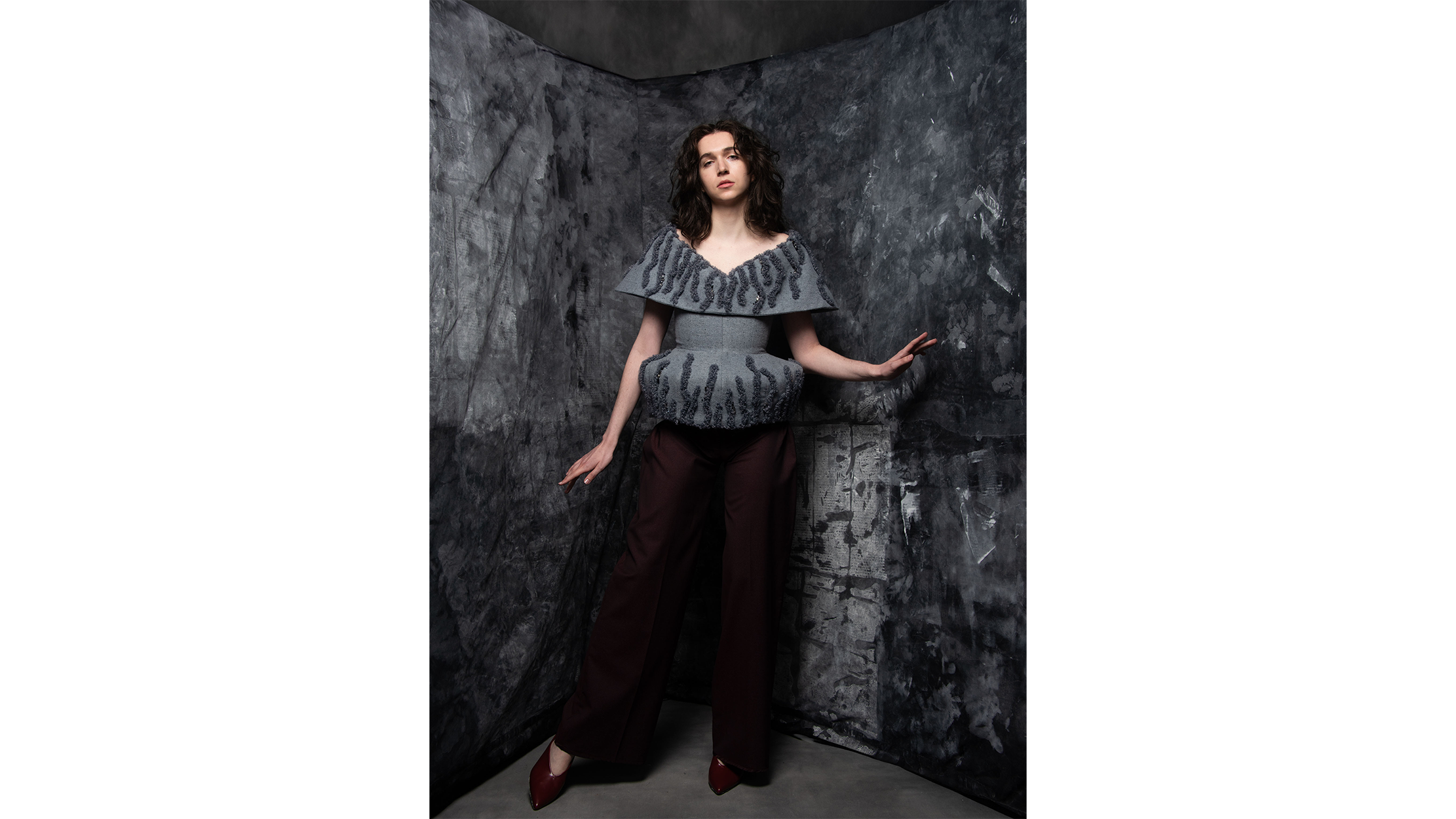
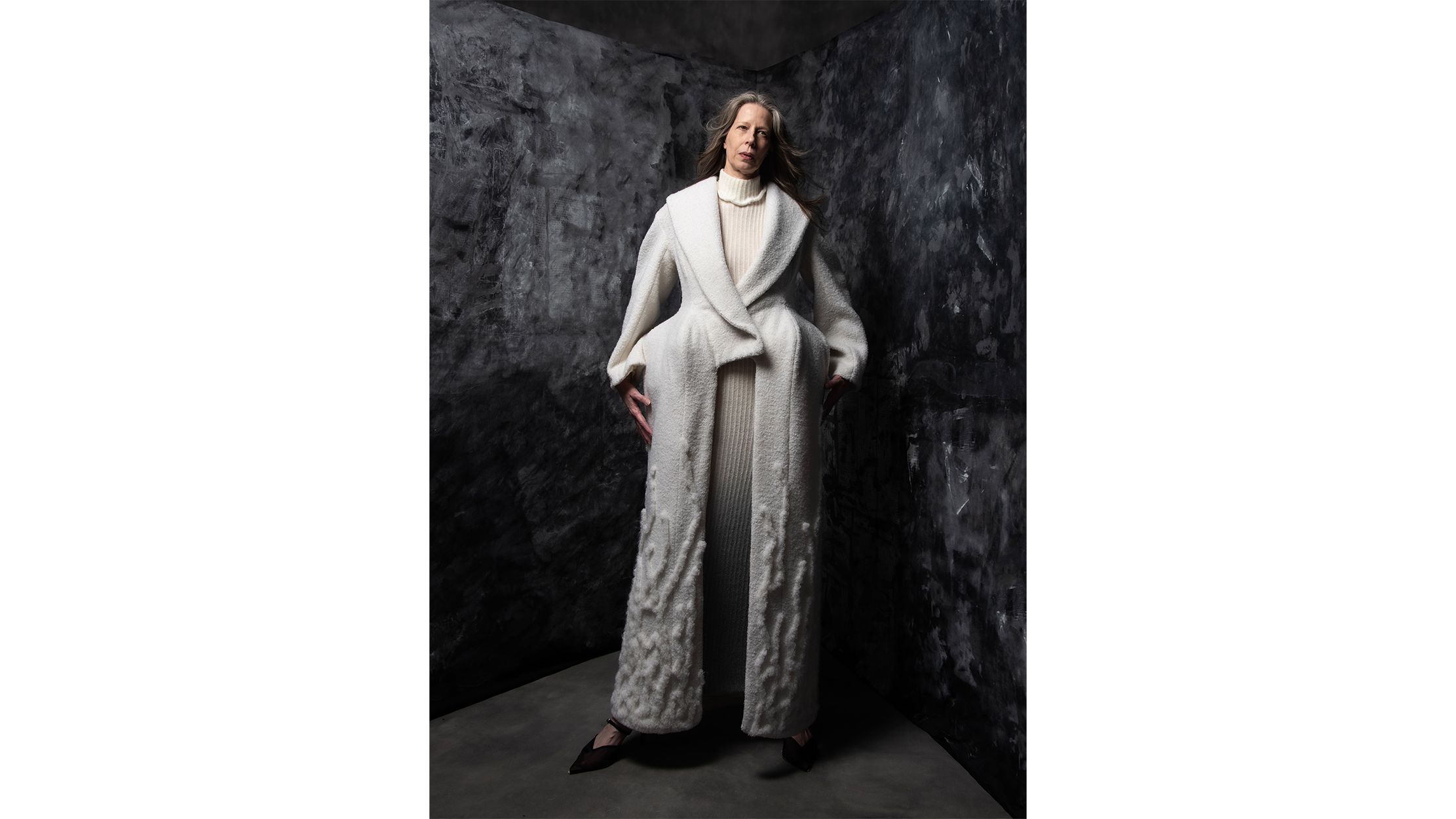
I used the three stages of cognitive immobility, awareness, retrieval, and resolution, as the framework for translating the concept into a tactile form. In the “awareness” phase, I researched how the brain’s activity and physical form could be translated into textiles and materials, specifically exploring how materials could hold memory. To recreate the way our brains light up when we retrieve a memory, I developed wire and beads into webbed sheets that resembled the brain while catching light through a collaboration with Swarovski. The wire also allowed me to mold the material directly to the wearer’s body. I used punch-needle tufting to make the act of creating the memory visible, resulting in a tonal, shadowy texture that resembled the sulci and gyri, which are the folds and grooves of the cerebral cortex. For the “retrieval” phase, I relied heavily on collage to explore the reconstruction of memory and generate silhouettes. I pulled from brain scans, womenswear from 1940s and 1950s Vogue issues, and even my own photographs from 2019. Finally, the “resolution” phase was about taking those experiments and resolving them into a cohesive collection. This included dyeing fabrics with indigo to achieve the moody blue I had been searching for. Sometimes it isn’t easier to do it yourself, but it’s definitely faster!
Was there a particular garment, technique, material, or look within your collections that became especially important to your overall story? Why?
Oh yes, “Thee Coat,” as I’ve been referring to it. It was the only silhouette and material technique from my first year that made it into the final collection, and it ultimately became a pillar that I built the rest of the collection around. I was exploring the idea of how materials could hold memory and what that might physically look like in fabric. Punch-needle tufting became a primary material technique that appears across several silhouettes, but it is most dramatically expressed on this floor-length, structured bouclé wool coat. The tufting alone took 10 weeks to complete and had to be finished before the inner structure and final finishings could be added. It was definitely a labor of love, but the final piece brought together so many of the themes I was exploring: memory being held and the overwhelming comfort and distortion that can come with experiencing cognitive immobility. After developing the coat, I continued exploring outerwear and distorting traditional outerwear shapes as a way to reinforce that narrative throughout the collection.
Many of the collections in this graduating class engage with larger ideas around identity, culture, memory, the body, technology, or the environment. What do you hope viewers take away from your all’s work beyond the clothes themselves?
I think my hope is that people find a bit of themselves in the work. Fashion, art, film, and music are all forms of escapism, so I hope viewers can get lost in the details, the stories, and the worlds we’ve created. Maybe they recognize an emotion, a memory, or even just a small part of themselves within the work. That sense of connection and admiration is ultimately what we’ve been working toward throughout these two years of exploration.
Was there anything about the processes of developing your thesis collections that challenged an assumption you initially had about your own design practices?
Yes. For a while, I thought my skills stopped at dressmaking. I used my time at FIT to intentionally push myself outside of that comfort zone and explore areas like outerwear and tailoring. While there are dresses in the final collection, I didn’t want them to be the “wow” factor; I wanted the collection to demonstrate that I could design beyond what I already knew I was good at. After two years of learning from my mentors and continually challenging myself, I now feel much more comfortable designing across categories. More than anything, the process taught me that being a designer isn’t about staying within the skills you already have, but being willing to keep learning to become a more holistic designer.
How has your time at FIT changed or expanded the way you think about fashion and your role as designers?
I think the biggest lesson I learned about fashion is essentially how to sell commercial art through a compelling story or point of view. My time at FIT taught me how to develop a story that is compelling not only to an academic audience, but also to a customer. I think that’s the sweet spot to be in as a designer because, at the end of the day, the goal is either to enter the industry, where you have to sell your ideas and products to a merchant, or start your own business, where you’re once again selling products through a unique point of view. Learning how to balance creativity with that commercial reality has probably been the most important lesson I’ve taken away from FIT. It’s made me think of myself not just as a designer, but as a storyteller who has to understand how to make people believe in and ultimately want to buy into that story.
What do you think makes your design perspective distinctly your own, and how has that perspective evolved throughout your MFA?
I draw on a personal experience or observation that I feel could make a compelling story. I then research that experience, something that initially feels absolutely and undeniably singular to me, and inevitably discover that it isn’t. Once I reach that point, I know it’s worth exploring and talking about. Throughout my MFA, this process has evolved through using online forums and other forms of research to gather people’s perspectives and identify the common themes within those experiences. That research gives me a stronger foundation before I begin the physical development of textures, materials, and silhouettes. Before my MFA, I would typically keep the research centered on my own point of view and then look for an external visual reference to help drive the narrative. I’ve learned that pushing the research further and understanding how others relate to the same idea gives me a much stronger foundation, not only for developing the collection, but for explaining and defending the choices I ultimately make. I think that balance between the deeply personal and the universally relatable is what has become most distinctly my own.
As you move beyond FIT and begin the next chapter of your career, what do you want to carry forward from these collections, and what are you excited to explore next?
Honestly, I feel like this collection could continue to evolve. I think there’s still more to be said about this collective feeling that there is a line of demarcation between life in 2019 and early 2020 and everything that came after the pandemic. What that looks like for me next, I’m not entirely sure, and I think I want to give this collection some time to shine and have its moment before deciding where it goes. What I do know is that my time at FIT cemented the core DNA of who I am as a designer. It pushed me to explore the themes I consistently return to through patterning, material, and silhouette development, but also taught me the importance of standing behind my own vision. That’s what I want to carry forward, continuing to challenge myself while trusting that my point of view is worth pursuing.
Your collection explores the way we reconstruct memories after an abrupt life change. What does nostalgia look like when it becomes less about remembering the past and more about being unable to move beyond it?
Living in nostalgia can become a cyclical trap. Speaking from experience, constantly comparing your present to your past can feel overwhelming and even depressing. But when the present or future feels uncertain, it’s also incredibly easy to look backward and romanticize what we perceive as better times. There’s something interesting our brains do when we revisit those idealized periods where we tend to remember the good and conveniently leave out the difficult parts. I think that becomes especially relevant in the larger societal conversations we’re having right now, particularly around the push toward more “traditional” roles and values. Nostalgia becomes harmful when it shifts from reflecting on the past to trying to recreate it. We can learn from what came before us, but attempting to return to an idealized version of the past ignores the complexities and hardships that existed alongside it. In that sense, being unable to move beyond nostalgia isn’t really about remembering the past; it’s about trying to recreate a version of the past that never fully existed in the first place.
You describe memory as simultaneously comforting and suffocating. How did you create that duality within the silhouettes and materials?
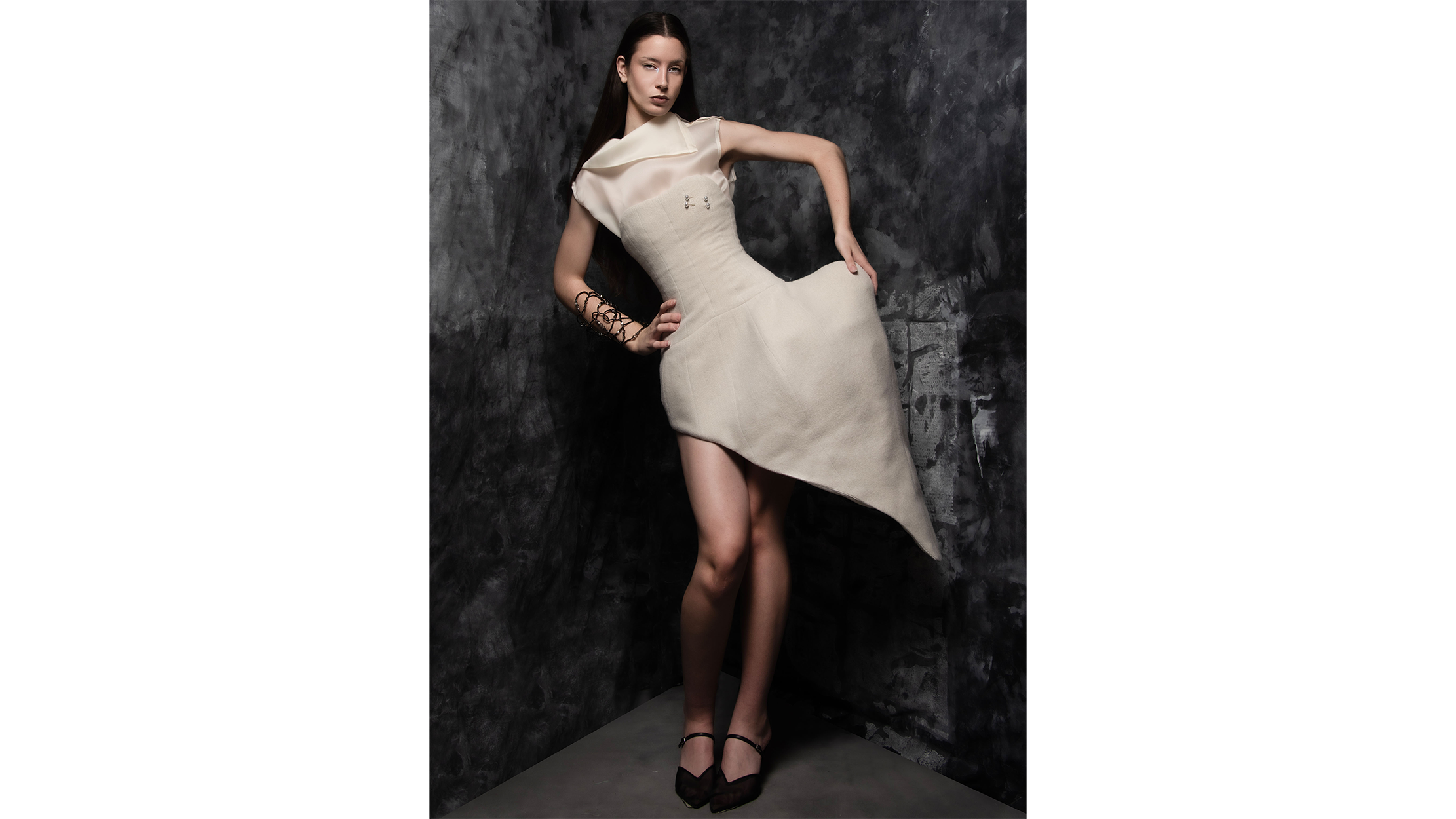
I wanted to use outerwear and layering as the driving force for expressing the duality between comfort and suffocation. Some of the silhouettes are intentionally very long and somewhat heavy, almost like a weighted blanket. Not uncomfortably heavy, but heavy enough that wearing the garment for an extended period would create a sense of discomfort or fatigue. That physical weight became a way of representing the emotional weight of being unable to move beyond the past. I also leaned into corsetry and asymmetry for some of the more dramatic silhouettes, creating a visual and physical tension that reflects the feeling of being pulled between the past and present. The rigidity of the corsets also provided a strong structural base for some of the softer, more tactile materials, like the tufting and beaded wire. That contrast between rigid and soft, restrictive and comforting, became an important part of how I communicated the duality of memory throughout the collection.
Interview by Emma Green, Assistant to Editor-In-Chief, PhotoBook Magazine
Tearsheets by Daniel Lopez, Art Director, PhotoBook Magazine
*Images Courtesy of FIT
RELATED STORIES