Femininity Without Permission: Palek Sethi’s FIT MFA Collection
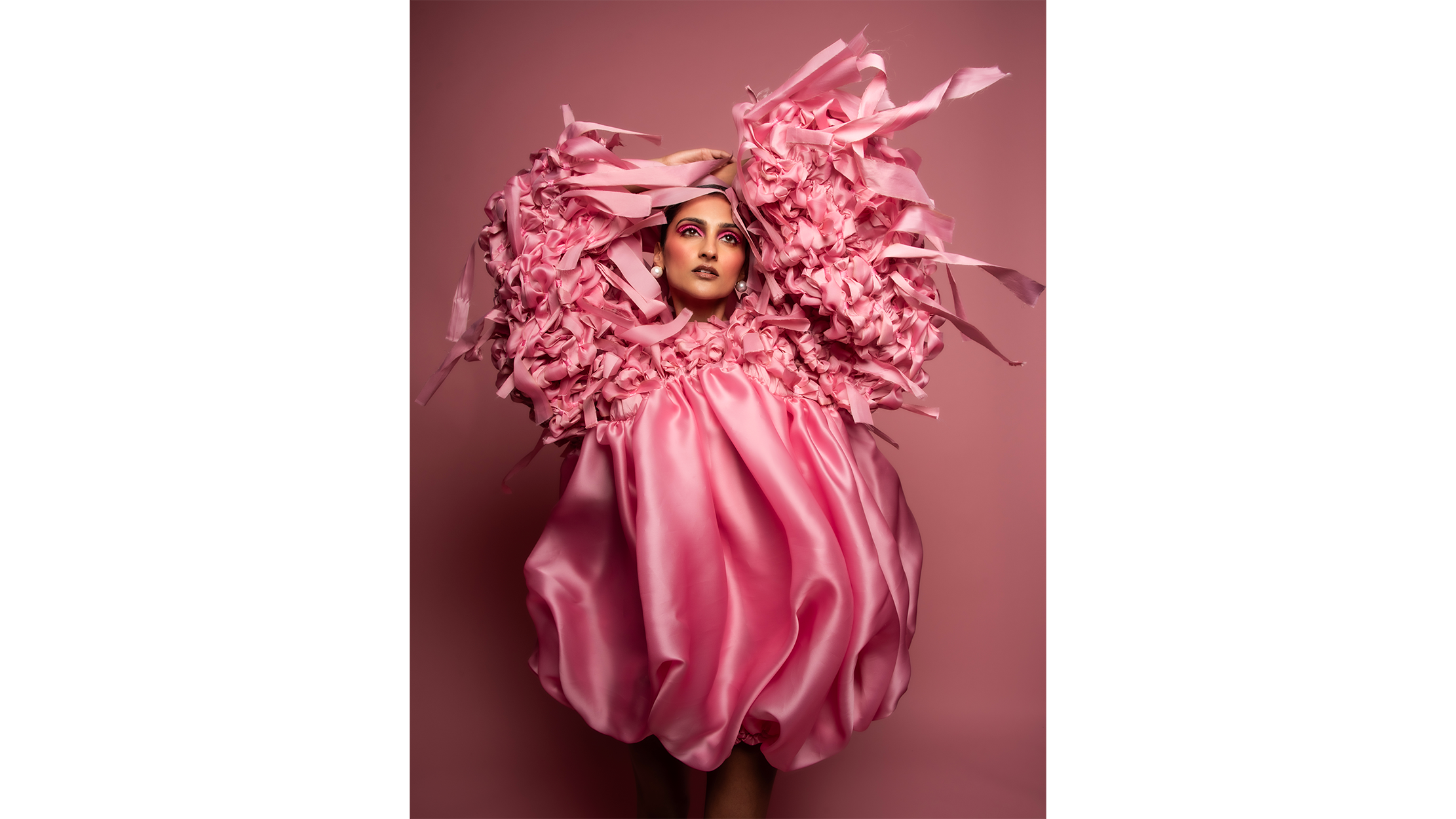
For Palek Sethi, pink has never been just a color. It carries the memory of her grandmother, the visual richness of growing up in India, and the complicated expectations attached to femininity. In Miss. Behaved, Sethi brings those associations into a collection that refuses to make itself smaller for anyone’s comfort. Exaggerated sleeves, sculptural volume, oversized bows, and unapologetic pink challenge the invisible rules that dictate how women should dress, behave, and occupy space. Drawing from historical dress, the male gaze, and the ways women have used clothing to express authority, Sethi reframes hyperfemininity as a form of self-determination rather than an invitation for judgment. Through intricate handwork and experimental denim manipulation, she transforms familiar materials and traditionally feminine details into something distinctly her own. Developed during her MFA at FIT, Miss. Behaved ultimately marks a personal shift for Sethi, from questioning whether her instincts are enough to embracing the very qualities she once worried might be too much.
What was the starting point for your MFA collection, and what initially made you want to explore that idea through fashion?
Miss. Behaved started with a question I had been carrying for a long time: who really decides what a woman should wear? Growing up as an Indian woman, I was very aware of the expectations placed on women around modesty, femininity, and how we are supposed to present ourselves. There is often an invisible line between being feminine and being considered “too much.” I became interested in that contradiction. Why are women encouraged to be feminine, but then judged when they embrace that femininity too openly? Fashion felt like the most honest way for me to explore that because clothing is so intimate. It sits directly on our bodies, but it also carries culture, memory, expectations, and identity. I wanted to take the things traditionally associated with hyperfemininity- pink, bows, florals, volume, ornamentation and ask what happens when a woman wears them entirely on her own terms. That became the emotional starting point for the collection.
Your collection brings together a specific set of personal, cultural, historical, or conceptual references. How did your research evolve as you moved from an idea into an actual collection?
My research began very personally and then slowly became much broader. I started with my own experiences of femininity and modesty, but as I researched, I realized these weren't just personal feelings; they were connected to much larger histories around women's bodies and how femininity has been constructed. I looked at the male gaze, hyperfemininity, and the ways women have historically used clothing to communicate power. The 1500s-1700s became an interesting reference because clothing was such an important part of how women constructed authority. I also looked at contemporary women who deliberately embrace femininity rather than reject it. At the same time, I kept coming back to my own culture. Pink reminded me of my grandmother, childhood memories, women’s rights, and the visual richness I grew up around. So the research became a conversation between history, theory, culture, and memory. Eventually, those references stopped feeling separate and became one visual language.
What role do your personal experiences play in your design practices, and how much of yourselves do you see reflected in these collections?
My personal experiences are probably the biggest reason I design the way I do. I don't think I really know how to separate myself from my work, and honestly, I don't want to. I grew up in India surrounded by color, textiles, craft, strong women, and very particular ideas about femininity. My grandmother, my mother, my childhood, and even small memories like the color pink have all found their way into my work. They may not always appear literally, but they influence how I see beauty. Miss. Behaved also reflects a very personal part of my growth during the MFA. I started the program wanting to get everything right. I was afraid of making the wrong decision. Through this collection, I learned to trust my instincts more. When I look at the collection now, I see more than clothes. I see two years of growing, questioning, failing, learning, and becoming much more confident in my own voice.
How did you translate the central concepts of your collection into something physical through silhouette, material, color, construction, or textile development?
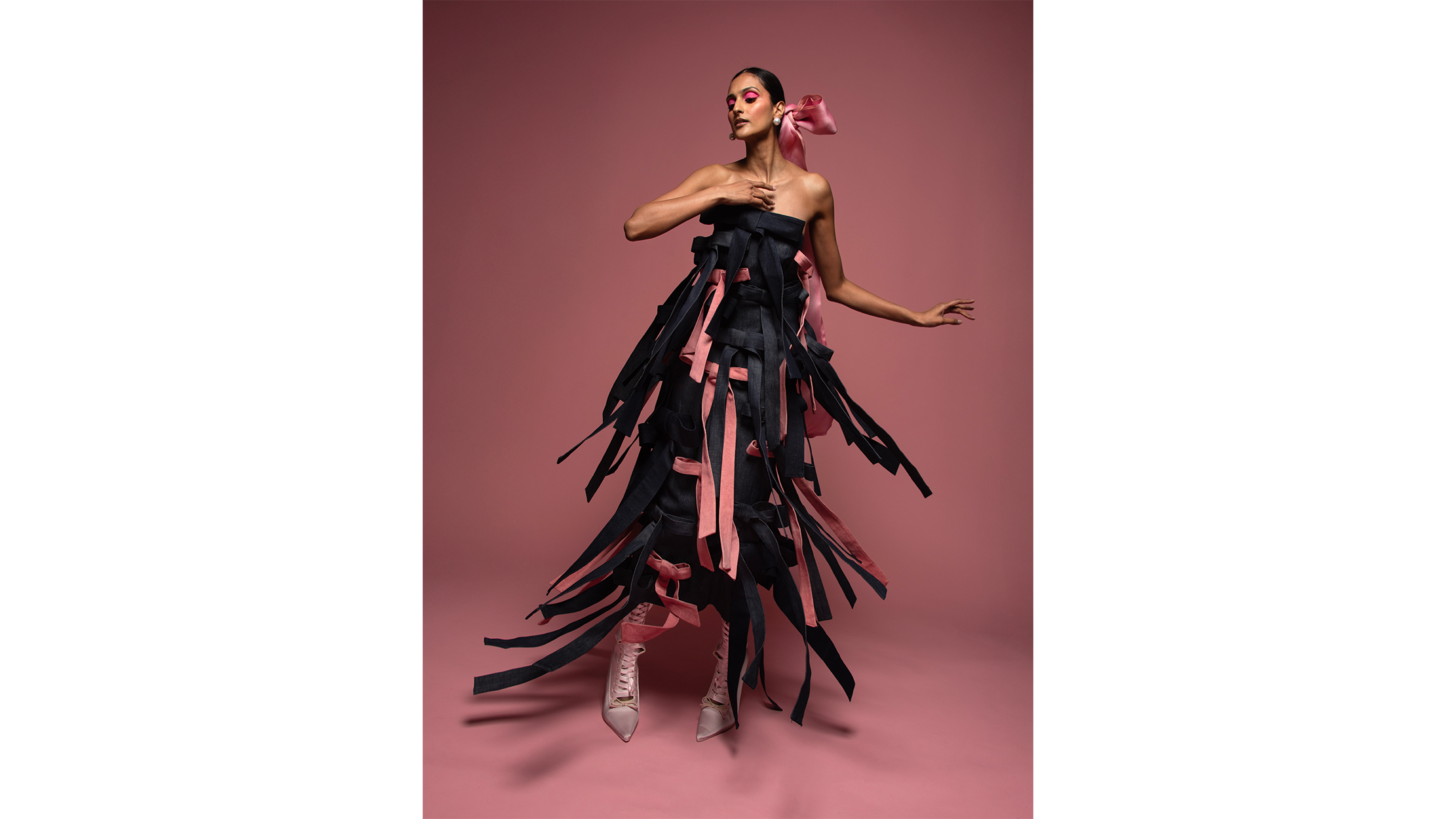
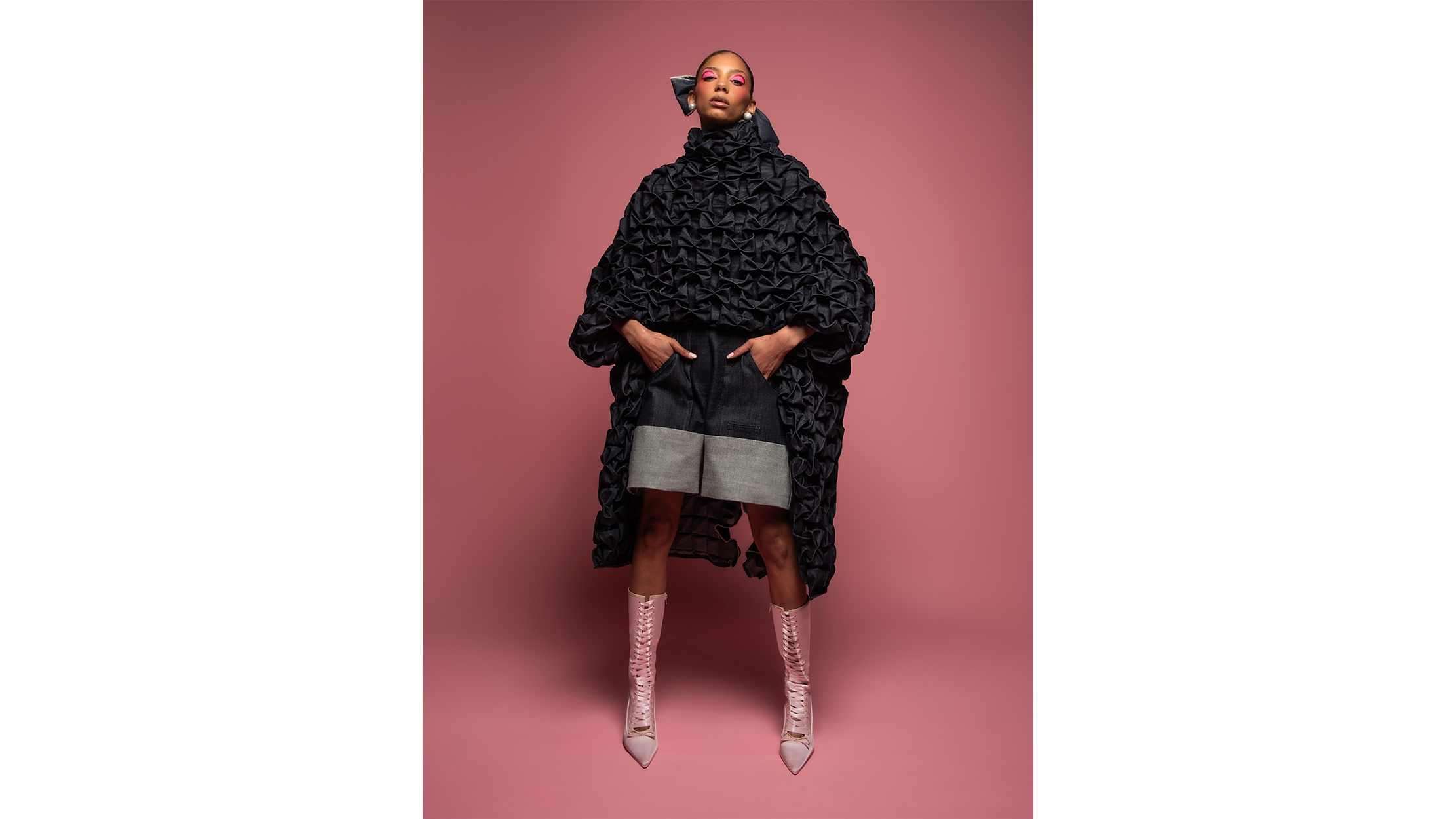
I wanted the collection to physically communicate the idea of taking up space unapologetically. If the collection was about a woman reclaiming her body and her femininity, I didn't want the clothes to quietly disappear around the body. The silhouettes became exaggerated: large sleeves, dramatic volume, bows, sculptural shapes, and proportions that intentionally demand attention. I started thinking about this as “protective maximalism.” The volume creates a kind of distance around the body while also making the woman wearing it feel powerful. Pink became especially important because it is so strongly associated with femininity and women’s rights. I wanted to take that association and make it bold rather than delicate. I also spent a huge amount of time on handwork, from a personal technique I call Bombastic Fil-coupe, smocking, and denim surface manipulation. Those details made the garments feel very personal. They are reminders that there is a human hand behind every piece, and that making something beautiful takes time, patience, and love.
Was there a particular garment, technique, material, or look within your collection that became especially important to your overall story? Why?
The denim pieces became especially important to me because they allowed me to completely transform a material that people already have such a strong visual understanding of. I have always loved denim, but I’m even more fascinated by what happens when you stop treating it as just denim and start treating it almost like a canvas. I spent a lot of time manipulating its surface, smocking, painting, distressing, layering, adding texture, and changing the way the fabric physically behaves, similar to origami, and feels. I loved taking something familiar and making it almost unrecognizable. I wanted the surface to have a sense of movement and discovery, where you could see one texture from far away and notice something completely different when you came closer. That process really reflects how I love to design. I get so much joy from changing a material with my hands and watching it become something unexpected. For me, textile manipulation isn't just decoration; it is a way of giving the fabric a completely new identity and making it tell part of the story.
Many of the collections in this graduating class engage with larger ideas around identity, culture, memory, the body, technology, or the environment. What do you hope viewers take away from your work beyond the clothes themselves?
I hope viewers leave with a question rather than a single answer. I want Miss. Behaved to make people think about the invisible rules we have all absorbed about how we are supposed to look, behave, and take up space. For me, the collection became about permission. Permission to be feminine. Permission to be loud. Permission to be excessive. Permission to wear something simply because you love it. I also hope people recognize the joy in the collection. The subject matter is serious, but the clothes themselves are playful, colorful, and full of life. I don't think empowerment always has to look serious or restrained. Most importantly, I want someone to look at these clothes and feel something. Maybe they recognize a part of themselves, maybe they question an expectation they have carried, or maybe they simply feel joy looking at something that was made with so much love. If I can create that feeling, I think the clothes have done their job.
Was there anything about the processes of developing your thesis collections that challenged an assumption you initially had about your own design practices?
The biggest thing I learned was that I didn't need to have everything figured out before I started making. At the beginning of my MFA, I thought being a good designer meant having a very clear answer and executing it perfectly. I was constantly questioning whether something was sophisticated enough, commercial enough, or whether people would understand it. But the thesis process taught me that some of my strongest ideas came from moments when I stopped overthinking. I would make something because I loved it, and only afterward understand why it belonged in the collection. I also realized that I naturally love maximalism. I love color, texture, embellishment, volume, and details. For a while, I wondered whether I needed to make my work quieter to be taken seriously. Miss. Behaved taught me the opposite. The things I was once worried were “too much” became the things that made the collection feel most like me.
How has your time at FIT changed or expanded the way you think about fashion and your role as designers?
FIT gave me the space to understand myself as a designer rather than simply trying to become one. Coming into the MFA, I had a lot of ideas and a lot of ambition, but I think I was still looking outward for validation. I wanted to know whether something was “good enough” before trusting myself. The faculty at FIT - Zoran Dobric, Juyeon Hong, Alex Alguire, and Cathleen Sheehan taught me to question why I make things, not just whether they look good. They pushed me to research deeper, experiment more, and understand that design can hold emotion, culture, and personal history. It also reminded me how much I genuinely love the process of making. There were nights when I was exhausted, fittings that didn't go as planned, samples that failed, and details that took hours longer than expected. But I still loved coming back to work.
What do you think makes your design perspective distinctly your own, and how has that perspective evolved throughout your MFA?
I think my perspective comes from constantly translating between different worlds. I am an Indian designer who has studied and worked in the UK as well as the US, and I naturally bring those experiences together. I'm drawn to the richness of Indian culture, color, craft, ornamentation, textiles, and storytelling, but I also love denim, contemporary fashion, and Western design language. I don't want to choose between those influences. I want them to exist together. I also realized during my MFA that I don't naturally gravitate toward minimalism. I love clothes that have personality. I love color, movement, texture, exaggeration, and details that reward you when you look closer. Earlier in my MFA, I think I was still trying to figure out what a “designer” was supposed to look like. By the end, I became much more comfortable asking what I wanted to make. That shift from seeking approval to trusting my own instincts is probably the biggest evolution in my design perspective.
As you move beyond FIT and begin the next chapter of your career, what do you want to carry forward from this collection, and what are you excited to explore next?
The biggest thing I want to carry forward is the courage to trust my instincts. Miss. Behaved taught me that work becomes stronger when I stop trying to predict what people will like and instead make something that I genuinely believe in. I want to keep that feeling with me as I enter the industry. I'm excited to continue exploring womenswear, denim, textile development, surface design, and the relationship between traditional craft and contemporary fashion. I especially want to keep finding ways to make clothing feel emotionally meaningful while still being relevant to how women actually want to dress today. But more than anything, I want to keep making. I want to keep learning from the people around me, keep experimenting, and hopefully keep surprising myself. After two years at FIT, I think the thing I'm most excited about is simply seeing where my curiosity takes me next.
You describe Miss. Behaved as a challenge to centuries of male-dominated ideas around modesty. What does reclaiming hyperfemininity mean to you today?
To me, reclaiming hyperfemininity means taking ownership of something that has often been used to judge women. Femininity doesn't have to mean weakness. Wearing pink doesn't make you less powerful. Wanting to look beautiful doesn't mean you are dressing for someone else's approval. And being sensual doesn't mean you are inviting someone to have an opinion about your body. Growing up, I think I absorbed a lot of these contradictions without even realizing it. There were invisible rules about what was “too much” for a woman to be: too feminine, too loud, too dressed up, too confident. With Miss. Behaved, I wanted to turn that “too much” into THE point. The bows, pink, smocking, volume, and embellishment aren't there because a woman needs to make herself more pleasing to look at. They are there because she likes them. For me, reclaiming hyperfemininity is ultimately about choice. A woman doesn't need permission to enjoy being feminine.
The collection ends with the question, “Who decides what a woman should wear?” How did that question guide your design decisions throughout the collection?
That question became almost like a compass throughout the entire collection. Whenever I questioned whether something was too much, I came back to it. Who decided that it was too much? Who decided that a woman shouldn't dress this way? And why should that opinion matter more than hers? It gave me permission to push everything further: the silhouettes, the volume, the bows, the pink, the texture, the handwork. But eventually, I realized I wasn't only questioning society's expectations. I was questioning some of the expectations I had placed on myself.
By the end, the question stopped feeling like a challenge and started feeling like an answer.
She decides.
That is what I wanted the collection to communicate. Not that women should dress a certain way, but that they should have the freedom to decide for themselves. I think that is why this collection means so much to me. I took something that had lived in my head as a question and turned it into something I could physically make, touch, and wear.
Interview by Emma Green, Assistant to Editor-In-Chief, PhotoBook Magazine
Tearsheets by Daniel Lopez, Art Director, PhotoBook Magazine
*Images Courtesy of FIT
RELATED STORIES