POET-LAB AW26: THE QUIET AFTER THE FRACTURE
The concrete floor at Spitalfields E1 had the colour of dishwater, and the chairs were packed so close that the front row's knees almost touched the runway. There was no set design to speak of — no projection, no flower wall, no scenography competing for attention. Just grey walls, flat light, and stillness. It was the kind of staging that either reads as underfunded or as a deliberate act of restraint, and within the first thirty seconds of Giuseppe Iaciofano's "Inside the Lab" show, it became clear this was the latter. The clothes needed nothing but a body and a room.
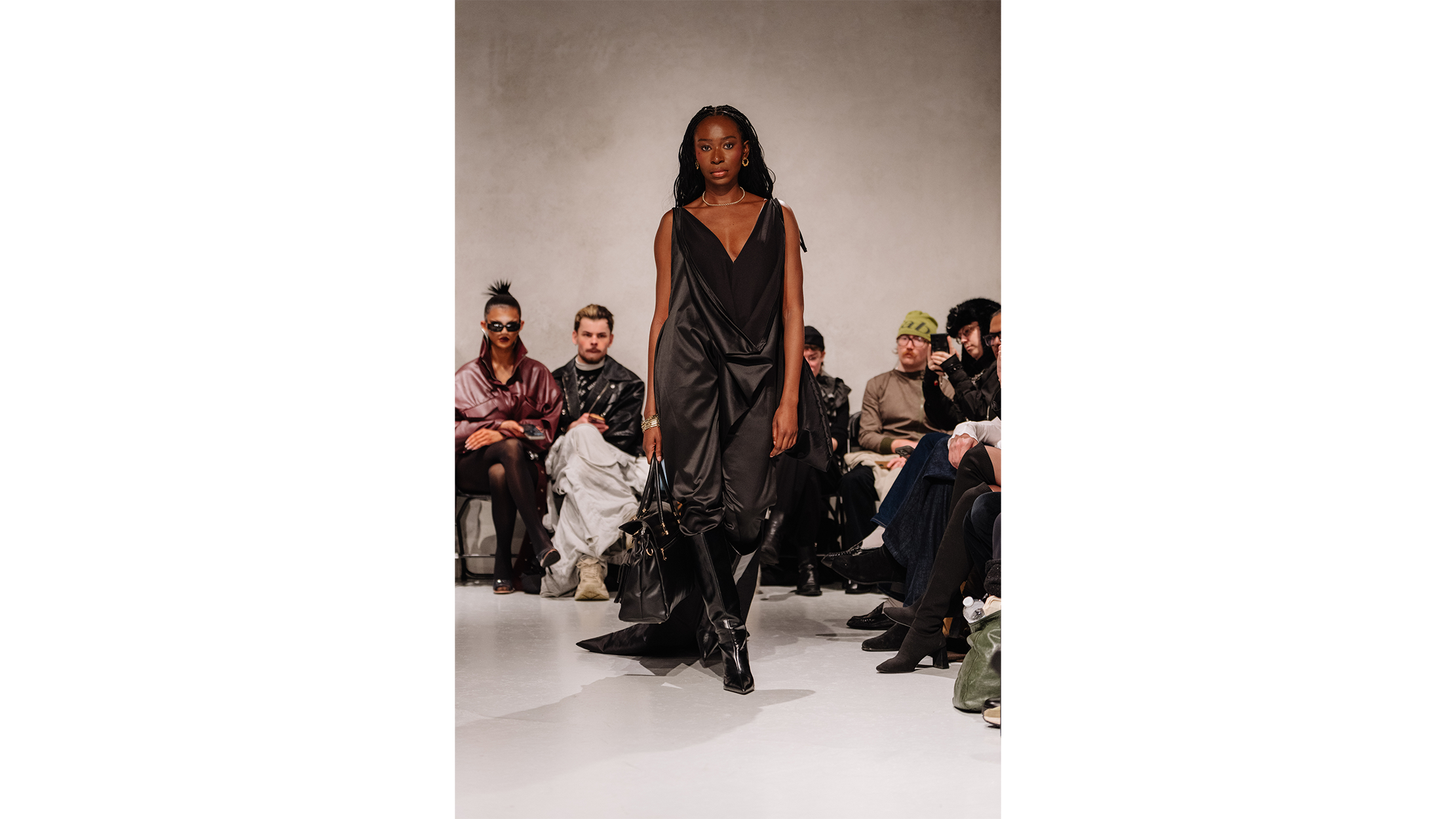
The opening look set the tone: a column of black satin that fell from one shoulder in a single unbroken pour, pooling at the ankles where it met polished boots. It was a garment that refused to announce itself, yet commanded the room entirely — the fabric catching the flat overhead light in liquid ripples as it moved, draping with the kind of weight that only comes from working with real material rather than digital rendering. There was no adornment, no hardware beyond a slim gold bracelet. Everything Iaciofano wanted to say about this collection was already there in that first exit: exposure as an act of intention, not invitation.
For Iaciofano, a Milan-born, London-based designer who founded Poet-Lab in 2023, the collection's emotional centre is the distance between performing femininity and choosing it. "Inside the Lab" is his term for the interior work — the private reckoning that happens before a woman walks into a room and
no longer adjusts herself to fit it. The show notes invoked Diana, Princess of Wales, and her famous refusal of the rulebook, but the reference felt less like celebrity worship and more like a shorthand for a particular kind of public dignity: the composure that follows rupture. This is territory Iaciofano knows personally. A cancer survivor who has spoken openly about discrimination he faced navigating fashion as a queer Italian designer in London, he builds from the premise that resilience is not performed loudly — it is worn quietly, in the cut of a shoulder and the fall of a hem.
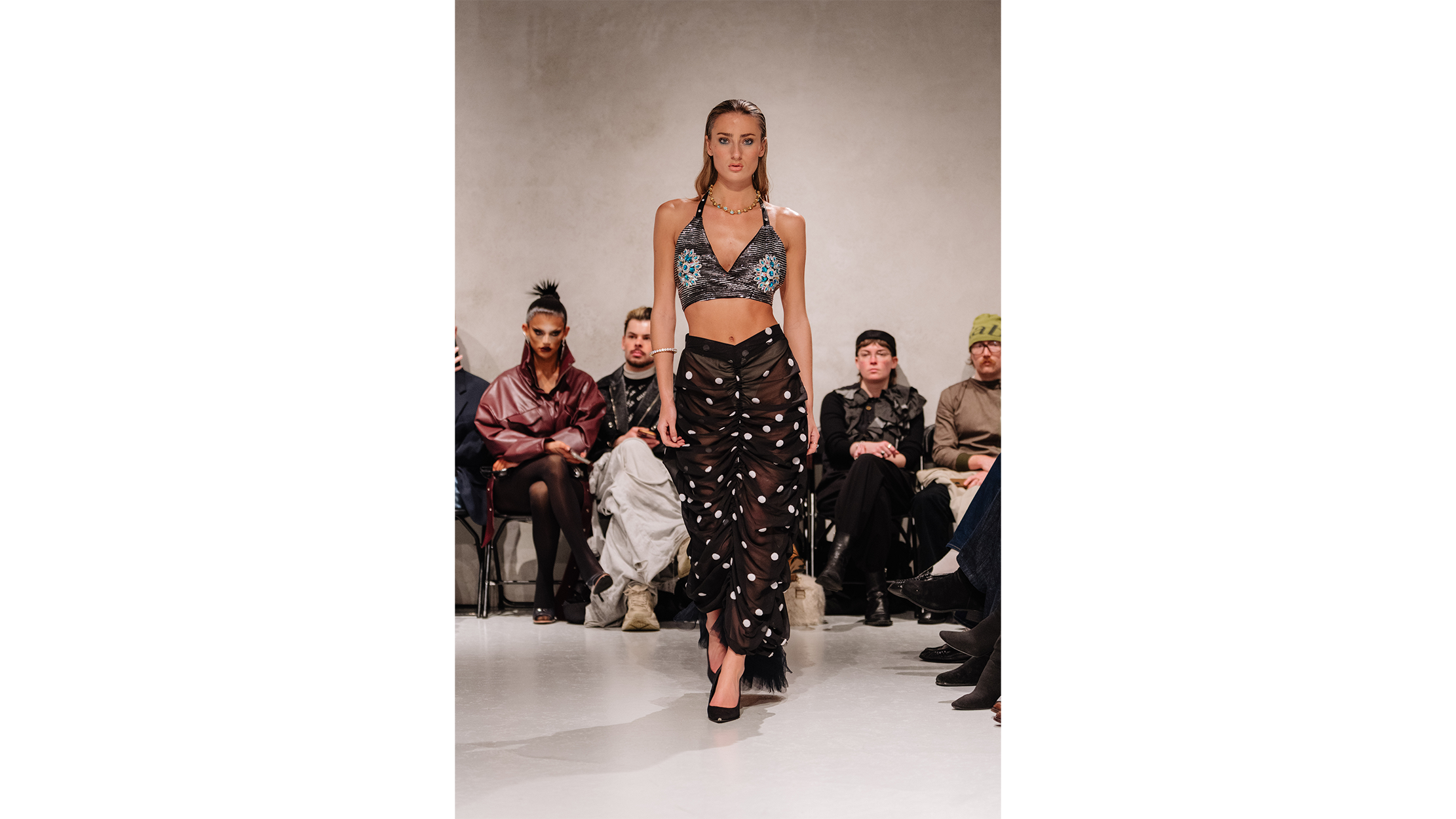
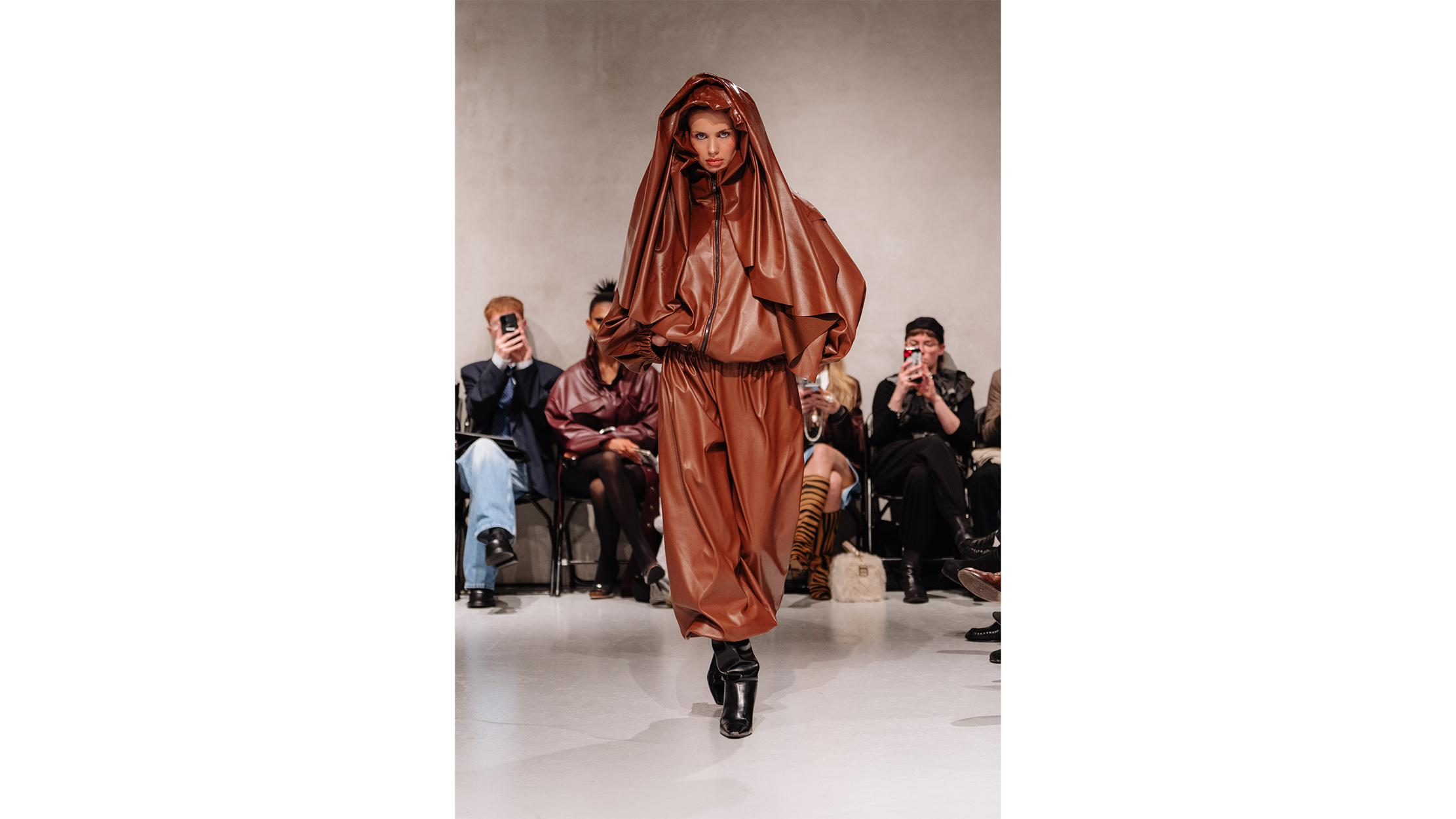
The collection moved through a vocabulary of controlled revelation. A bralette encrusted with turquoise floral embellishments — somewhere between heirloom brooch and nightclub armour — sat above a ruched polka-dot skirt in sheer black organza, the fabric gathered so tightly it created its own topography, bunching and releasing around the body like a held breath. It was one of the collection's more overtly decorative moments, yet even here the sensuality felt authored rather than offered. A cognac leather ensemble — hooded, voluminous, zipped to the throat — turned protective outerwear into something monastic, its oversized proportions swallowing the model's frame in glossy, animal-coloured skin. Every piece in the collection is constructed from repurposed deadstock fabrics and plant-based leathers, a commitment Iaciofano frames not as trend but as testimony — each textile carrying its own previous life into a new silhouette.
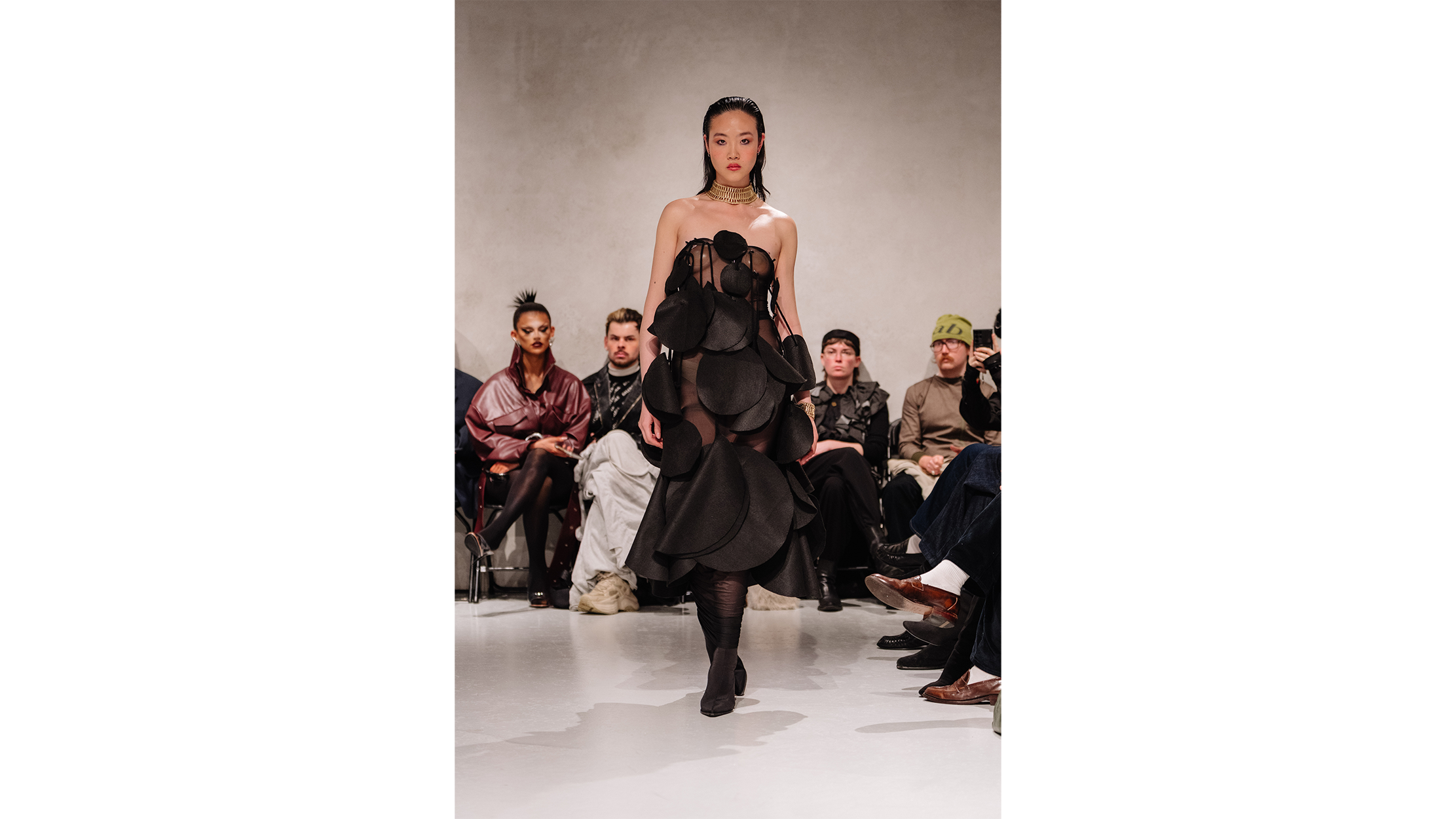
The standout sculptural moment arrived midway through: a strapless dress built entirely from overlapping discs of stiff black felt, layered like the scales of some deep-sea creature or the petals of a flower pressed between pages and then released. The sheer mesh beneath let skin flash through the gaps, but the overall effect was architectural rather than seductive — a dress that occupied space with the authority of a structure, not a surface. Under the flat Spitalfields light, the felt absorbed rather than reflected, giving the piece a matte density that made everything around it seem overexposed by comparison.
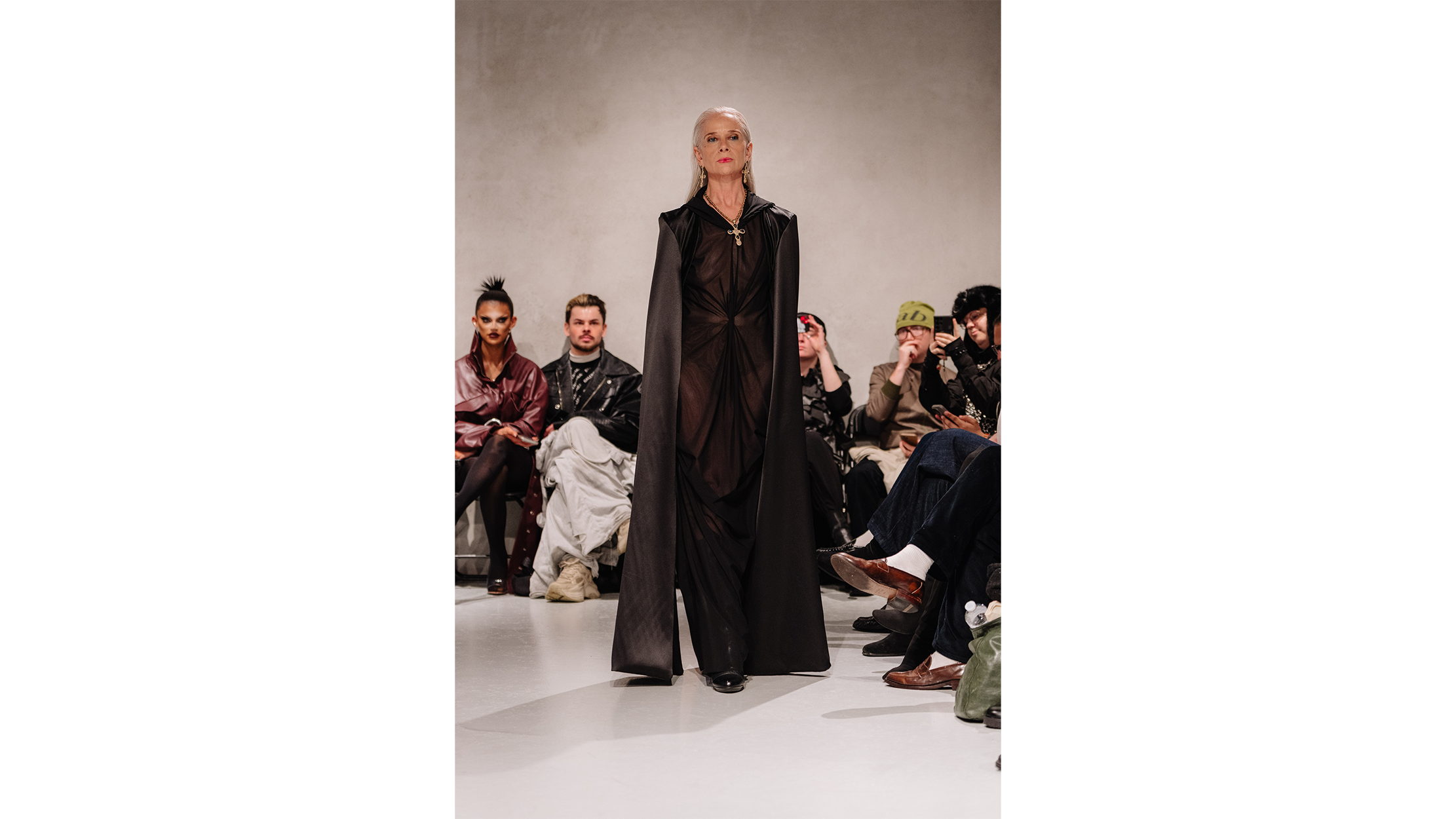
But it was in the casting that "Inside the Lab" made its most eloquent argument. The runway included Elton Ilirjani, the Albanian-American model and genderless fashion advocate whose presence in Poet-Lab shows has become something of a creative partnership; Elliott with 2 T's, whose walk brought a performer's command of presence to the austere space; and a silver-haired older model who swept down the runway in a floor-length sheer black gown with cape-like panels that trailed behind her like smoke, a gold cross resting against her collarbone — the kind of image that made you reconsider every assumption you'd ever held about who gets to be powerful in a room full of fashion people. Former elite athlete and Bridgerton actress Genevieve Chenneour walked too, adding yet another register of physical authority. Iaciofano has said that inclusivity and ethics are, for him, a single word, and here that philosophy was not signposted but simply enacted — a range of bodies, ages, and identities wearing the same design language with equal ownership.
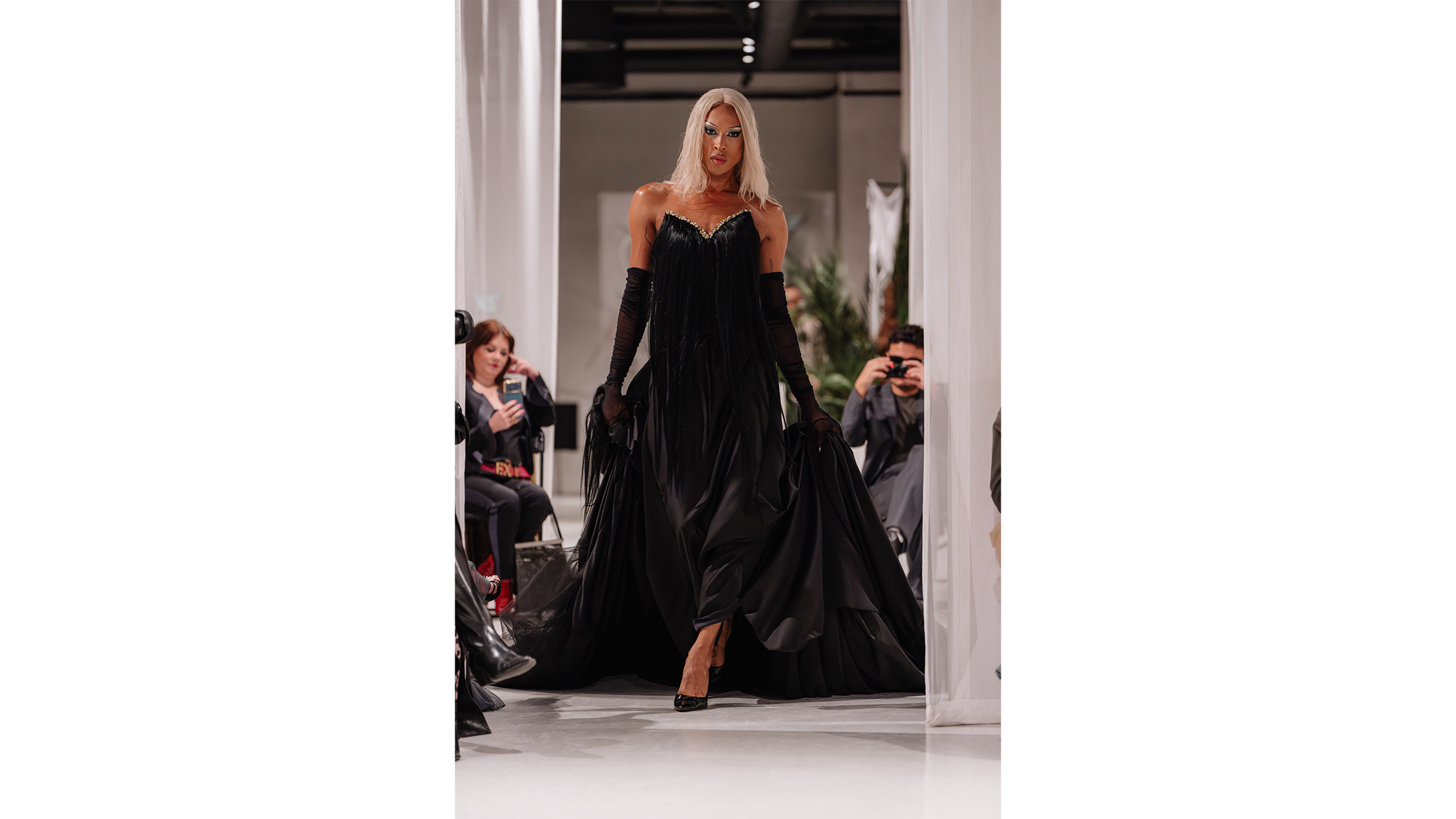
The show closed with Tayce in a reimagining of Princess Diana's wedding dress — a sweeping black gown with a crystal-trimmed sweetheart neckline, sheer opera-length gloves, and yardage that pooled and billowed as if the fabric itself was making a declaration. It was the collection's most theatrical gesture, and deliberately so: the Diana reference, stripped of its white and its innocence and recast in black satin and unapologetic glamour, became a statement about what femininity looks like when it is no longer waiting for permission. The fringe detailing at the bodice trembled with each step, catching the light like something alive.
Walking out of Spitalfields afterwards, past the market stalls and the lunch crowds, the memory that lingered was not of any single garment but of the silence in that room — the way Iaciofano had engineered an atmosphere where watching someone walk in a well-made dress felt, for a few minutes, like witnessing a private act of self-possession made public. In a fashion week increasingly saturated with spectacle and sponsorship decks, "Inside the Lab" offered something rarer: the conviction that clarity is its own kind of drama, and that the most radical thing a collection can do in 2026 is simply trust its clothes.
Poet-Lab AW26 "Inside the Lab" was shown at Spitalfields E1, London, during London Fashion Week, February 2026.
Photography by Marcus Hartelt for LFW.
Article by Aayush Anima Aggarwal, Contributing Editor, PhotoBook Magazine
Tearsheets by Daniel López, Art Director, PhotoBook Magazine
*Images Courtesy of Poet-Lab
RELATED STORIES