NAOMI HART AW26: THE QUIET WEIGHT OF BEING
Behind the models, the screen kept shifting. Blurred treetops swaying as though filmed from beneath a canopy. A slow pan across water. Then, without warning, the London skyline — the Gherkin, the Shard, that whole glass-and-steel assertion of velocity — rendered soft and distant, like a city seen through the window of a departing train. The backdrop at Fashion Scout was doing exactly what Naomi Hart's collection was about to do: holding nature and metropolis in the same frame, asking which one you'd rather stand still inside. When the first model appeared on the polished concrete runway, the room didn't gasp. It leaned forward. The clothes had that quality — they didn't grab you by the collar. They made you come to them.
Hart, a London College of Fashion graduate who launched her label just three years ago, has built a reputation for conceptual womenswear that favours provocation over politeness. But for AW26, she wanted to reverse the engine. "There's a lot of chaos in the world right now," she said backstage, still flushed from the final walk. "I really wanted to strip it back, but still bring a sort of elevated, durable quality." What emerged was a collection that holds tension between restraint and risk — garments that look composed from across a room but reveal their strangeness up close, like a sentence that only shows its second meaning on the reread. She built the entire thing in roughly two weeks, a fact she offered with a laugh that was half disbelief, half defiance.
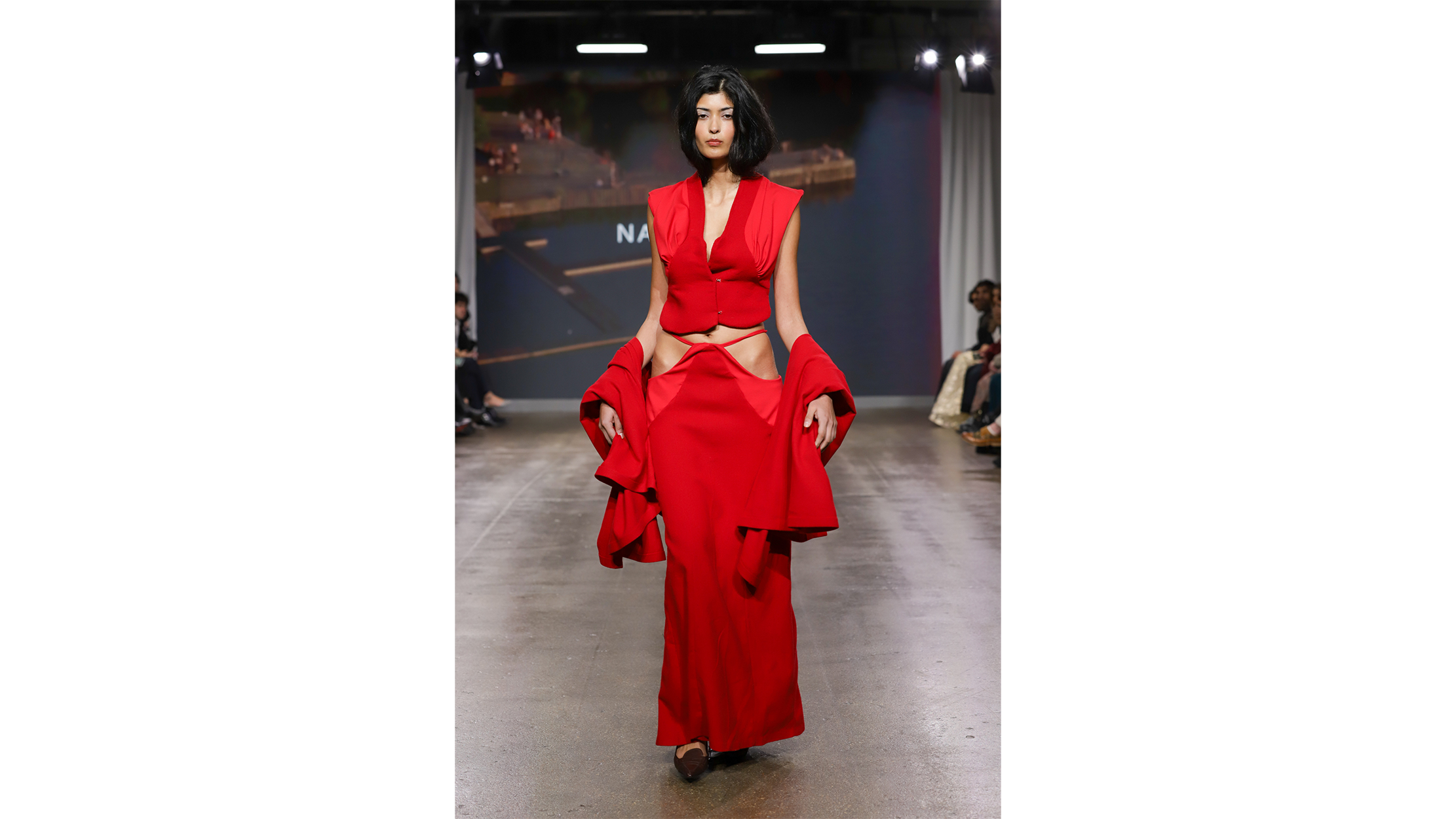
The all-red look stopped the room's breath mid-inhale. A cropped waistcoat cut sharp at the shoulder, fastened tight with a deep V that ended just above the navel, connected to a floor-length skirt by nothing more than two thin straps crossing bare skin at the waist. But the real architecture lived at the hips, where two great sculptural panels of red fabric flared outward like wings caught mid-fold — not fluttering, not decorative, but weighted, purposeful, as though the garment had been interrupted in the act of becoming something else entirely. As the model walked, those panels swayed with a heavy pendulum rhythm, catching the overhead lights on their creased surfaces. It was the most physically commanding piece in the collection, and also, somehow, the quietest. It didn't shout red. It inhabited red — the red of clay, of old lacquer, of something that has been that colour for longer than anyone can remember.
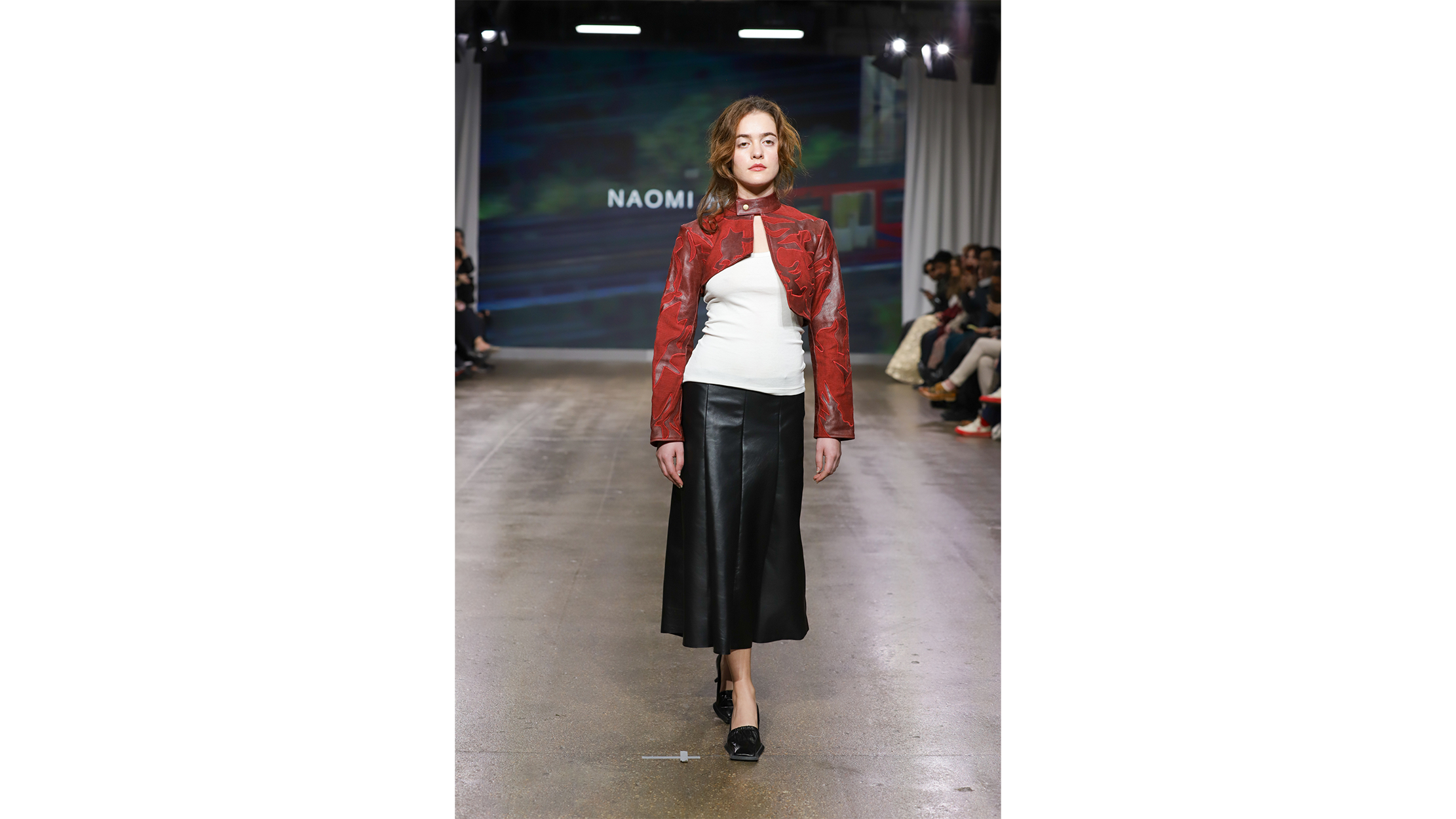
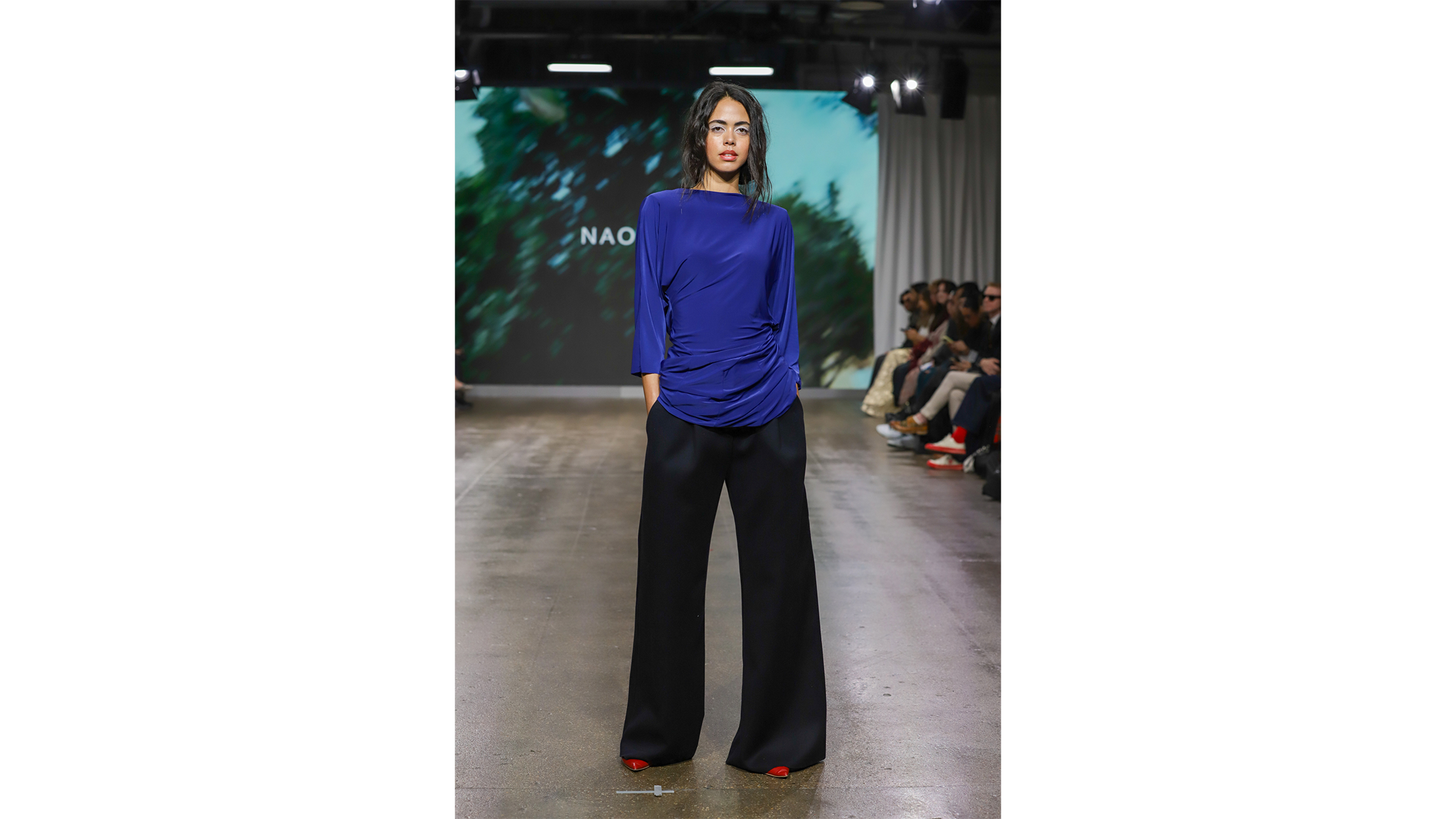
Elsewhere, Hart's pattern cutting worked in subtler registers. A cropped jacket in deep oxblood leather bore abstract organic shapes cut or appliquéd across its surface — forms that suggested leaves, or the vein maps of leaves, or perhaps something more anatomical, depending on the light. It fastened at the throat with a single brass snap beneath a neat mandarin collar, and beneath it sat the most democratic pairing in the show: a plain white top and a clean-panelled black leather midi skirt. The contrast was the point. Hart's creative cuts and material experiments don't exist in isolation; they need the ordinary to push against, the way a willow needs still water to show you its reflection. A violet draped top in what appeared to be a fluid jersey gathered asymmetrically at the hip, pooling and pulling like fabric caught in a slow current, paired with wide-leg black trousers so perfectly weighted they barely moved as the model strode forward, hands resting in deep pockets. The red pointed shoes beneath were the only punctuation — a quiet exclamation at the end of a long, considered sentence.
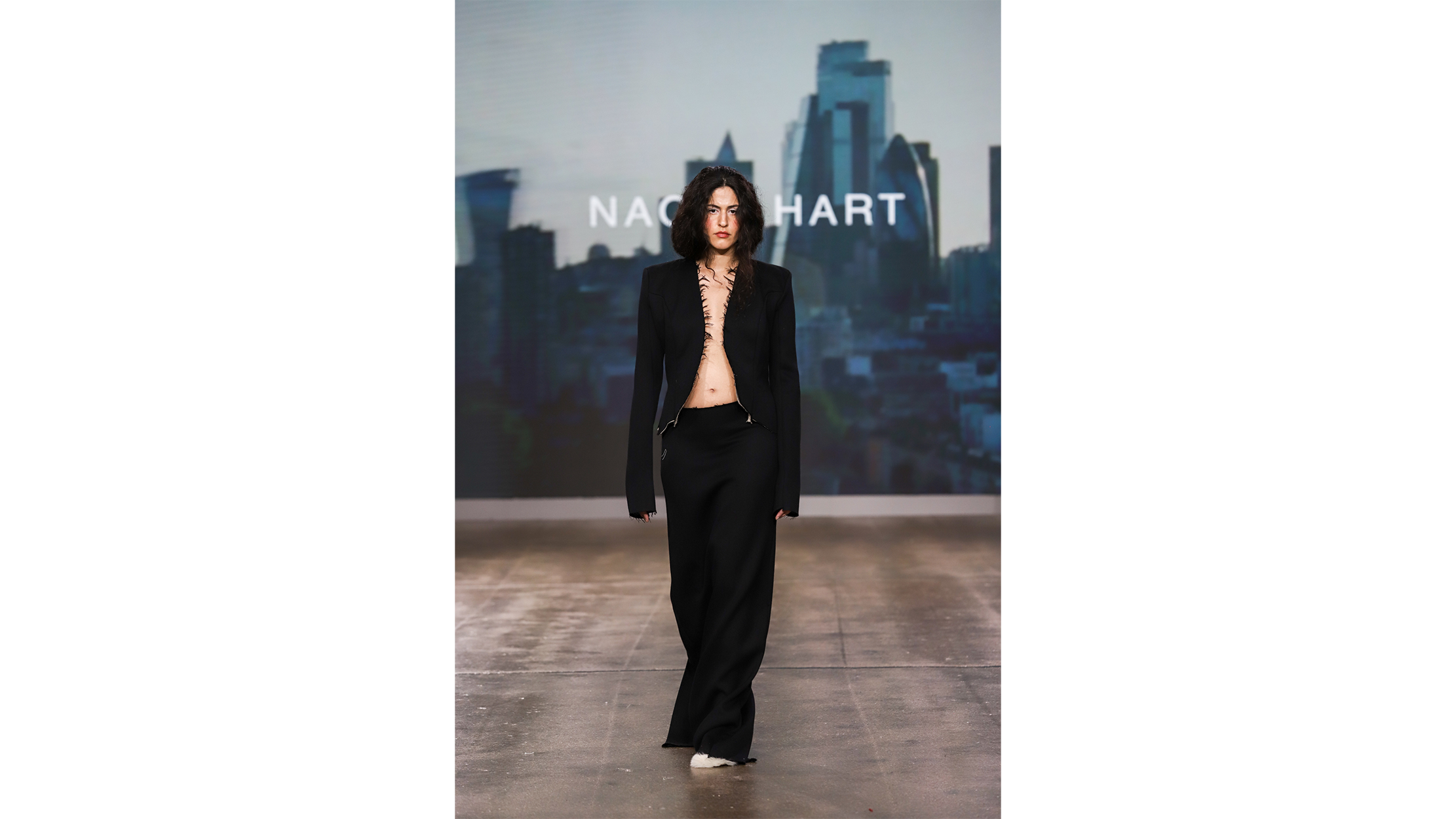
The black look was the collection's nerve centre — its most exposed and most controlled moment simultaneously. A sharply tailored blazer, worn open against bare skin, its front edges left deliberately raw and fraying in tendrils that looked almost like claw marks or briars tracing the body's centre line. The silhouette was classically severe — strong shoulders, clean sleeve — but that ragged opening turned formality into vulnerability, as though the garment had been carefully constructed and then carefully undone. Paired with floor-length black trousers and soft cream-white shoes, it walked in front of the London skyline projection, and the juxtaposition felt intentional: the city's hard edges behind, the body's softness ahead, the frayed seam between them left unresolved. This was Hart's thesis in a single look — the sovereignty of stillness is not the absence of tension, but the willingness to hold it without flinching.
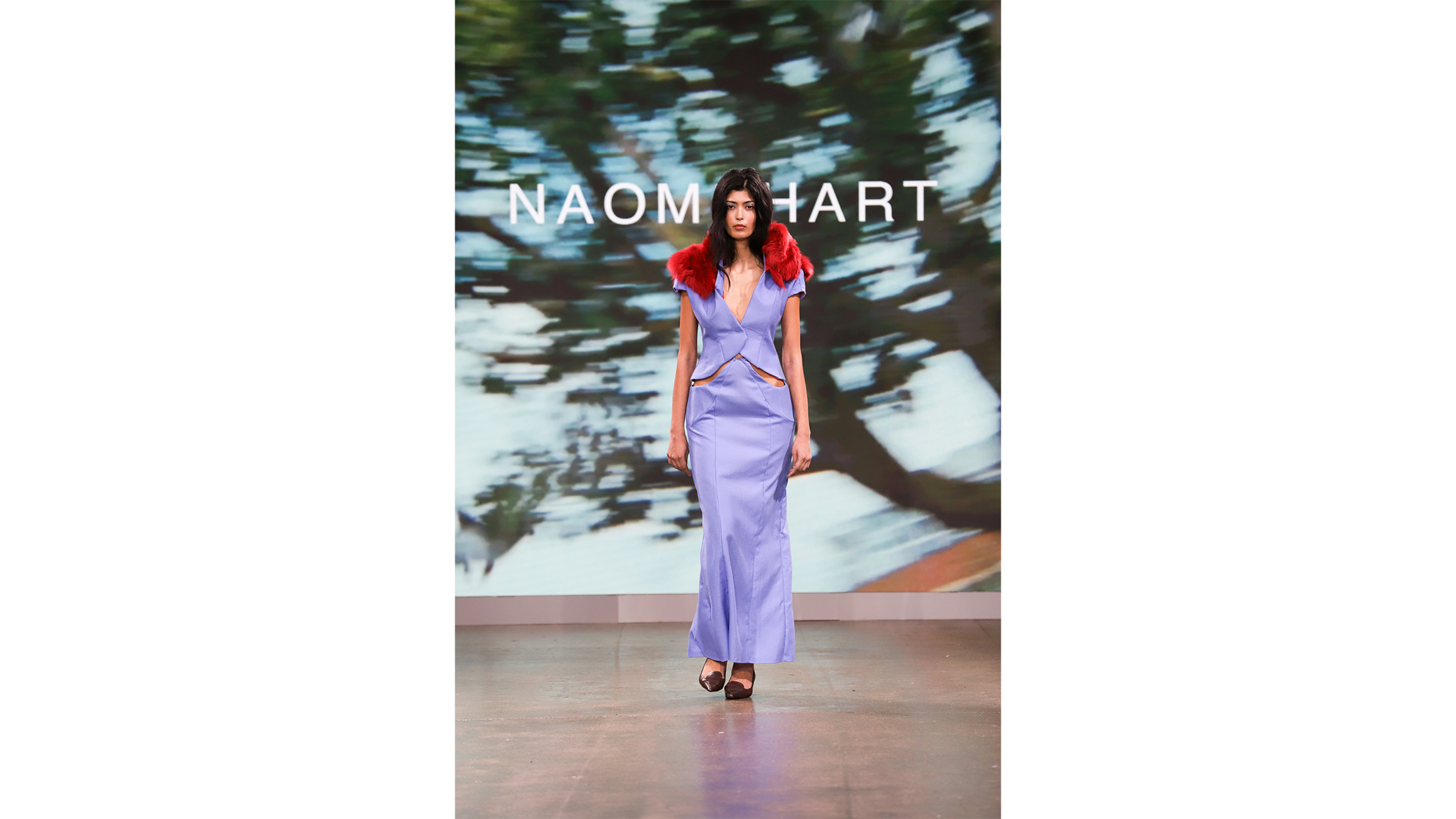
Then came the lilac dress, and the room's temperature shifted again. A full-length column in cool lavender with a crossover V-neckline and slender cut-outs at the waist — elegant, almost bridal in its length and composure — disrupted at the shoulders by a flush of deep crimson fur. Pony-hair, from the look of it, plush and unapologetically tactile against the smooth satin-like fabric beneath. It was the collection's most playful collision: pastoral softness meets animal warmth, restraint meets the thing it can't quite contain. Hart grew up in the British countryside, close to her father's creative practice, and though the press materials don't specify what he made, you could feel the evidence in the work itself — a comfort with texture, with the weight of real materials in the hand, with the idea that beauty doesn't have to be refined out of its wildness to be taken seriously. Every garment in the collection is handmade through a small scale production process, and selected pieces are available to rent — a quiet commitment to circularity that Hart treats not as a marketing line but as an extension of the same philosophy: own less, hold more.
Hart admitted backstage that self-doubt is a permanent companion. "I always doubt myself," she said, and the admission carried no performance, no false humility — just the flat honesty of someone who knows the feeling well enough to name it without flinching. Her message to emerging designers was similarly unadorned: keep making things, and trust yourself more. "The speed of everything — it's chaotic, there's things flying around everywhere," she said of the industry she is choosing, deliberately, to move through at her own pace. "The way to find something is you just need to slow down. There's a lot of beauty in that." It was a statement that could have sounded like a platitude from anyone else, but from a twenty-something designer who hand-cuts every pattern and built an entire London Fashion Week collection in a fortnight, it carried the full weight of practice.
As the final model disappeared and the projected trees returned — branches blurred into watercolour, light filtering through digital leaves — the room held its pause a beat longer than fashion week typically allows. What Hart had staged was not a collection about rejecting the world's noise, but about choosing what to let in. The frayed blazer, the sculptural red wings, the crimson fur against cool lilac — none of it was quiet in the conventional sense. It was quiet the way a held breath is quiet: full of everything that comes next. In an industry that rewards the perpetually visible, Hart is making a case for the sovereignty of the partially revealed — the garment that lets you in through a cut-out rather than a billboard, that earns your attention through the weight of its fabric rather than the volume of its announcement. The willow, after all, does not compete with the oak. It bends toward the water, and the water, without being asked, receives it.
Photography by IDEA PR
Article by Aayush Anima Aggarwal, Contributing Editor, PhotoBook Magazine
Tearsheets by Daniel López, Art Director, PhotoBook Magazine
*Images Courtesy of Naomi Hart
RELATED STORIES