The Plasticity of Identity: Roy Luo’s FIT MFA Collection
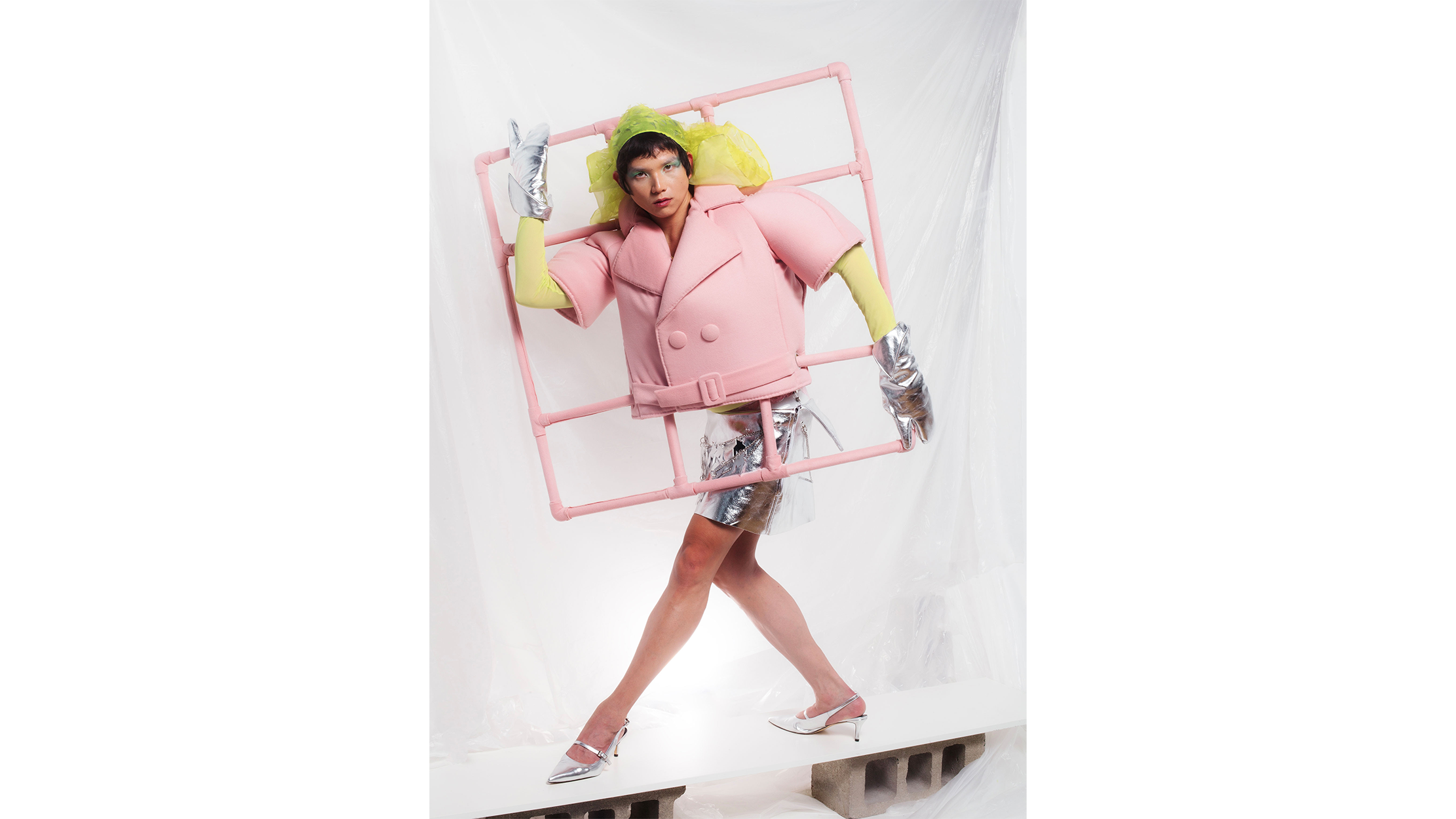
Plastic is rarely asked to explain itself. It imitates, replaces, reproduces, and reshapes, slipping into everyday life until its artificiality becomes almost invisible. In Self-Assembly Required, FIT MFA designer Roy Luo uses this contradiction as a starting point for examining gender, identity, and the performances through which the body is understood. Informed by Roland Barthes’ writing on plastic as a substance defined by its capacity for transformation, Luo draws connections between synthetic materials and the ways gender is constructed, expressed, and consumed. Lingerie-inspired trompe l’oeil, exposed intimates, and sculptural forms resembling injection-molded parts bring these ideas into physical form, while PVC, latex, wool, and leather take on unexpected roles through experimental textile development. Childhood memories of toys and dolls also inform Luo’s fascination with the boundary between the real and the artificial, grounding the collection’s theoretical questions in a longstanding interest in play and imitation. Rather than treating each look as a finished statement, Luo builds a visual language through recurring details and interchangeable pieces, suggesting that identity, like the garments themselves, remains open to reinterpretation and reassembly.
What was the starting point for your MFA collection, and what initially made you want to explore that idea through fashion?
My collection was a natural evolution of my interests in toys and constructing my own methods of play through design. I was drawn to a Barthes quote on the notion of early plastics as an “alchemic” medium, for its ability to be anything. A lot of the textures that intrigued me were synthetic, something so moldable yet odd in the context of fashion. I think those contradictory material dialogues set up an interesting way to approach textiles, whether hard or soft, in their relationship to the body.
Your collection brings together a specific set of personal, cultural, historical, or conceptual references. How did your research evolve as you moved from an idea into an actual collection?
Research is something that grows and evolves with a body of work, and it can come from unexpected places. For example, a lot of the Casa Susanna references were pulled from a small exhibit at the Met that I happened to walk into. Their gender performances became a direct throughline for the performance of plastics around the same era, as intimate vessels of domestic performance. I thought of performance or this idea of artificiality in multiple aspects, such as seeing the costumes from Velvet Goldmine at the Museum of Moving Image. Or referencing the injection-molded frames from research developed in another class where I chose to study Jun Takahashi and Gundam robot kits. I think it’s important as a designer to actively engage in research and bridge these points of reference back to actual theory. Being receptive to new research is also crucial. I tend to throw away a lot of ideas as I design, but the ones that stick around are the ones that I can bridge back to my central concept.
What role do your personal experiences play in your design practices, and how much of yourselves do you see reflected in these collections?
So many of my early childhood interests were centered around toys, especially play centered around vinyl figurines (Littlest Pet Shop) and dolls. These were often gendered toys that, much like fashion, were assigned and coded a certain way, but brought about a more imaginative form of play. I always thought of fashion in this manner, a performance, and often these dolls were plastic imitations of “the real”. This relationship between the real and artificial has always been a point of interest in my work, whether realness is something prescribed or intrinsic to an object. I also think a lot of my early arts education, visiting museums a lot, and being receptive to media has helped with the more critical point of view I bring to my work. I don’t see my collections as a direct reflection of myself, but rather a reflection of how I see the world. I need that extra degree of separation to allow for nuance, as no one really designs in a vacuum. I couldn’t have made this same collection without the same relationship to my personal experiences as I have now.
How did you all translate the central concepts of your collections into something physical through silhouette, material, color, construction, or textile development?
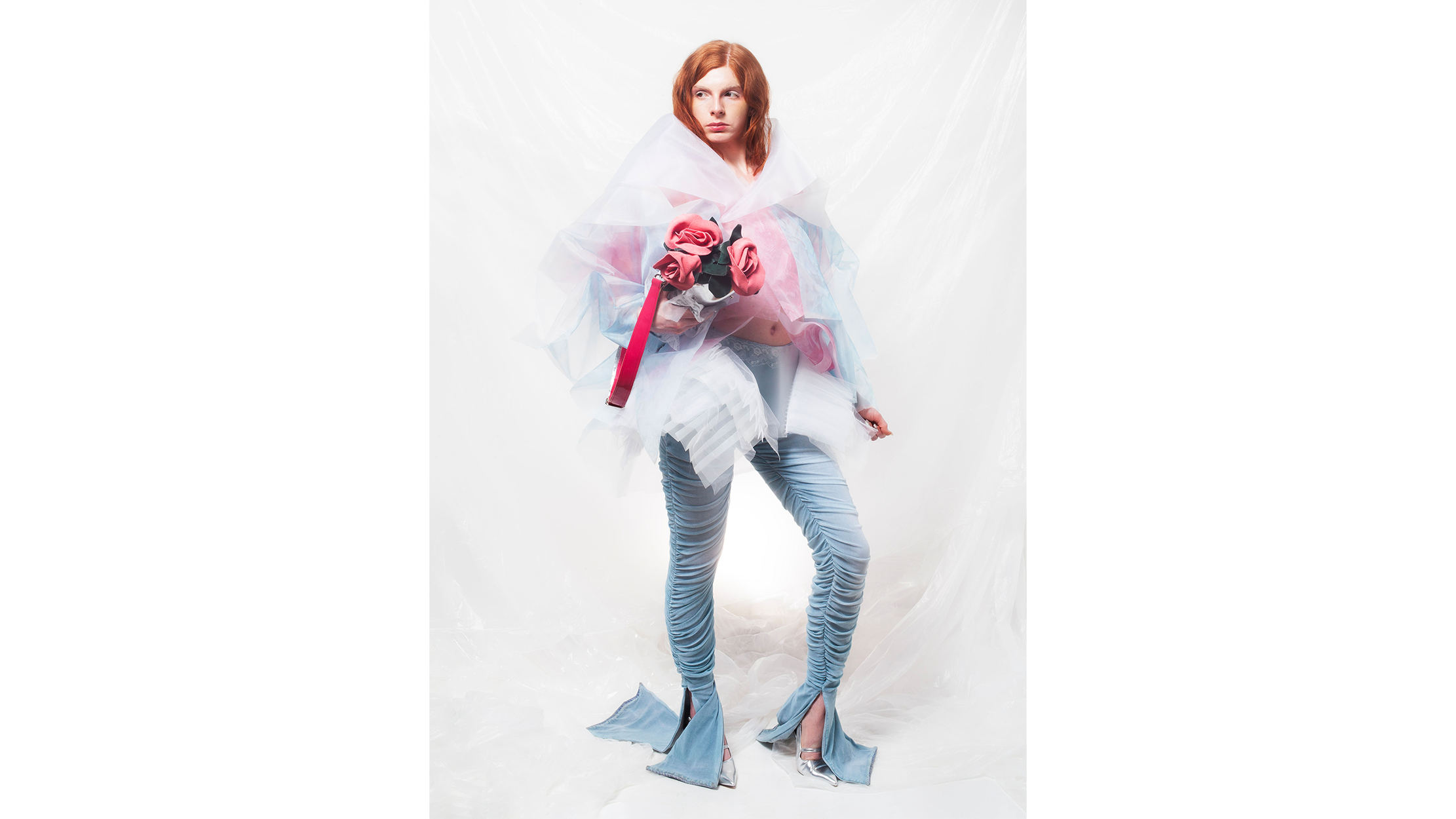
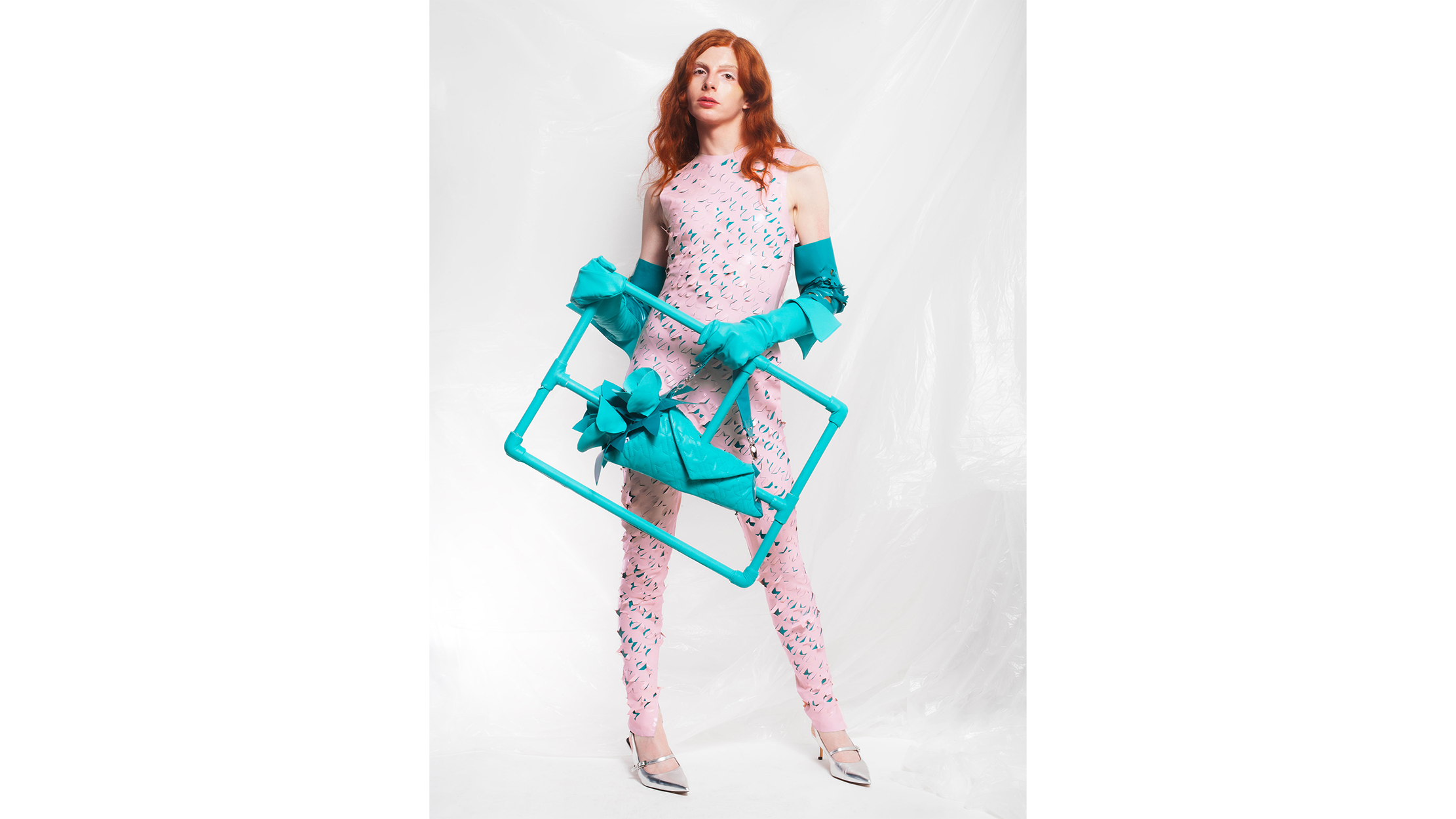
The central concept was explored through multiple methods. I wanted to explore gender performance using lingerie as a code, bringing the interior spaces of performance outwards. There’s this relationship between the domestic space as feminine and the masculine space as outward performance, spaces of capital. So through this subversion, I played with creating trompe l’oeil underwear pieces, combining briefs and panties, etching and embroidering onto unconventional materials, and subverting codes of menswear through more delicate fabrications like this vinyl-cut PVC I developed. I also found irony in the material notion of exploring plasticity: this idea of a synthetic material that has infiltrated everywhere in fashion as something intimate, bonding materials like polyester organdy together with a sonobond machine or gluing my latex pieces together.
Was there a particular garment, technique, material, or look within your collections that became especially important to your overall story? Why?
It became important to me to have a visual element repeat in multiple instances across different materials, rather than designing in silos of looks. One particular inspiration was creating garments with the look of injection-molded parts with bars and frames. It became such a striking code in the collection that I loved repeating different variations from wool to leather. It really became crucial to the central idea of Self-Assembly Required, which is taking these plastic, mass-produced ways of performing identity and assembling new meaning from them.
Many of the collections in this graduating class engage with larger ideas around identity, culture, memory, the body, technology, or the environment. What do you hope viewers take away from your all’s work beyond the clothes themselves?
I want this collection to be understood as a satirical critique of material performance, and for that to happen, the textiles cannot be taken at face value. I’ve had guest critics turn their nose right away at the material nature of the collection, without the chance to critically engage with the nuance of my work. I’ve also had critics who deeply understood the theoretical links I was building between gender performance and the performance of plastics in the everyday and these themes of “realness”. I think it also boils down to how vast fashion is at the end of the day and what we choose to engage with in the medium, whether commerciality or something more artistic, along with the worldview you bring. Research goes beyond the visual and it goes beyond the material, and that’s how I often approach my work, as well as understanding the works of others.
Was there anything about the processes of developing your thesis collections that challenged an assumption you initially had about your own design practices?
I think I challenged myself and really changed the nature of how I design throughout this process. I had the challenge of designing ten looks, and it was the first time I considered designing through individual pieces, rather than a head-to-toe look that would only work on its own. It was important for me that every piece had something else to pair back to or call back to; again, at the end of the day, it is about assembling something new out of what’s given to you. I’ve definitely expedited the way I create as well as established a new perspective on my collections as something alive, and less so finite. By this I mean, I never stop designing of course, but it’s important to bring a comma to a work and carry over the ideas you still want to explore.
How has your time at FIT changed or expanded the way you think about fashion and your role as a designer?
FIT has expanded the way I thought of fashion in New York, at least compared to Canada, where I’m from. There’s so much I learned in creative conception and development, as well as a more solid business perspective, through my classes and projects. I think FIT has helped in my introduction to the industry in New York, and I’d love to see where that grows.
What do you think makes your design perspective distinctly your own, and how has that perspective evolved throughout your MFA?
My design perspective has always been situated in kitsch. I love bringing these weird, sublime ideas to my work and always grounding them back to theoretical concepts, and that’s definitely primed me well for this MFA. The color stories and material languages I develop are nuanced, and I think the MFA has made me more tuned into my perspective. I wouldn’t call it an evolution, but rather a better understanding of my point of view. I think through so many of our design and branding classes, you have a clearer, more succinct understanding of your design language and what you bring to the table.
As you move beyond FIT and begin the next chapter of your career, what do you want to carry forward from these collections, and what are you excited to explore next?
I want to bring forward a lot of the hard skills I developed in this collection, the rapid prototyping as well as the design codes I’ve established. Right now, I’m questioning my own relationship to labor. I tend to exhaust myself as I create, yet it’s something that perpetually drives new work. This has been inspiring a new collection in the works. I’m debuting a Pre-Fall collection this October in Vancouver, which I hope to grow into a New York debut by February. I’m always inspired to create new work based on my experiences.
Your collection explores “gender plasticity” through the material idea of plastic as something pliable, transformative, and imitable. What drew you to plastic as a metaphor for gender and the body?
I was inspired by Roland Barthes, stating, “plastic...[as] the stuff of alchemy [and] the transmutation of matter. so, more than a substance, plastic is the very idea of its infinite transformation; as its everyday name indicates, it is ubiquity made visible.” This idea of ubiquitous everyday objects and the idea of performance was a direct throughline towards gender performance. Plastics were developed to replace a lot of these more expensive material goods like wood and metal in the 50s and 60s; thus, it became a material of middle-class domesticity. It kind of was intrinsic to the gender performances of trad-wives if you think about it in the context of Tupperware parties and plastic lawn flamingos. It also is such a queer material in the more theoretical idea of imitating the “real” and existing as an “other” medium. Queerness is so defined by plastics through the “realness” performed in ballroom or the synthetic ways gender is performed in silicones and dress. Our bodies are plastic in this sense, in the way they are open to “infinite transformation,” to quote Barthes.
You describe the body as a product and explore reproduction, embodiment, and intimacy. How did those ideas influence the actual construction of the garments?
Reproduction became a crucial aspect of my work as I repeated multiple design elements in various mediums, in the very nature of plastics to be reproductions of expensive goods. I had taken the same lace underwear pattern and replicated it through printing, laser engraving, and embroidery. These intimate objects, often close to the body, are exposed or flashed in this collection through garments with open backs and levels of transparency. I defined the body as a product in its relationship to consumption; the clothes in this collection afford new ways of performing for consumption in the ways they blur or define gendered dress. This also influenced the construction of my garments in new manners, such as bonding in latex or heat bonding PVC with polyester organdy on a Sonobond machine. As a designer, I allow the materials to dictate their methods of construction, and that often leads me down new pathways in design.
Interview by Emma Green, Assistant to Editor-In-Chief, PhotoBook Magazine
Tearsheets by Daniel Lopez, Art Director, PhotoBook Magazine
*Images Courtesy of FIT
RELATED STORIES