In Search of the Forgotten Feminine: Brigid Holzer’s FIT MFA Collection
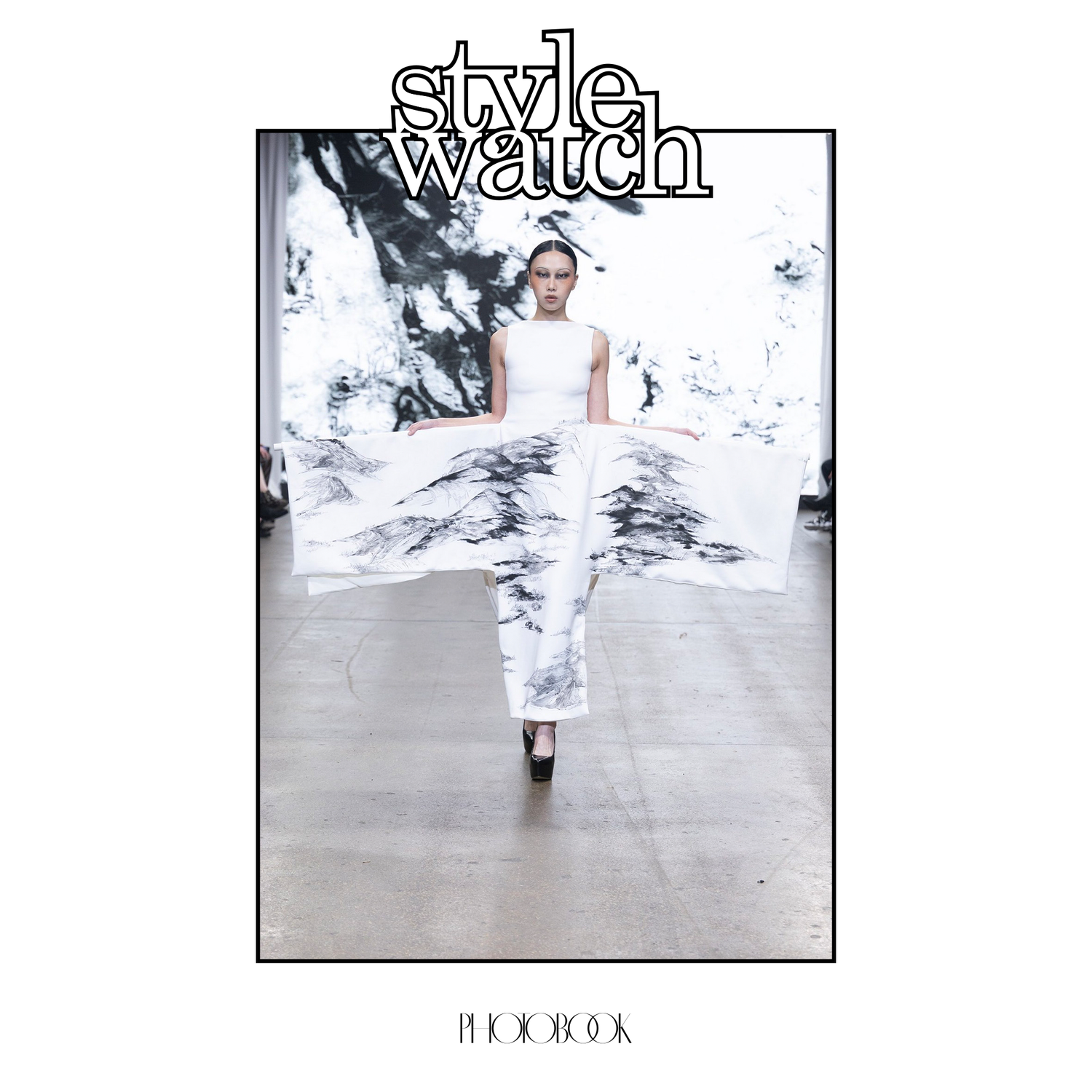
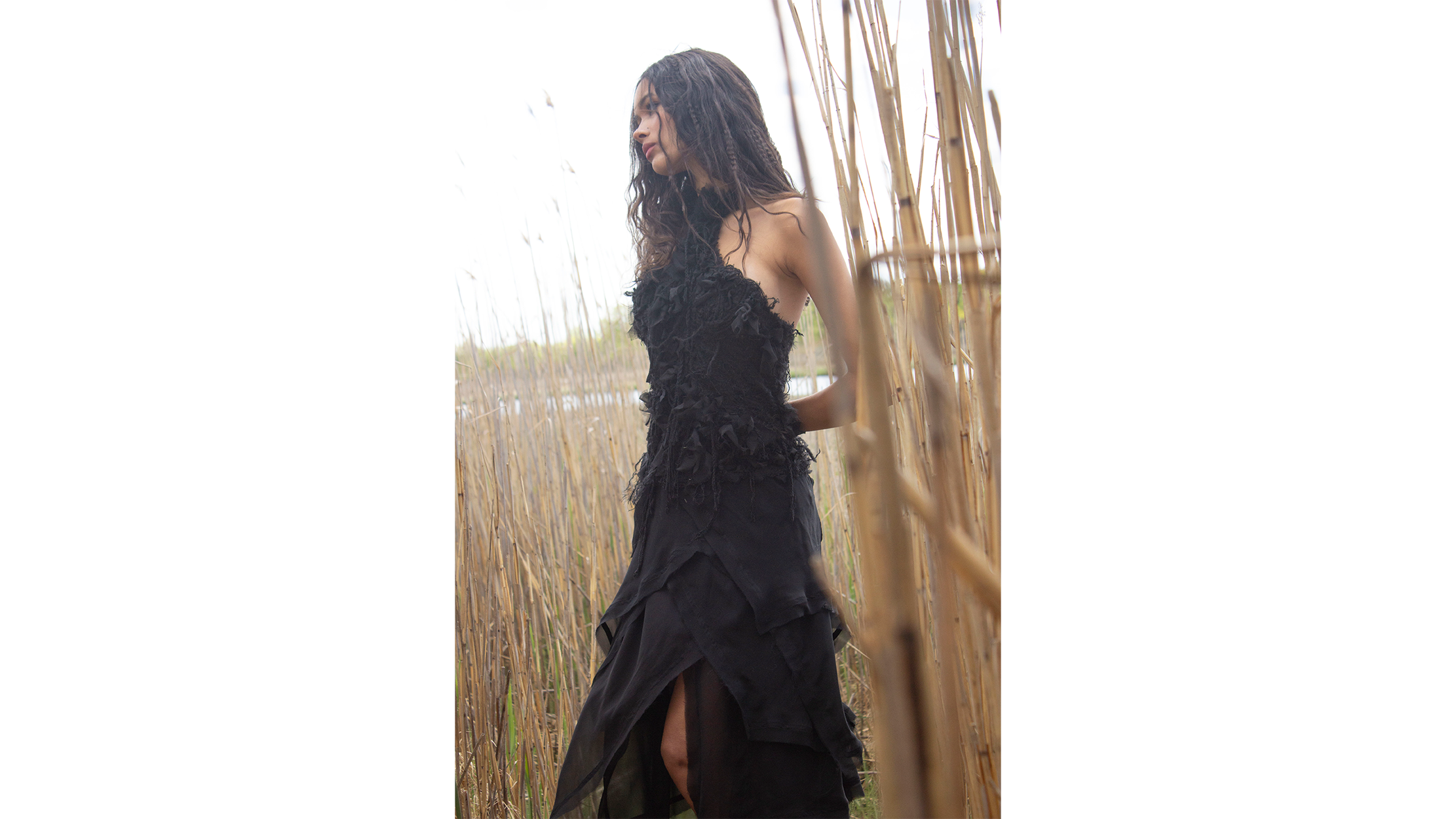
A name can outlive the story of the woman who once carried it, just as a mythology can persist long after its original meaning has faded. Maiden, an FIT MFA graduate collection by Brigid Holzer, follows these disappearing histories through the intertwined legacies of maternal lineage and pre-Christian Irish folklore. Inspired by the designer’s mother’s maiden name, Coughlin, and its Gaelic roots, the collection considers how generations of women and the beliefs they inherited have been obscured by time, patrilineal succession, and cultural reinterpretation. The resulting garments feel like fragments recovered from a half-remembered past: translucent silks evoke the fragility of memory, while sculpted felt and irregular silhouettes give form to something more ancient and elusive. Drawing on Irish wool traditions, feminine mythological figures, and an intuitive process that embraces the unpredictability of draping, Maiden treats clothing as a form of excavation. Rather than attempting to reconstruct history exactly as it was, the collection asks what remains beneath the surface—and what might emerge when we look again at the stories passed down to us.
What was the starting point for your MFA collection, and what initially made you want to explore that idea through fashion?
Maiden explores the ephemeral state of feminine beings and the forgotten mythologies of pre-Christian Ireland. The collection centers around my mother’s maiden name, Coughlin, derived from the Gaelic word “cochal,” meaning “descendant of one with the cloak.” The collection looks at how, through patrilineal succession, maiden names pass into obscurity. Maiden also looks at the broader pagan culture within Ireland, which has similarly fragmented through time. Within these fragmentations, I found space to reimagine the past through a sort of mythological revisionism. Reflecting deeply on my mother’s heritage, I wanted to look further into pagan myths and the misunderstood archetypal feminine entities that have become obscured and driven underground. Many seemingly lost practices are unconscious memories, hidden in plain sight. They have survived through adaptation: the goddess Brigid became a Catholic saint, and the religious realities of mythology survive through folklore and fairy tales. Maiden looks at what is lost from consciousness when stories, myths, and maiden names pass through generations, while simultaneously positing that fading is not disappearance but transformation.
Your collection brings together a specific set of personal, cultural, historical, or conceptual references. How did your research evolve as you moved from an idea into an actual collection?
The collection started as a focused personal and familial exploration of maiden names that deepened into a broader analysis of memory and mythology. I began looking at the name Coughlin as a personal reflection, specifically examining its fading through patrilineal succession. But within the fragmentation of maiden names, I found deeper parallels with Jungian archetypes and the mythologies of pagan Ireland. Organically, the collection broadened into a deeper exploration of pagan Ireland. As my concept broadened, my designs followed suit.
What role do your personal experiences play in your design practices, and how much of yourselves do you see reflected in these collections?
A classmate recently told me there's something Midwestern about my work. It wasn't how I wanted to describe myself, but I have come to recognize that our origins often live in our creative blind spots. Like the landscapes of pagan Ireland, these dreary, isolated spaces are where the human necessity for storytelling becomes exaggerated. Storytelling offers an escape from monotony, driven by a yearning for something beyond the familiar. This desire for reinvention and fantasy within a Midwestern childhood inevitably seeps into my work.
How did you all translate the central concepts of your collections into something physical through silhouette, material, color, construction, or textile development?
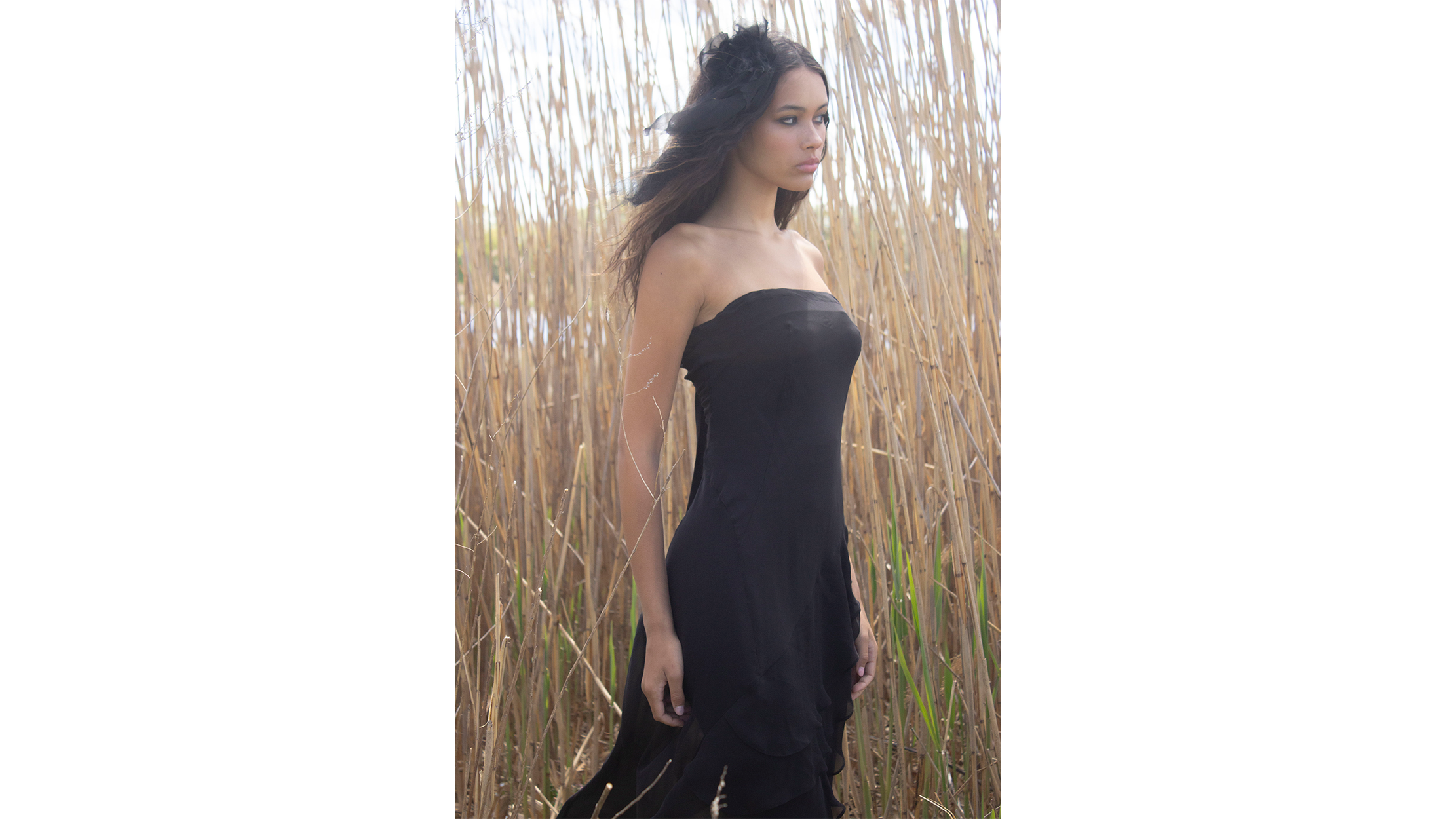
It was never a linear process. There’s a concept, a sketch, a drape, a pattern, and a material, and the lines between those dance about. My sketches changed constantly as I draped and developed new materials. Initially, my sketches and prototypes were grounded in the name Coughlin and its historical meaning: “one with the cloak.” Because of this, my early silhouettes reflected an obscured, cloaked figure. However, as my concept expanded to look at archetypes and cultural fading, those shapes became more abstract and fluid. I worked with slippery, transparent silks, a reference to the gossamer of memory. I cut on the bias to get liquid-like, dynamic drapes. I played with felting to create sculpted silhouettes. The collection was meant to feel natural, with organic asymmetry and rawness, and feminine in a spectral, chthonic way.
Was there a particular garment, technique, material, or look within your collections that became especially important to your overall story? Why?
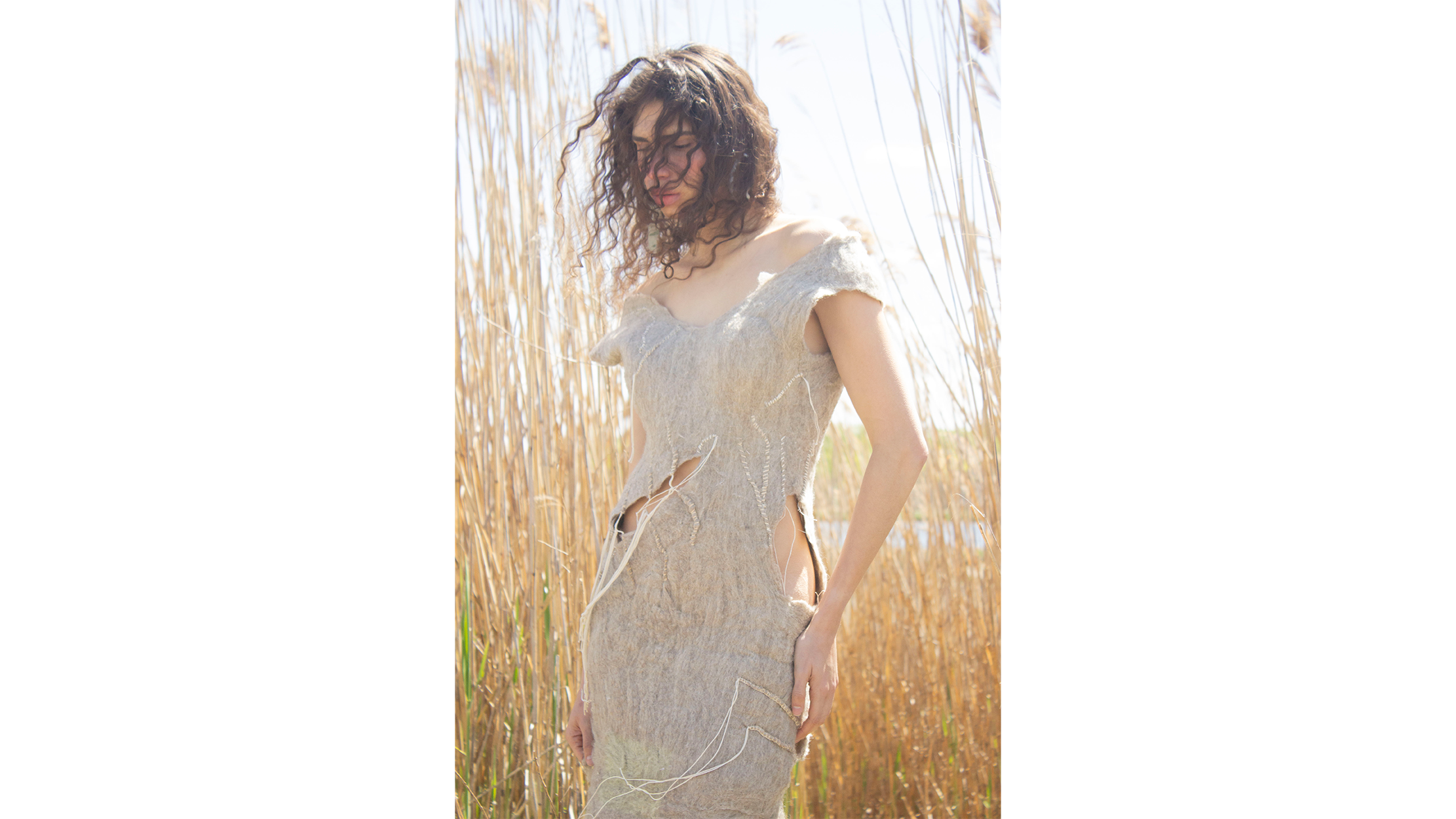
I found a connection to wool and felting. Wool has a deep tether to Ireland, but it also tells a story of fading. Once prized for its waterproof qualities, the global preference has shifted toward wool from other countries. The rainy, dark climate of Ireland will never allow sheep to produce that soft, desirable wool, and so it has sort of faded away, even though the image of wool lingers as a cultural symbol of Ireland. Tying back to the idea of names and familial lineage, my paternal grandmother grew up on her family’s woolen mill in Germany, brushing angora rabbits and collecting their fur to make knit garments. Her family name, Wollenschlager, traces back to the medieval wool trade, another thread in the history of maiden names. That tradition was left behind when she came to America. Felting was my way of working with wool; it allowed me to develop my own transformative connection to the material.
Many of the collections in this graduating class engage with larger ideas around identity, culture, memory, the body, technology, or the environment. What do you hope viewers take away from your all’s work beyond the clothes themselves?
To be curious about the past.
Was there anything about the processes of developing your thesis collections that challenged an assumption you initially had about your own design practices?
You can’t perfectly plan the ending.
How has your time at FIT changed or expanded the way you think about fashion and your role as designers?
I felt more attuned to materiality. Through fibers, dyes, and manipulations, there is a necessary storytelling to be done. In Maiden, I was drawn to creating a visual counterbalance between materials and silhouettes, specifically using felt in a way that felt light, or dark, raw textures in a way that felt feminine.
What do you think makes your design perspective distinctly your own, and how has that perspective evolved throughout your MFA?
My design perspective in this collection centers on reimagining the past through a personal lens. While the subjects I explore, such as memory, lineage, and myth, are universal, my recollection of them is intimate and fractured. Maiden looked at how collective memories can become fragmented as they are unconsciously carried through generations. Our personal perspectives shape how these memories and stories are retold and imagined. Throughout my MFA, this perspective has evolved from a reflection of history into a tactile exploration. These fragmented, ancestral memories directly shape the raw textures and irregular silhouettes of this collection.
As you move beyond FIT and begin the next chapter of your career, what do you want to carry forward from these collections, and what are you excited to explore next?
The main revelation I am carrying forward is a dedication to curiosity. I think of Maiden as my stepping stone. From it, I intend to keep exploring materiality as a means of storytelling, and storytelling as a personal way for me to reimagine the fragile memories of the past.
With Maiden, you look at femininity through the mythology of pre-Christian Ireland and the history of the maiden name. What drew you to the idea of the name—and what can be lost when it is replaced through patrilineal succession?
Maiden allows me to look backward as an observer, curious about women of the past and what they surrendered. I am fascinated by the maternal names shed and forgotten through centuries of patrilineal succession. The focus of the collection isn’t just a maiden name replaced; it’s the memory of a woman’s daily rituals and her essence. I am interested in how the histories we inherit are shaped by the people who record them, and how the lived experiences of feminine entities and the beliefs of pre-Christian cultures can become obscured or misunderstood over time. This extends into the mythology of pre-Christian Ireland. Archetypes like the Banshee, the Selkie, and the faeries have been reimagined through generations, sometimes becoming flattened into modern fantasies and tropes. These figures once belonged to living belief systems and offered ways of understanding the human experience. As the original contexts of these beliefs recede, there is space to reimagine what has been lost and what we have unconsciously carried forward. In developing my designs, I drew inspiration from psychologist Marie-Louise von Franz and her interpretation of fairy tales and myths as the purest, most stripped-down expressions of the collective unconscious. Exploring these misunderstood feminine entities alongside the erasure of the maiden name is a form of excavation. I am interested in how these lost histories, though obscured from our conscious awareness, still unconsciously carry through, linger, and live within the next generations.
Your design process is described as intuitive and fluid, almost like watercolor. How did that intuitive process interact with the more researched historical and mythological foundations of this collection?
Watercolor has always fascinated me because it was the medium my father painted with, but I can best describe my creative connection to it through the words of artist Leonor Fini. She once noted: “After painting at an easel, which I find so severe, almost like a guillotine, I find great freedom in working with watercolors.” She spoke of how you never truly know what the final piece will be, how even accidental splotches serve as unexpected inspiration. Fini described the dynamic nature of the medium as a “tussle between [painter and the water]. The water runs away. So I strike it, stalk it, try to make it obey me. Then, in its disobedience, it forms things I like.” In my design process, traditional patternmaking is the severe guillotine, with its precision and demand for close attention. Draping, however, is my watercolor, which can be done with greater freedom. On the dress form, the fabric acts like water: it refuses to obey perfectly, but within that defiance, it creates forms I like. This intuitive tussle is how the foundations of Maiden materialized. I didn't approach the creation process rigidly. Instead, I let the evocations of lineage and the feminine archetypes of Irish folklore guide my silhouettes and material choices.
Interview by Emma Green, Assistant to Editor-In-Chief, PhotoBook Magazine
Tearsheets by Daniel Lopez, Art Director, PhotoBook Magazine
*Images Courtesy of FIT
RELATED STORIES