Behind the Iron Curtain: Egor Belykh’s FIT MFA Collection
For Egor Belykh, fashion is a way of preserving the stories that shape us. At the center of the FIT MFA graduate’s collection is his mother, Nadezhda, whose resourcefulness and enduring relationship with fashion in late-1980s Siberia became the foundation for a deeply personal exploration of memory, identity, and resilience. Growing up in the Soviet Union, she reworked her late father’s uniforms and studied vintage patterns to create a wardrobe of her own, finding a sense of self-expression in dressing well despite the limitations of her circumstances. Through family photographs, Soviet military references, and the geometric principles of Russian avant-garde art, Belykh transforms these personal histories into a contemporary ready-to-wear collection that balances the strength of structured tailoring with the softness of fur, lace, and silk. Drawing on the symbolism of the Iron Curtain, his work considers the tension between protection and vulnerability, hardship and hope. At its heart is a tribute to the women who persevere, finding beauty and individuality in the act of carrying on.
What was the starting point for your MFA collection, and what initially made you want to explore that idea through fashion?
The starting point was my mother, Nadezhda, who had her self-described peak in fashion in the late 1980s. Growing up in a small Siberian town called Kurgan in the USSR, she would often have to upcycle her late father’s uniforms, study at night school, and work during the day so she could afford to dress up, because it meant a lot to her to look good. Going into my master's degree, I was self-reflecting a lot on the path of becoming a fashion professional and knew that the theme for the thesis had to be deeply personal. Russian women in Western media are often portrayed in a doll-like manner, and I wanted to, instead, show a true, strong, and stoic beauty like that of my mother. I also knew it had to be ready-to-wear because I refuse to design a garment not meant to be worn long-term.
Your collection brings together a specific set of personal, cultural, historical, or conceptual references. How did your research evolve as you moved from an idea into an actual collection?
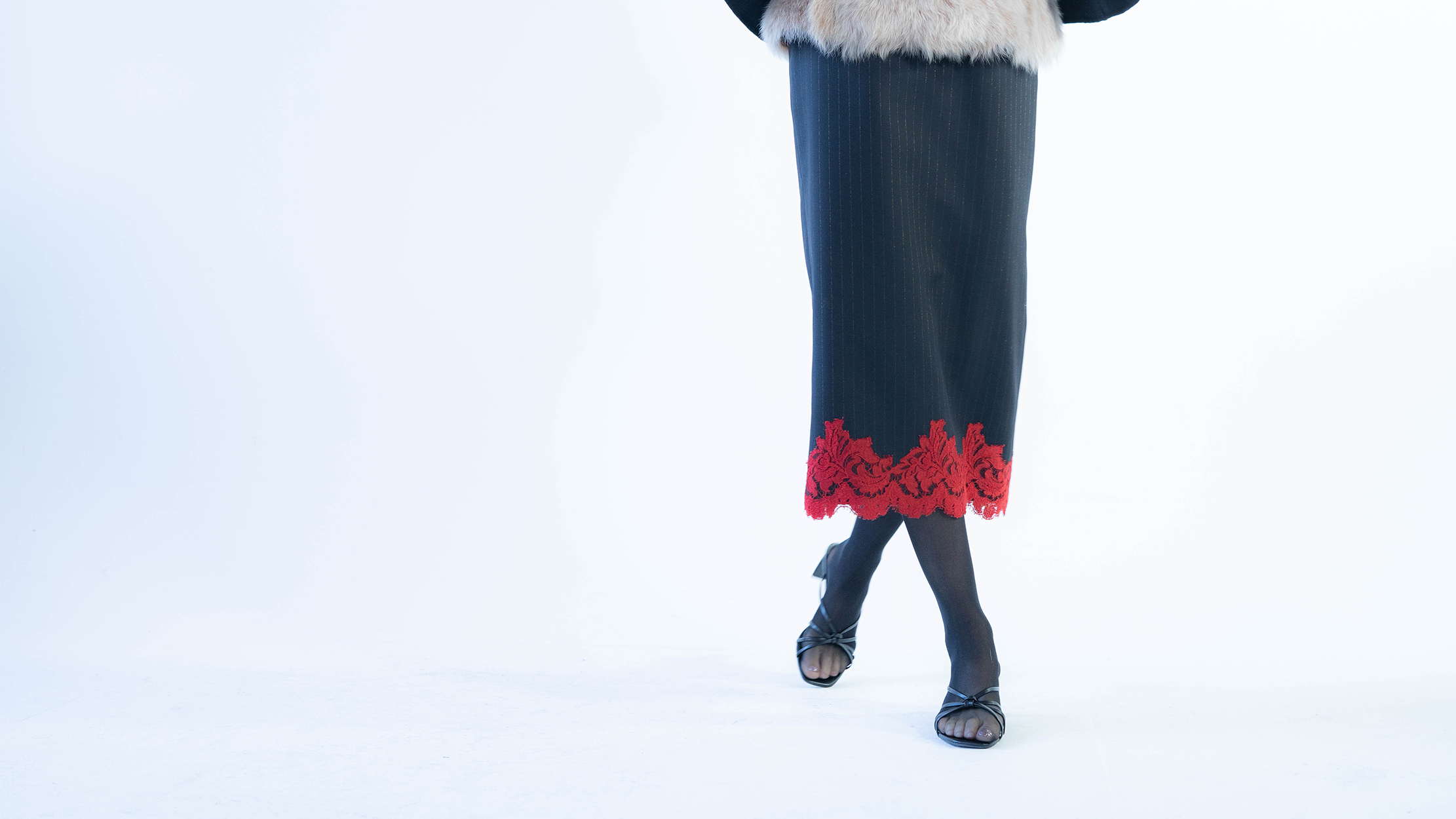
Looking through images of my mother, besides her obvious love for all things leather, a strong sense of complementary colors and how she worked them into her outfits became apparent. It reminded me of the artists of the Russian avant-garde, namely Rodchenko and Malevich. “Rodchenko reduced painting to its bare logical and material minimum by covering three separate canvases in single flat applications of the primary colors—red, blue, and yellow.” (MoMa) and with that, Rodchenko proclaimed “the death of painting.” I feel similarly about the fashion industry today; the pace has increased so much, the look of today has become homogenized, and the silhouette has become obsolete. For instance, we don’t talk about anything from the 2010s or 2020s as we do about the 1980s power shoulder, or the 2000s Y2K. Therefore, I knew I had to use the very strong and stoic photo references from the family albums. In combination with the study of 1980s vintage patterns from Burda magazine that my mother read, as well as historical references such as military uniforms of the time, the silhouettes for the collection were created. Following constructivist studies, in the absence of form, I decided to focus on texture through additions of fur and lace that were also heavily present in the references. Those textures were then carefully placed on the silhouettes, referencing paintings like Sportsmen (1931) by Kazimir Malevich.
What role do your personal experiences play in your design practices, and how much of yourselves do you see reflected in these collections?
All of the work I do is a reflection of myself. It is the only way to stay true to this craft and have the passion to keep going for me. I do not shy away from difficult topics and try to bring as much of my culture into the project. For instance, another one of my references was Christo, an Eastern European artist who had moved from behind the Iron Curtain to the West, which is similar to my upbringing. I always think of myself as a Russian designer working in the United States; the context is very important. While my muse is my mother, I see my customer as global. Having had some work experience in luxury fashion, I also tend to play to my strengths here, with a focus on tailoring and quality garment construction.
How did you all translate the central concepts of your collections into something physical through silhouette, material, color, construction, or textile development?
Nadezhda, my mother, became my muse. Family albums with photos of her and her friends were translated into silhouettes. Fabric choices were also largely made based on what she was wearing: leather, fur, wool, with the addition of a few luxurious silks that she could not afford. Her love of primary colors in outfits, in combination with studies of constructivism, became a color story. Soviet uniforms were studied and reworked similarly to how my mother treated her late father’s garments. 1980s vintage patterns were looked at through constructivist lenses, often reducing or segmenting the panels of the pattern.
Was there a particular garment, technique, material, or look within your collections that became especially important to your overall story? Why?
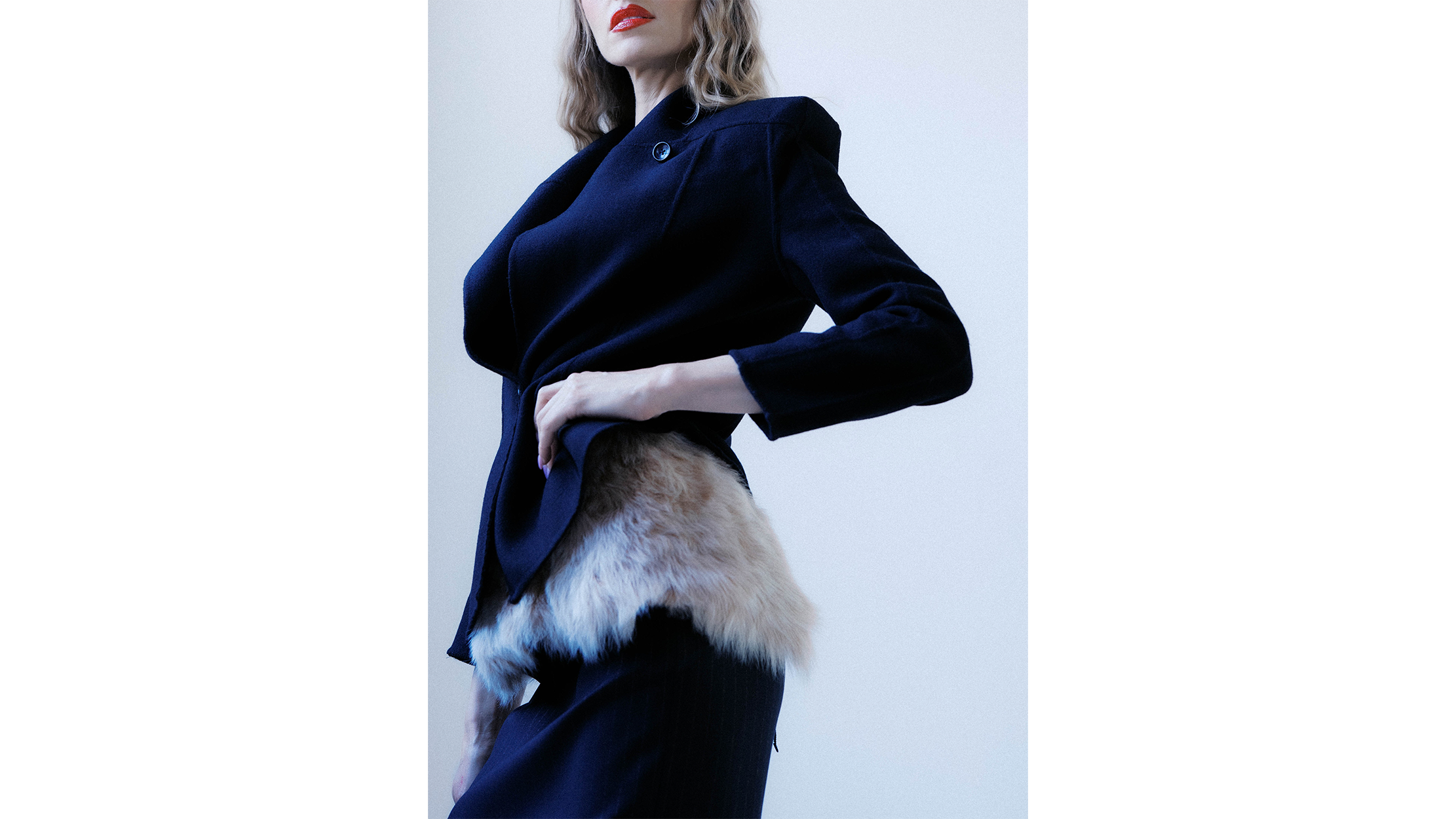
Natural fur. While a controversial material, I grew up with a mindset of it being a practical first. In my hometown, temperatures can go down to -45C some winters, and nothing can keep you as warm as a fur coat can. I tried to consider how this beautiful material can be used in milder climates, with a detachable fur collar on a trench coat, and a skirt piece that can be tied around your waist to keep you warm. I hope that feeling of warmth the material provides translates the motherly love I feel. The leather, on the other hand, provides a strong sense of protection for the outerwear, referencing the Iron Curtain itself.
Many of the collections in this graduating class engage with larger ideas around identity, culture, memory, the body, technology, or the environment. What do you hope viewers take away from your work beyond the clothes themselves?
While I took a more practical approach with my collection being ready-to-wear, following the pragmatism of the Russian avant-garde, I hope that editorial work translates the stoic beauty of Russian women I seek to portray.
Was there anything about the processes of developing your thesis collections that challenged an assumption you initially had about your own design practices?
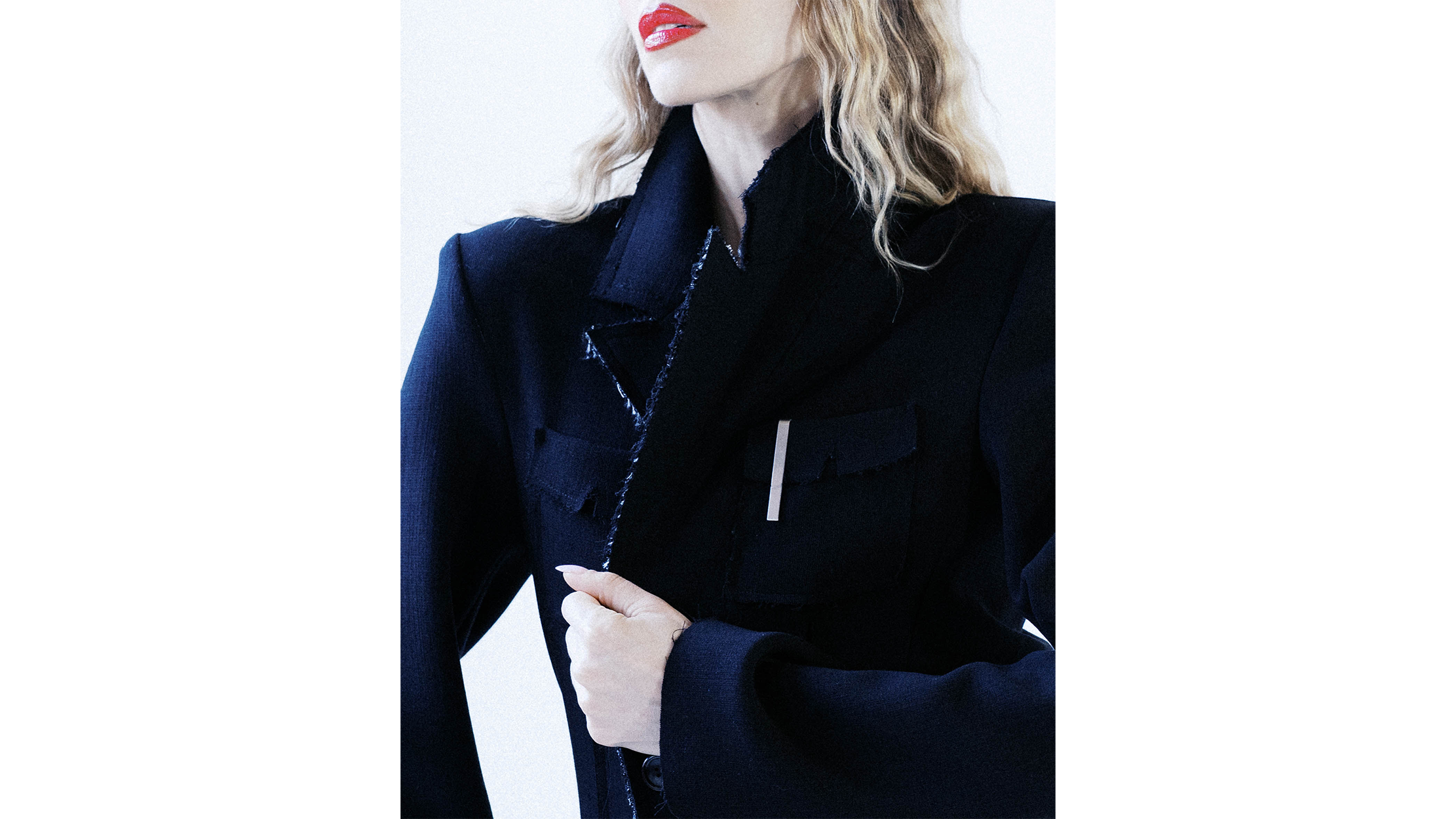
I consider myself a strong patternmaker. A lot of design processes happen through my alteration of historical tailoring silhouettes in 2D. For me, to break the convention and take my exploration in a different direction, I decided to redrape certain parts of the tailored garments on the form, focusing on segmenting the body, similarly to constructivism. This is how the intricate square shoulder pattern on the only double-faced wool jacket in the collection was created, taking a break from the conventional while respecting the original structure.
How has your time at FIT changed or expanded the way you think about fashion and your role as designers?
I have always been detail-oriented, and my previous roles within fashion were all technical. At FIT, I have been able to step back and look at the bigger picture. I created a brand for myself, with a much fuller and more complete creative vision. This foundation can serve me if I choose to open a business in the future.
What do you think makes your design perspective distinctly your own, and how has that perspective evolved throughout your MFA?
I think my upbringing was unlike anyone else who has been in this program before; therefore, it was easy for me to just be myself and focus on the quality of my work. Going back to everything around me being reflected in my work, I think the shift in perspective happened through small things like conversations with the faculty and classmates; I can’t really put into words what changed.
As you move beyond FIT and begin the next chapter of your career, what do you want to carry forward from these collections, and what are you excited to explore next?
The hard truth is that I need to integrate into the industry and start making money; exploration is a lower priority on the list. I have great confidence in my skills, gained through both work experience and MFA. Right now, I am just excited to start learning more little things in the process that are not taught in class, following mentors that I hope to find in the industry.
You describe the Iron Curtain as both a historical reference and a metaphorical uniform for strong and hopeful women. How did you translate that idea of strength and hope into the garments themselves?
Hope-Nadezhda-is what my mother’s name literally translates to in English. No matter what hardship she faced growing up that day, she put on her primary colored uniform and persevered. While her name is just a suggestion of her character, she, to this day, fully embraces it. Similarly, my garments are merely a suggestion to the strong and hopeful women of today. I suggest the image of strength through the power shoulders of the 80s and uniform-like cuts; hope through the warming soft touch of fur, transparent silk scarves with a print of a rowanberry tree, native to my homeland, that stays bright red through the deadly winter freeze. The layering of textures, hard and soft, is a paradox of the Iron Curtain. The image of strength portrayed through the outfit is just a suggestion of the wearer’s character. The real strength comes from not losing the hope within.
You drew from family photographs and historical artwork; what did you discover through that research that surprised or changed the direction of the collection?
Even though I started with my mother’s photos, I found myself drawn to a lot of group photos in the albums. Combined with the idea of my mother reworking her late father’s uniforms for her to wear, I decided to look into menswear cuts that her friends were wearing in the photos, eventually leading me to study differences in vintage cuts I found in Burda, a magazine my mother used to get patterns from. It led to cuts that project more of a soft strength, for example, a large leather men’s trench but with shoulder pads taken out. Another example is a 1980s uniform jacket in double crepe that can also be worn as a mini dress, with a raw-edge finish as a nod to my grandfather’s uniform, reworked with my mother’s touch.
Interview by Emma Green, Assistant to Editor-In-Chief, PhotoBook Magazine
Tearsheets by Daniel Lopez, Art Director, PhotoBook Magazine
*Images Courtesy of FIT
RELATED STORIES