Beyond the Human Body: Yufan Song’s FIT MFA Collection
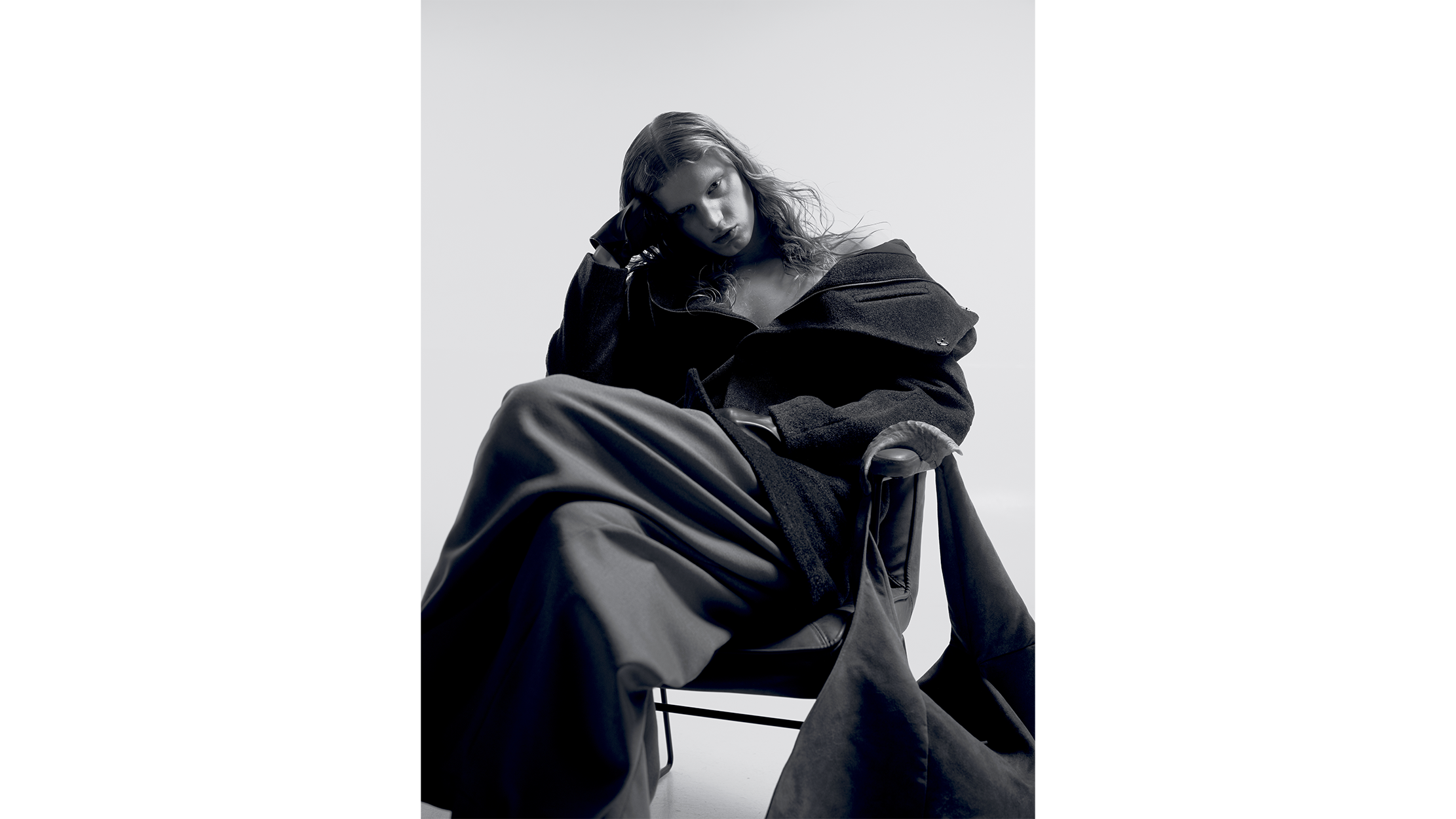
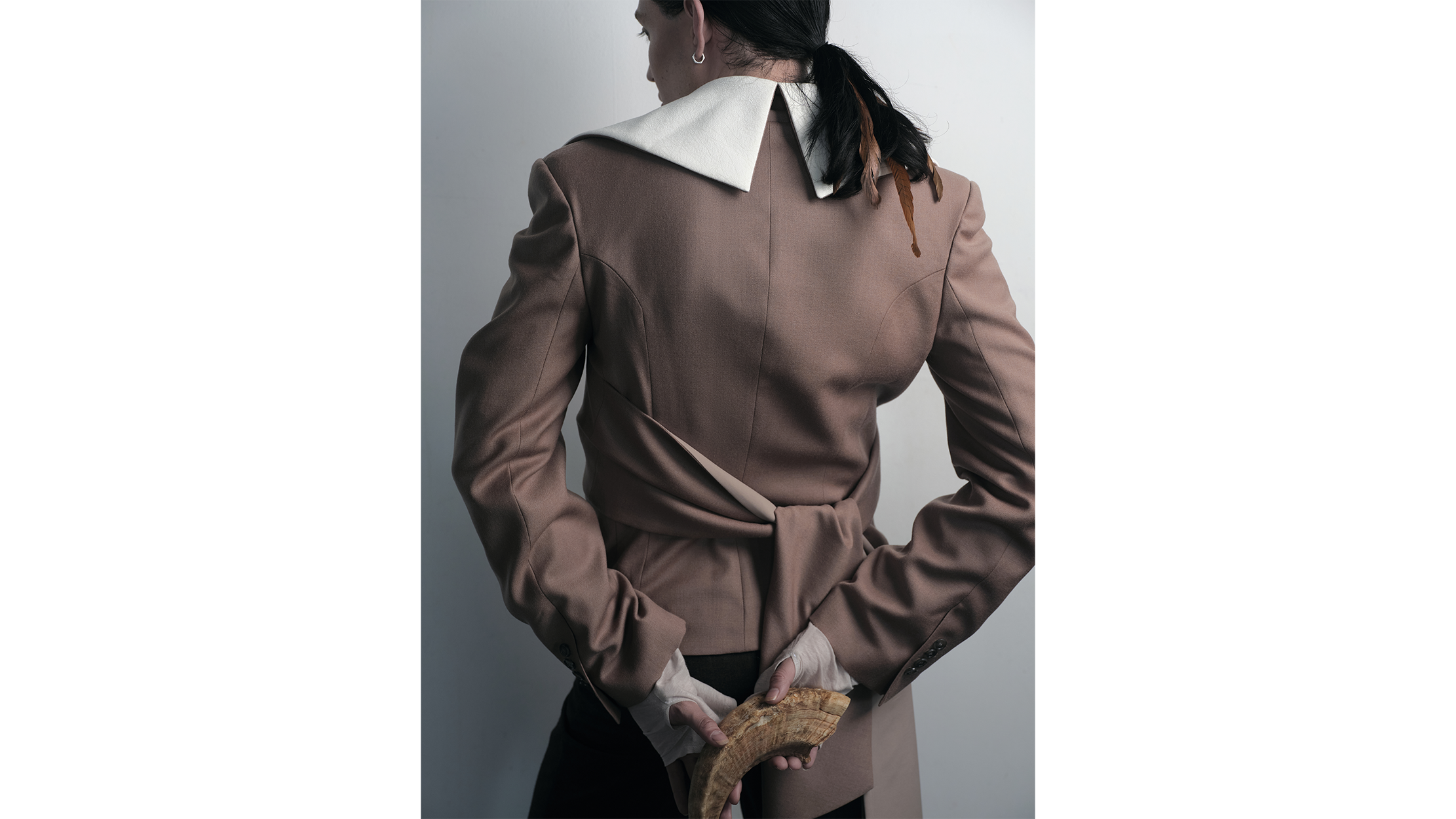
At the edges of cities, where industrial traces interrupt the landscape and nature begins to reclaim its space, Yufan Song finds the starting point for Symbiont Nature. The FIT MFA designer’s menswear collection considers what happens when the human body is no longer treated as the default against which every other form of life is measured. Informed by travel through transitional landscapes and a cross-cultural education spanning China, Singapore, Scotland, and the United States, Song’s research develops into a posthumanist inquiry into how humans and nonhuman species might coexist in an increasingly unstable environment. Centaurs and sirens offer more than mythological reference points; they challenge the boundaries separating bodies, while clothing becomes a kind of prosthetic extension, providing protection and possibilities for transformation. Through exaggerated proportions, experimental silhouettes, and contrasts between materials, Song brings these questions into the physical language of menswear without losing sight of how the garments function in everyday life. The result is a collection that moves between speculative thinking and ready-to-wear design, asking viewers to reconsider not only the relationship between fashion and nature, but also whose body we imagine clothing is meant to serve.
What was the starting point for your MFA collection, and what initially made you want to explore that idea through fashion?
The starting point for my MFA collection is a continuation of a research topic I have been exploring since my bachelor’s graduation collection. My inspiration often comes from traveling to diverse locations and observing the transitional spaces between natural landscapes and urban environments. I am particularly drawn to these “in-between” zones—places that exist somewhere between no-man’s-land and the urban environment—because they reveal both a raw ecological presence and visible traces of human intervention and industrial activity. This led me to think more critically about fashion as an interesting medium for exploring this relationship because it is such a distinctly human-centered industry. Clothing is designed around the human body, while also reflecting systems of production, consumption, and industry that separate us from the nonhuman world. Through menswear, I wanted to question this separation and explore what happens when human and nonhuman references begin to overlap. The collection therefore became a way for me to translate this tension into silhouette, material, and the physical relationship between the garment and the body.
Your collection brings together a specific set of personal, cultural, historical, or conceptual references. How did your research evolve as you moved from an idea into an actual collection?
I have been focused on pattern making, tailoring, and the interaction of the wearer’s body and the structure of garments. My conceptual ideas are transforming into experimental directions, mainly working in those directions. And visual research could always build up my design universe upon the 3D working process.
What role do your personal experiences play in your design practices, and how much of yourselves do you see reflected in these collections?
Personal experience is where my practice begins, but not where it stays. My research and thesis collection started with observations I made while traveling between uninhabited landscapes and urban areas. I saw the fluid boundary between the artificial and the natural. Once the research begins, I deliberately distance myself from those experiences and examine the design process from an observer's perspective. I treat my own observations as source material to be questioned rather than a story to be told. From that position, I hypothesize about phenomena that might emerge in a post-humanist society and the challenges humanity may face in it. The collection is a speculative response to those scenarios. So what is reflected of me in the work is a way of seeing rather than a personal narrative: attentive to the environment, shaped by moving between cultures, and analytical about what I observe.
How did you all translate the central concepts of your collections into something physical through silhouette, material, color, construction, or textile development?
I’m interested in developing experiments that borrow from or respond to forms found in my original research, and then using the outcomes of those experiments as a way to visualize and further understand my ideas. In my collection, I explored body anatomy and the merging of human and nonhuman bodies, which led me to focus primarily on silhouette, proportion, and shape. Through manipulating and exaggerating the body, I was able to turn more abstract ideas into physical forms. At the same time, I considered how these experimental forms could exist as garments—how they might be constructed, worn, and interpreted on the body. For me, this process is where fashion sits between artistic expression and functionality: the garment can communicate a critical idea while still engaging with questions of wearability, construction, and the practical realities of fashion.
Many of the collections in this graduating class engage with larger ideas around identity, culture, memory, the body, technology, or the environment. What do you hope viewers take away from your all’s work beyond the clothes themselves?
We believe that aesthetics, values, and experiences are deeply personal, and that this subjectivity is central to the way we approach design. Across our class, different perspectives, backgrounds, and practices come together to create a body of work that reflects both diversity and inclusivity. More importantly, the collections demonstrate a high level of critical engagement with the world around us. Through our individual practices, we examine questions of identity, culture, memory, the body, technology, the environment, and our relationships to one another. Fashion becomes not simply an object or a garment, but a medium through which we can investigate, question, and respond to contemporary issues. We hope viewers take away more than an appreciation of the clothes themselves. We hope the work creates curiosity, encourages reflection, and opens up conversations around the ideas and questions embedded within each collection. Design as a form of expression and critical inquiry—one that can invite audiences to look more closely, think differently, and engage with the complexities of the world we inhabit.
Was there anything about the processes of developing your thesis collections that challenged an assumption you initially had about your own design practices?
During the development of my thesis collection, I initially planned to incorporate hardware directly into the garments to explore the relationship between human and non-human elements, particularly the contrast between organic human bodies and inorganic materials. I was very interested in pushing the design toward something more experimental and unconventional. While creating this collection, I realized that some of the concepts might not be suitable for ready-to-wear design. This challenged my initial assumption—that I could fully embrace avant-garde design concepts while also creating a commercially viable collection. It prompted me to rethink how to strike a balance between experimentation and practicality, as well as wearability, in my design practice. The process helped me understand that my design practice may need to exist somewhere between conceptual and commercial; I would explore unconventional materials and ideas within the experimental phase, and translate the outcomes into final design pieces.
How has your time at FIT changed or expanded the way you think about fashion and your role as designers?
During my two years at FIT, I had the opportunity to gain hands-on experience in New York’s fashion industry, meet people in various roles within the field, and learn that a seasoned designer must have a broad understanding of both business and design. I realized that even the most eye-catching and avant-garde designs cannot succeed in the long run if they are detached from sound business operations. It is essential to consider the relationship between design, the market, and the target audience, clearly assess one’s position in the market, and plan for one’s professional development.
What do you think makes your design perspective distinctly your own, and how has that perspective evolved throughout your MFA?
My design perspective is distinctly my own because it comes directly from my personal experience, and that experience also shapes my research direction. I was born and raised in China, then educated in Singapore, Scotland, and the United States. Moving between these cultures gave me a cross-cultural knowledge system and a heightened sensitivity to how people interact with their surroundings, including cultural, geographical, and even climatic conditions. At the start of my MFA, I used my individual project to examine how this identity and self-awareness had shaped my career journey and creative direction. That reflection moved my practice from personal observation toward broader questions about environment and coexistence. In my thesis collection, this developed into a posthumanist inquiry into the coexistence of humans and nonhumans. I examined how industrial activity affects nature and how we might live together in a more delicate balance. For me, the MFA was a progression from understanding who I am as a designer to asking what responsibility design has toward the systems it belongs to.
You imagine clothing as a living extension of a hybrid body, drawing from figures like centaurs and sirens. What interests you about blurring the boundary between human and nonhuman forms?
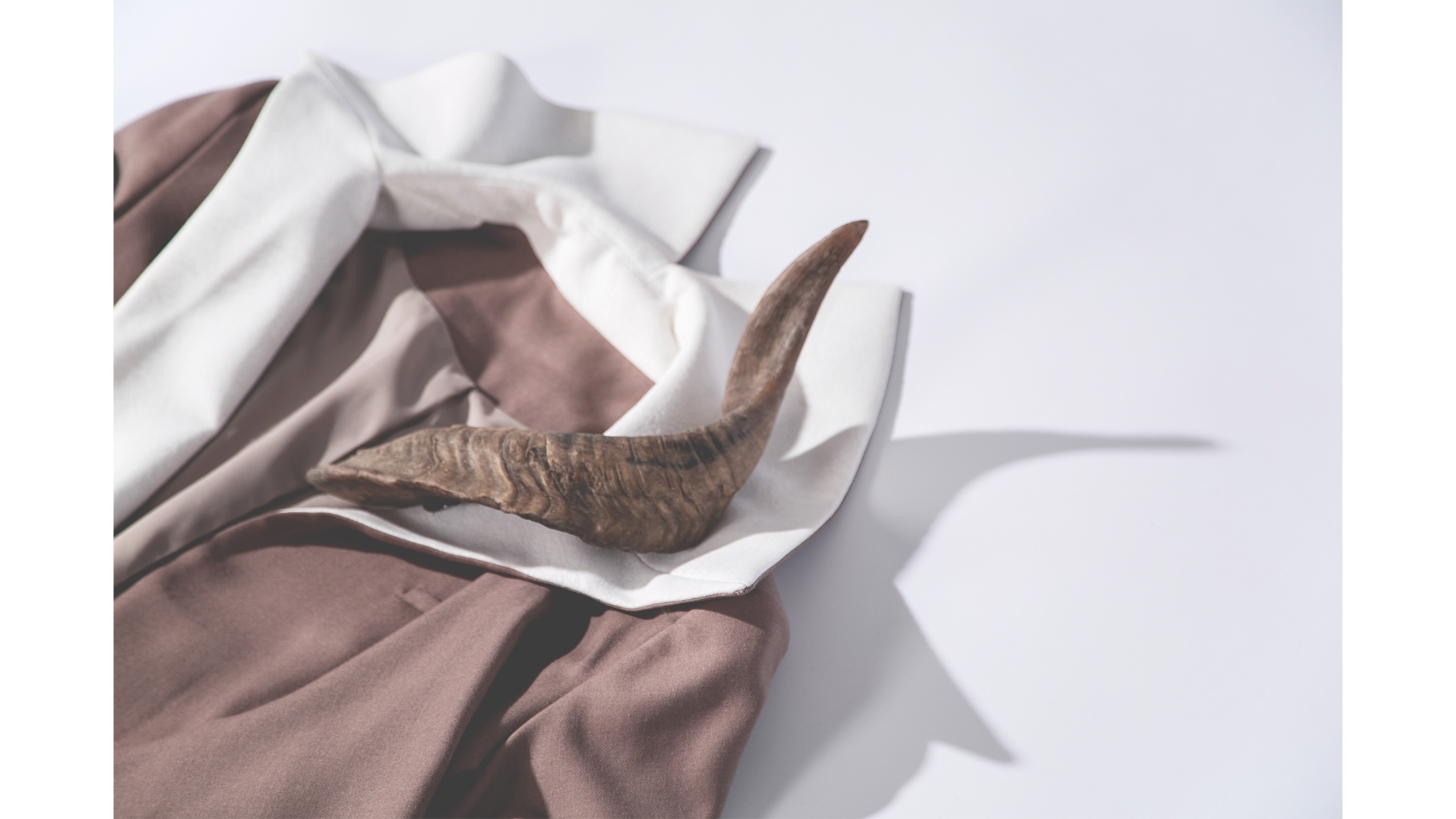
Throughout history, our definitions of the "non-human" have been based on human knowledge, whether biological, theological, or anatomical. Centaurs and sirens are products of that gaze: projections of human anxiety and desire onto other bodies, rarely allowed to exist on their own terms. What interests me is whether this standard is impartial, and what design can do once it is no longer taken for granted. Imagine a post-humanist, ecologically unstable future in which humans and non-humans face the same threats and modern technology can no longer buffer the difference. Many non-human bodies are better adapted to survive, with fur, scales, shells, and fat layers that regulate temperature, protect, and camouflage. By comparison, the human body is fragile and depends on external protection. Clothing is that protection: a prosthetic layer that has always compensated for what the body lacks. This is why I see clothing as a living extension of a hybrid body rather than as decoration or mere covering. Drawing on the centaur's fusion of anatomies and the siren's fluid form, I treat garments as an interface between species. By blurring the human/non-human boundary, I want to challenge the assumption that the human body is the default and every other body a variation.
You describe the collection as both conceptually driven and commercially viable. How did you navigate the tension between creating something radically experimental and something that could realistically be worn?
For me, conceptual ambition and commercial viability are not opposing forces. They operate at different stages of the design process. In the early stages, the concept drives research, silhouette, and material exploration without constraint. As the collection develops, I begin translating those ideas through the lens of ready-to-wear: fit, wearability, construction, fabrication, pricing, and the customer who will actually wear the garments. Because I always keep in mind that this is a menswear ready-to-wear collection, I never abandon the concept. Instead, it is refined into wearable form. The experimental idea might live in a cut, a surface treatment, or a structural detail, while the overall garment stays balanced and familiar enough to be styled into a real wardrobe. For me, the tension is productive: constraint sharpens the concept and makes it more resolved.
Interview by Emma Green, Assistant to Editor-In-Chief, PhotoBook Magazine
Tearsheets by Daniel Lopez, Art Director, PhotoBook Magazine
*Images Courtesy of FIT
RELATED STORIES