Loza Maléombho’s Portals of Heritage

Photos by BFA /Quadir Moore
Fashion has the power to join and create worlds of its own. Rooted in heritage, it stretches imagination through technology and transforms vision into lived experience through collaboration. With Loza Maléombho’s vision rooted in culture and Delphine Diallo’s forward looking artistry guiding the use of artificial intelligence (AI), came to life a multisensorial artistic project that moved beyond the runway into storytelling—building landscapes, atmospheres, and a portal into artistic vision.
Unfolding as an immersive portal, the showcase invited audiences to move through time and traditions. Heritage became fluid, no longer confined to nostalgia but reimagined as a living archive. In this space, cultural symbols, like masks, formed a bridge with modern technology, imagery, and texture to expand the experience into a multidimensional work of artistry.
What began as Loza Maléombho’s private vision became a shared experience, where the garments themselves carried the dialogue between ancestry and innovation. In their textures, shapes, and movement, heritage revealed itself not as something preserved, but as something that is constantly evolving through fashion.

Photos by BFA /Quadir Moore
How did embracing AI and including it as part of your creative vision for the collection affect its creation process? What was made easier and what became more difficult?
I feel like AI through the intermediary of Delphine Diallo (the AI artist for the video) gave me an extension to the storytelling I want to express with my work. It allowed me to create the environment around the collection close to how I perceived it in my mind: landscapes, atmospheres, and moods that frame the physical garments in a way that feels alive. It was like being able to translate imagination into visuals almost instantly.
The showcase transported audiences through time and traditions. In what ways do you think this journey allows them to find a deeper connection to the collection?
The journey allows audiences to experience heritage not as something static but as something alive, fluid, and futuristic. By moving through layers of time, they begin to see how the past isn’t behind us. It flows within us and informs our future. That continuity is what helps people find themselves in the work, whether or not they share the same background.
Do you think this immersive concept allowed for the audience to understand your vision better than they would have in a more traditional format?
Absolutely. Our immersive portal was designed as a living, breathing world rather than a runway. Instead of passively watching clothes walk down a runway, people stepped into an environment where sound, imagery, and texture framed each piece. This multisensory approach allowed the audience to not just see, but feel the philosophy behind the collection. Inspired by African cosmology and more precisely by Hermetic principles, paired with Delphine’s visual storytelling in a way a traditional show could never achieve.

Photos by BFA /Quadir Moore
This project was done in collaboration with forward-thinking creatives that helped bring the experience to life. How was it putting the show together as a team?
I wrote the script and defined the vision, while Delphine Diallo brought it to life visually, Becce and DJ Benivory shaped the sound design, and Orun handled the technical aspect of the show. This constellation allowed each discipline of fashion, photography, scenography, and sound to merge into one living body. Everyone arrived with their own perspective but also a true willingness to listen. I gave only minimal direction, letting the process unfold organically. In many ways, it became a fluid co-creation perfectly aligned with the story we were telling. That synergy transformed the show into something far greater than the sum of its parts.
What was it like when you finally got to see your vision come to life?
It felt like stepping into a dream I’d been carrying for five years. Until then it existed only as anxious ideas in my mind. Seeing it manifested—: the garments, the portal, the lighting, the audience’s reactions—was emotional. It was no longer my private vision.t became a shared experience.

Photos by BFA /Quadir Moore
Why is heritage, and specifically African heritage, such an important aspect of creating art?
Because heritage is not nostalgia; it’s a living archive. African heritage in particular has been misrepresented or reduced for centuries. By weaving it into contemporary, even futuristic frameworks, I’m not just referencing it, I’m expanding it by showing its sophistication, depth, and ongoing relevance to global culture.
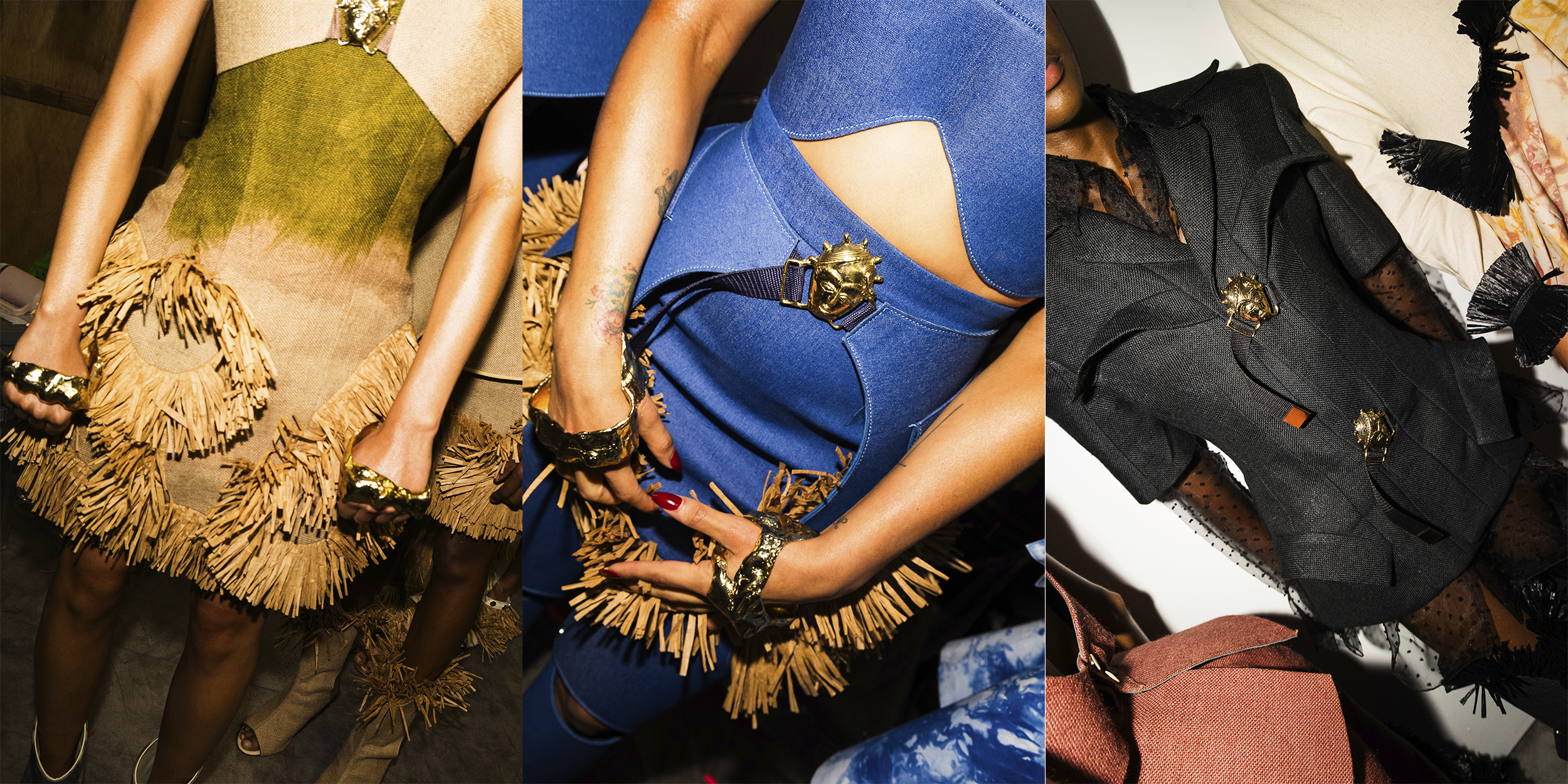
“Ivorian Masks” are part of the exhibition. How do you tackle incorporating cultural objects in your work in a respectful way and without losing their integrity?
The masks are not a motif I borrow from the outside, they’re part of my own cultural DNA. Even the brand’s signature mask is a personal emblem, symbolizing the fusion of worlds and, in my case, the fusion of my multicultural background. Working with Ivorian masks in this experience is therefore not an external “exploration”, but an affirmation of heritage. When I incorporate them, I approach them as living symbols rather than decorative elements. I study their context, and translate their spirit into new forms without distorting their meaning. In doing so, I’m making a statement about continuity: how ancestral objects can exist in dialogue with contemporary design, and how tradition can remain intact even as it evolves.
Having been born in Brazil and raised in Côte d'Ivoire and the United States, you probably had to learn to adapt and find your personal identity. How has this shaped the way you create?
Living between cultures taught me to embrace paradoxes. For years I felt divided, but in my work that sense of fragmentation becomes a source of fusion. I now create from multiple geographies and histories at once, with the openness to weave disparate elements into a coherent whole. That’s why my pieces seem to exist across different times and places yet speak with one voice, they are my lived experience translated into form.
Photos by BFA /Quadir Moore
Community is often found in fashion and heritage. What sort of community do you hope to build with your work?
A community of cultural custodians and visionaries: artisans, young creatives, thinkers, and audiences who want depth, authenticity and self mastery. I want it to be horizontal, not hierarchical. A network where knowledge and opportunity flow both ways, and in that sense, African heritage becomes a source of innovation, not limitation.
Your SS26 collection was a very visual showcase. Are there any other senses you want to explore and focus on in future collections?
Yes. We’ve explored sight and sound extensively, but I want to work more with scent and touch, sensory triggers that connect directly to memory and emotion. Imagine walking into a space where a garment’s texture and fragrance tell as much of a story as its silhouette.
What does the future hold for you as an artist? Are there any technologies other than AI you would be interested in using in your work?
The future is about deepening the multidimensionality of my practice. Beyond AI, I’m excited by augmented reality (AR) and virtual reality (VR) as tools to extend fashion into immersive narrative worlds, and by materials that merge sustainability with innovation. Ultimately, I see technology as a way to expand the ritual of fashion—to make it more participatory, more sensory, and more timeless.
Interview by Sabine Obermoller, Contributor, PhotoBook Magazine
Tearsheets by Daniel López, Art Director, PhotoBook Magazine
RELATED STORIES