Freda Xia: The Strength of Vulnerability
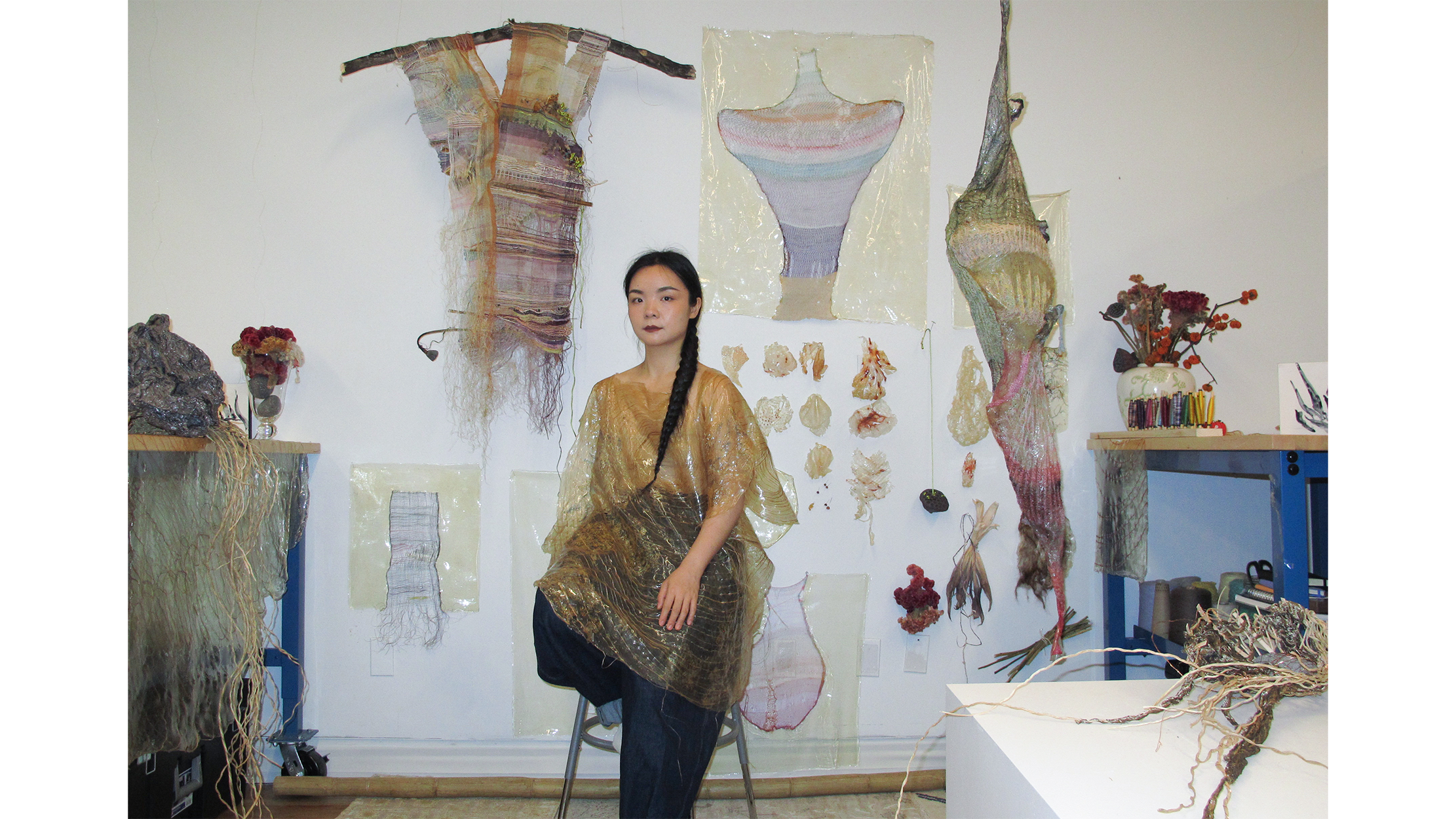
For artist Freda Xia, textiles are both a material and a metaphor through which she explores the body, vulnerability, memory, repair, and transformation. Her versatile practice spans traditional Chinese painting, wearable forms, biomaterials, performance, and installation. By observing how her materials react to tension, rupture, and repair, Xia creates a dynamic exchange between delicacy and resilience. Through her work, she explores delicacy not as a flaw, but as a form of adaptation and strength. In this interview, Xia discusses the challenges of working with unstable materials, the influence of New York City, and how her practice continues to evolve through experimentation, transformation, and material exploration.
How did you get started as an artist, and what initially drew you to working with textiles?
I grew up surrounded by art from a very young age, and I realized early on that art was my natural language. It became the way I thought, observed, and communicated with the world. I began formal art training at six, studying line drawing, printmaking, and traditional Chinese painting with the artist Xinsong Liao. What stayed with me most from that early training was not only the technique, but also a sense of openness. My mentor never pushed me toward a fixed style. Instead, he encouraged intuition, curiosity, and freedom in the making process. I think that became the foundation for how I understand myself as an artist. Later, I studied traditional Chinese painting at the China Academy of Art, where I became deeply attentive to line, negative space, rhythm, and the relationship between a mark and the surface that carries it. Textiles entered my practice through my exploration of wearable forms. When I studied fashion design at Parsons, the body became much more present in my thinking. I began to realize that textiles are fundamental to wearability, but they are also among the materials most closely connected to human life. They touch the body, protect it, restrict it, carry memory, and transform through movement. That intimacy, combined with textiles' enormous imaginative possibilities, drew me to the medium. From there, I began exploring how textiles could move beyond clothing into sculpture, biomaterials, performance, and space.
You work across textiles, biomaterials, wearable forms, performance, and installation. How do you decide which material or textile best suits the concept and craftsmanship you want to express in your work?
For me, the work and the material develop in dialogue, continually informing one another. I do not always begin with a concept and then choose a material to express it. Sometimes the material comes first because I already have an emotional, physical, or cultural relationship with it. Raw silk is a good example. I have a very personal attachment to it. It connects me to my home and family, and my father has even helped me reel silk by hand. I also love how sensitive raw silk is to color, tension, and touch. It can feel delicate, yet it can also become surprisingly strong. Biomaterials entered my practice through a different path. Through conversations with biomedical researcher Dr. Liwen Zhang, I became increasingly interested in how biomaterials and silk-based materials are used in tissue repair and regenerative medicine. Her research made me think more deeply about repair as something that can happen materially and internally, often beyond what is visible. That opened a new direction for me because repair was already central to my own work. Sometimes the concept leads me to the material, and sometimes the material opens a new conceptual direction. I think of that relationship as a conversation. I test how a material stretches, tears, absorbs color, responds to gravity, or interacts with the body. Those behaviors often change the original plan. The final form develops through that negotiation between what I intend and what the material can do.
You explore the body as a “shifting boundary” through ideas of rupture, repair, adaptation, and transformation. What does this mean to you as an artist, and what are you trying to present through your work?
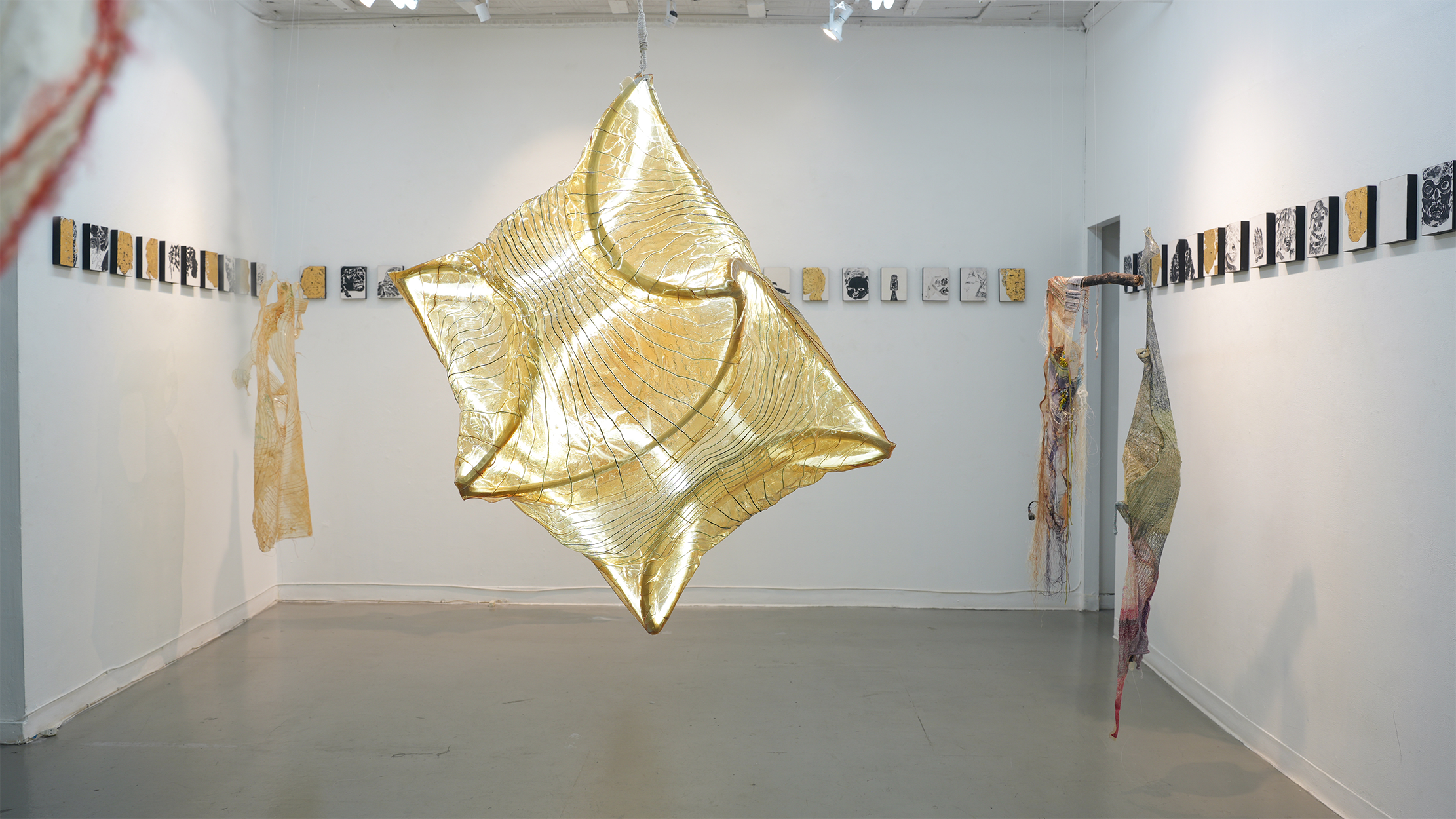
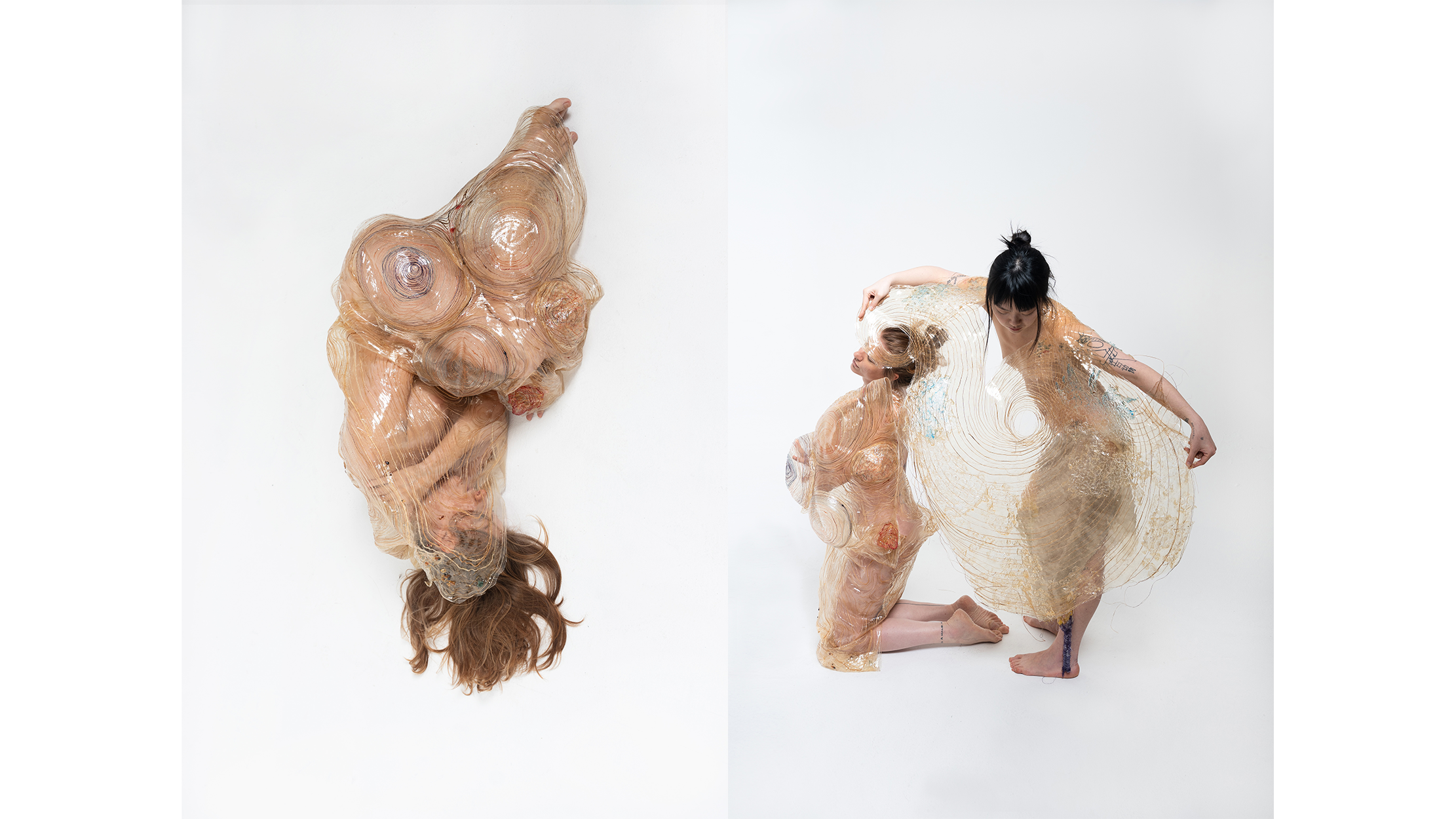
For me, the body as a shifting boundary comes from lived experience. My own experience with surgery and recovery changed the way I understood skin and the body. I began to see skin not as a fixed surface, but as something constantly negotiating between inside and outside, protection and exposure, strength and vulnerability. It stretches, softens, tears, heals, and carries evidence of what has happened to it. That is also how I began to think about my materials. A membrane can shrink, tear, soften, or require reinforcement. A knitted structure can collapse and then be repaired. The body and the material began to mirror one another. For me, repair does not mean returning something to its original state. Repair changes the structure. It leaves a trace. Sometimes the repaired area becomes thicker, more sensitive, or supported in an entirely new way. What interests me is the moment when vulnerability becomes active. A body or a material can be fragile and still adapt, reorganize, and continue. That is what I try to make visible through Negotiated Skin.
Has pursuing an MFA in Textiles at Parsons School of Design influenced your approach to your artistic practice? Has the program introduced you to new materials, techniques, or styles that have shaped your work?
Absolutely. The MFA has helped me understand textiles as a field that can connect material research, the body, technology, social questions, and space. Critiques and interdisciplinary conversations have pushed me to explain why a material choice matters, not just how it looks. They have also encouraged me to move from individual wearable pieces toward larger installations, where gravity, light, architecture, and the audience become active parts of the work. Technically, I have expanded my practice through digital jacquard weaving, knitting, biomaterial development, and modular construction. My residency at Praxis Fiber Workshop deepened my experience with digital weaving and helped me think more closely about image, density, and structure as elements of the cloth itself. At Parsons, I am now exploring how woven and knitted structures can support larger biomaterial membranes and incorporate light. The program has made my practice more rigorous, but it has also helped me recognize that painting, textile structure, bodily experience, and material research can all exist within the same language.
You were named an inaugural CFDA x Bezos Earth Fund Next Thread Initiative Scholar this year. Has being recognized through this award opened up any new opportunities or influenced the direction of your work?
Being selected as an inaugural 2026 CFDA x Bezos Earth Fund Next Thread Initiative Scholar has given me both practical support and a stronger sense of responsibility. The scholarship supports my tuition and thesis materials, giving me more room to continue the slow, repetitive testing that biomaterial research requires. It has also brought my work into conversation with people who are thinking seriously about the future of fashion, material responsibility, and systems of production. The recognition has made me feel more responsible for considering how this research could move beyond a single artwork and become part of a more viable material system. I have been thinking more seriously about whether biomaterial membranes could reduce our dependence on synthetic organza, plastic films, and other petroleum-based surfaces while still offering transparency, flexibility, lightness, and structural possibilities. That has pushed me to test not only the material's appearance, but also its durability, scalability, and behavior at larger dimensions. I am especially interested in how biomaterials might move from small experimental surfaces into wearable structures and larger spatial applications. I still value uncertainty and material change, but I now document recipes, failures, structural tests, and scale more carefully. The program has strengthened both my commitment to this research and my responsibility to develop it toward something materially meaningful, while keeping the emotional and bodily core of the work present.
What has been one of the most challenging parts of developing your artistic practice, and how have you navigated or overcome it?
One of the hardest parts has been working with inherently unstable materials. My biomaterial membranes can shrink, soften, tear, or respond differently to changes in temperature and humidity. A test that works at a small scale can behave completely differently when translated into a wearable form or a large suspended surface. Scaling up has forced me to consider weight, joining, reinforcement, lighting, storage, and installation at the same time. I have learned to work through smaller modules and repeated tests. I document recipes and drying conditions, experiment with different fibers and support structures, and place reinforcement only where it is needed. I also leave room for the material to change. Overcoming the challenge has not meant making the material completely predictable. It has meant building a process that can respond to change through adjustment, repair, and collaboration. That approach has made the work more structurally thoughtful, but it has also become part of the work's meaning.
Your work explores repair and transformation. How do you show those ideas through your materials and designs?
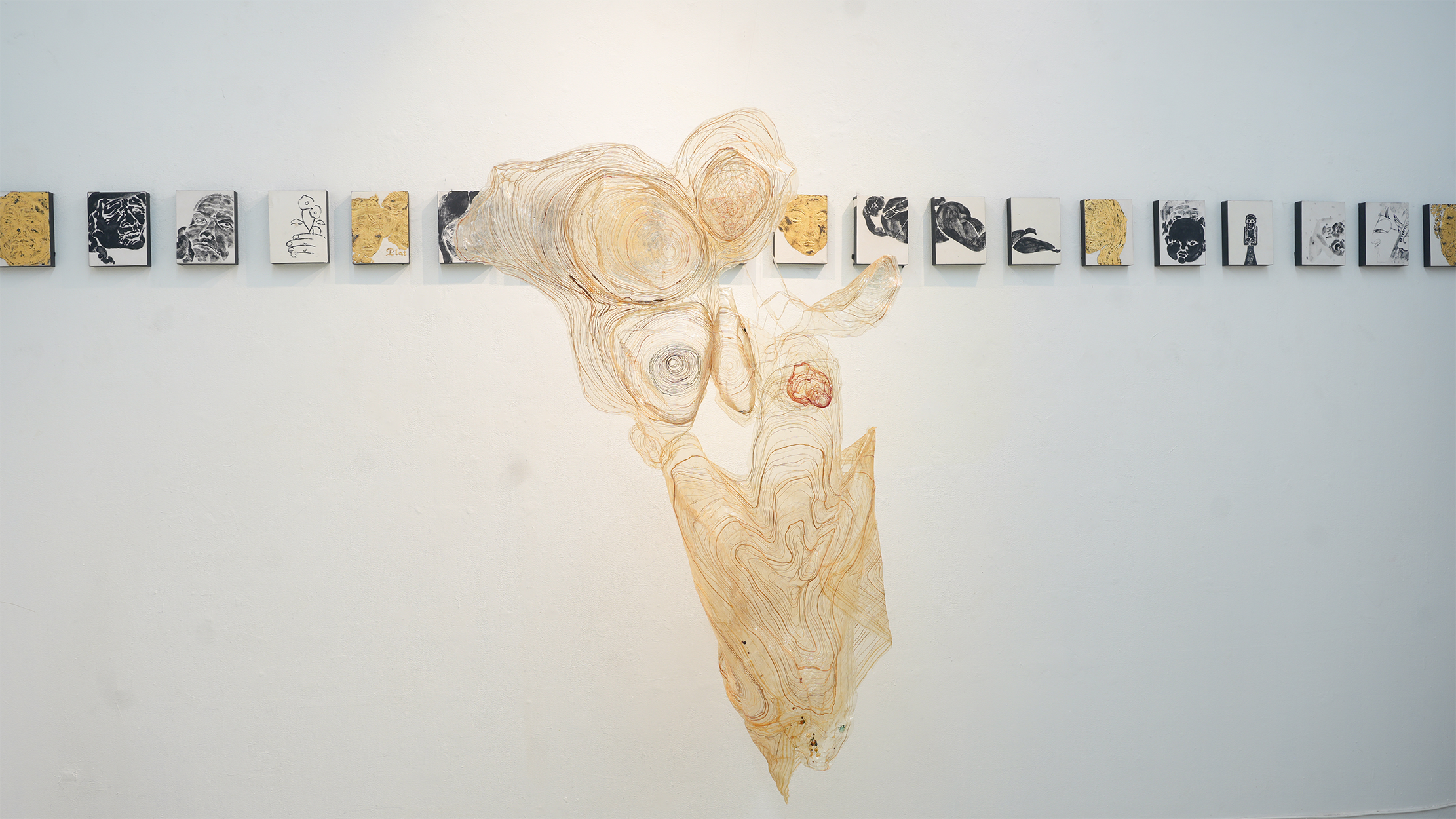
I show repair by allowing it to remain visible. I use seams, layered membranes, knots, dropped stitches, reinforced edges, and areas where one material holds another. In one early Negotiated Skin structure, a hand-reeled raw silk form partially collapsed. I reinforced it with a silk-protein biomaterial and kept the repaired area exposed. That moment changed the piece. The repair became a record of pressure and care instead of something to conceal. Transformation also happens through time. The membranes dry, contract, become more translucent, and respond to gravity. When they are combined with silk, wool, plant fibers, or discarded fruit and vegetable skins, the surfaces develop different densities and traces. I often repeat formation, drying, stretching, stitching, and reinforcing, so the finished work contains the history of those actions. The material does not simply represent repair. It has actually undergone stress, change, and support.
How does your connection to traditional Chinese art or craft show up in your work today?
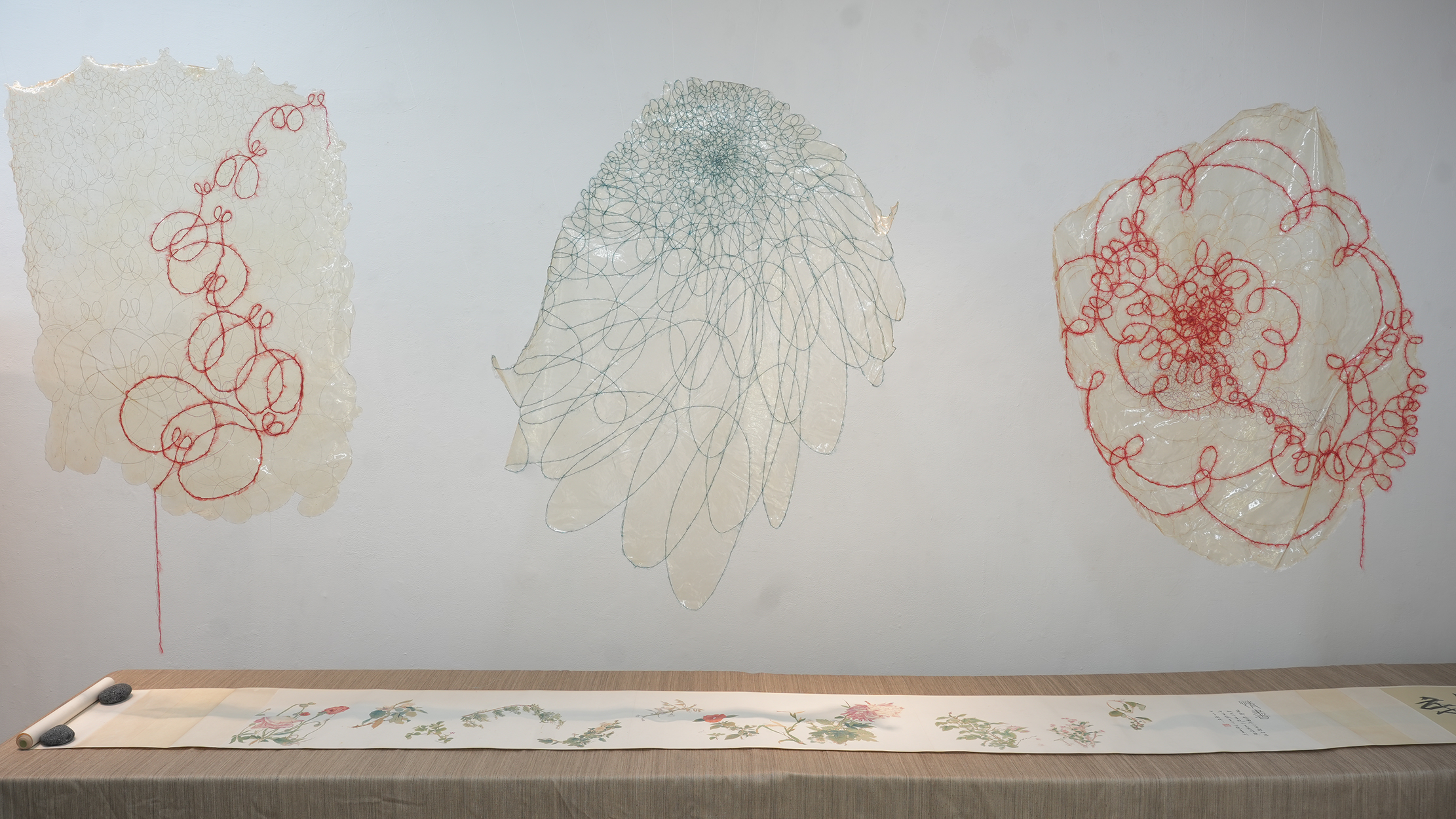
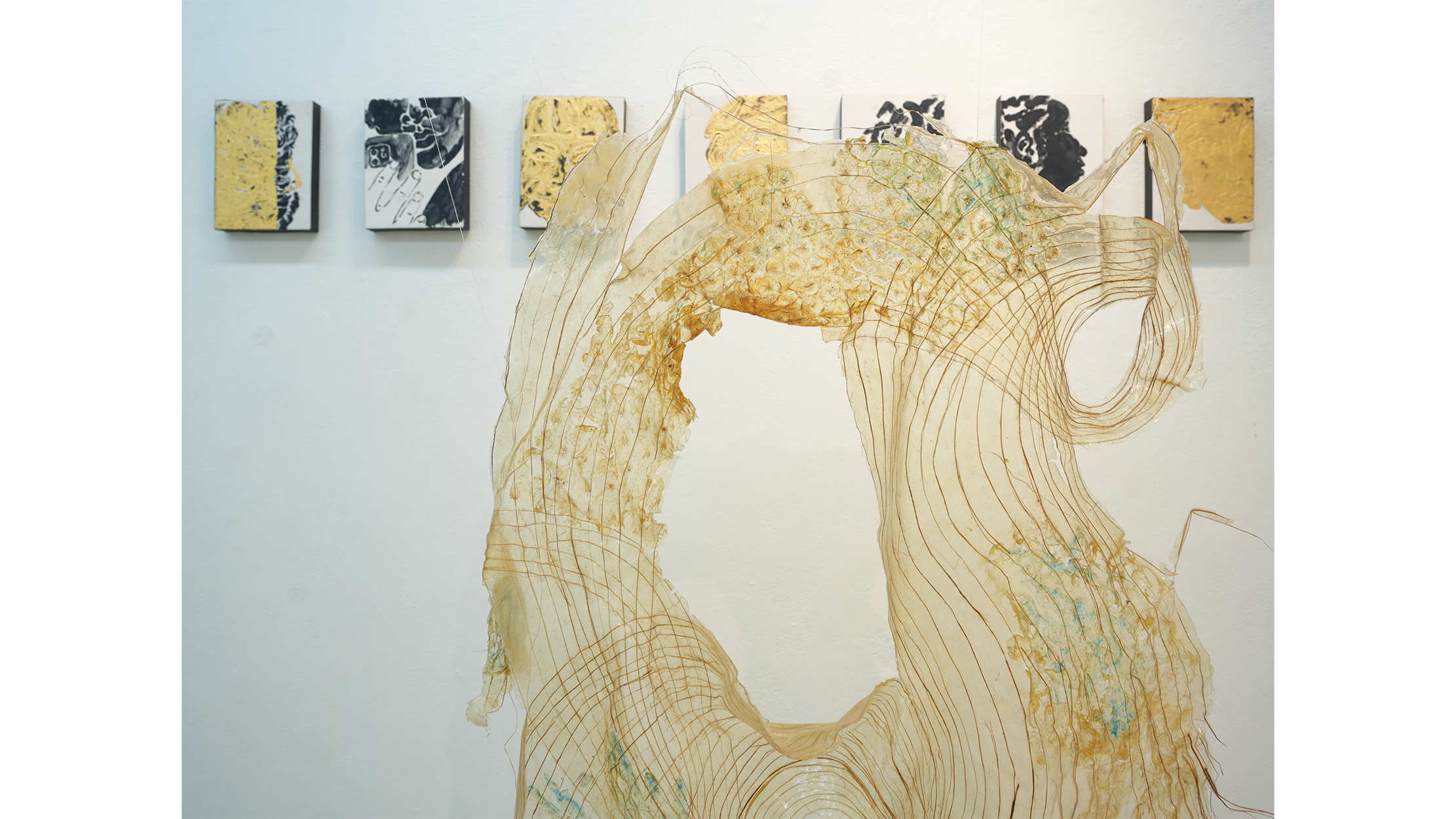
I think through line, emptiness, translucency, repetition, and the hand's movement. A suspended membrane can function almost like a brushstroke in space, while the openings around it can be just as important as the material itself. I also work with mineral pigments and have created long silk works that carry the pacing of a scroll, where an image is encountered gradually through time and movement. What I carry forward from traditional Chinese painting is not a fixed visual motif, but a way of observing and making. Across painting, textiles, and biomaterials, I am drawn to processes that develop layer by layer. A painted surface accumulates through repeated marks, a textile structure grows through repeated threads and gestures, and a biomaterial membrane forms through casting, drying, layering, and repair. For me, each layer carries time, touch, and adjustment. Traditional painting taught me that a surface can hold breath, pressure, and different speeds of attention. Hand-reeling silk and building forms through repeated gestures extend that sensitivity into three dimensions. My work now moves between Chinese painting, textile structure, and biomaterial research, but the attention to line, touch, and material presence remains continuous.
How has living and working in New York City influenced your creative vision and the ideas you explore through your work?
New York has made my practice more open and more spatial. Fashion, performance, art, technology, and many cultural histories exist in close proximity here. That has allowed me to work across fields without feeling that I need to stay within a single category. Collaborating with threeASFOUR, developing work at Parsons and Praxis, and presenting my first New York solo exhibition during New York Textile Month each showed me different ways that textiles can exist in public. Living in New York has also made me more aware of constant movement and change. Coming from Hangzhou, I feel the tension between different rhythms, cultures, and ways of living very strongly. That tension has entered my work. The city has also made me think more deeply about bodies in relation to architecture. We constantly move through crowded, temporary, shared spaces, negotiating closeness, protection, and exposure. Those experiences enter my suspended installations and wearable forms. New York has given my work a sense of urgency, but it has also made community and exchange much more central to the way I develop it.
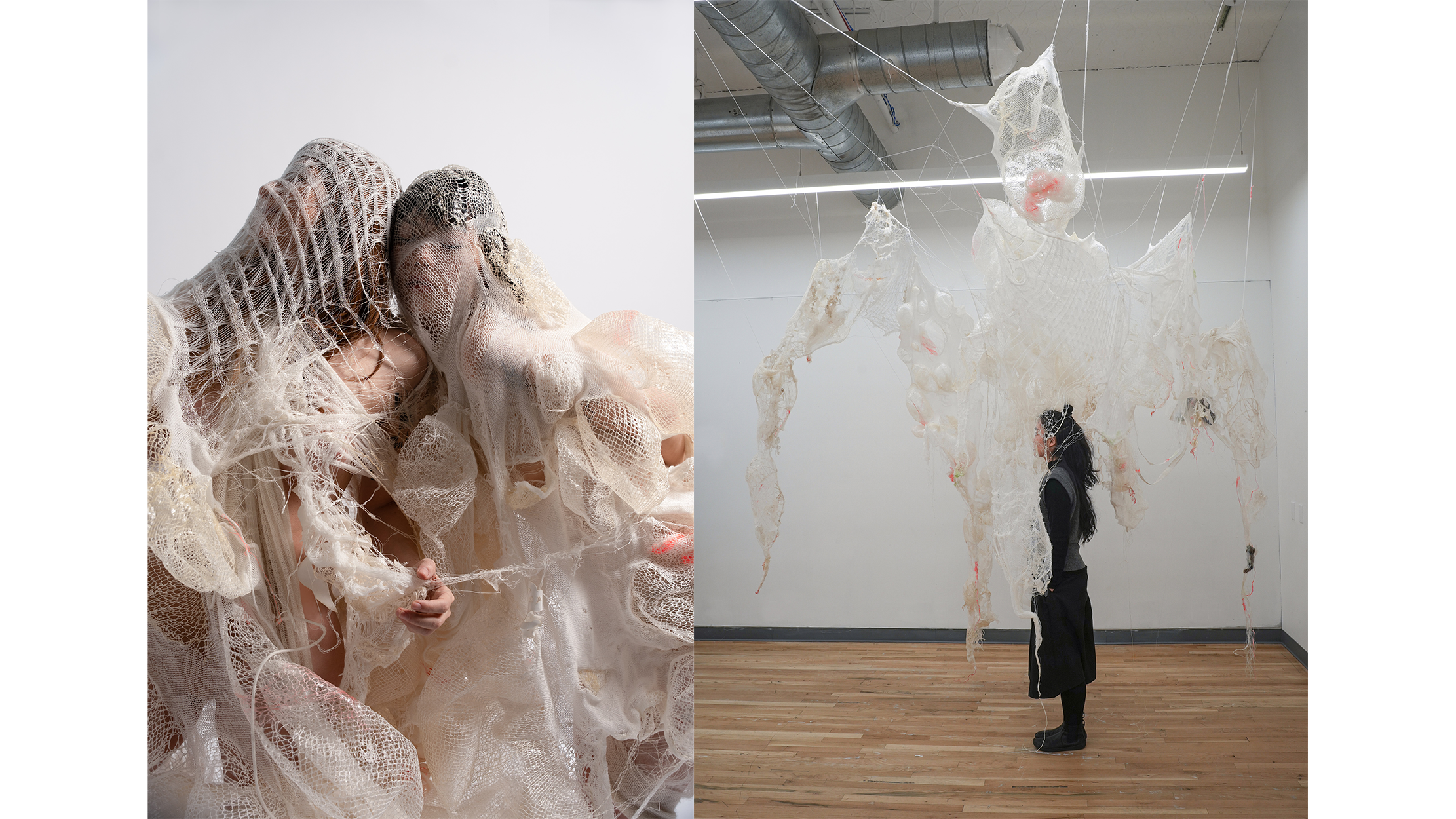
What does working directly with the body allow you to explore that you might not be able to explore through a traditional textile piece?
Working with the body allows me to test textiles as active boundaries. Once a material is worn, it has to respond to breathing, weight, heat, balance, friction, and movement. The body can stretch a membrane, pull against a knitted structure, or reveal where a form protects and where it exposes. These relationships are difficult to understand when a textile remains flat and still. Performance matters because it reveals change over time. A material may begin as a protective layer and gradually sag, open, or become restrictive. The person wearing it also makes decisions about how to move within those limits. That exchange creates both emotional and physical tension. The body is not simply a display surface for me. It is a testing site and a collaborator. What I learn from the body then informs my installations, where gravity, architecture, light, and the movement of viewers take on similar roles.
Was there a particular project or piece that challenged the way you think about your materials or artistic vision? What did you take away from that experience?
My recent solo exhibition, Negotiated Skin, challenged me to understand the project as an environment rather than a collection of separate objects. The exhibition brought together mineral-pigment paintings, handwoven works, biomaterial membranes, wearable forms, digital jacquard weaving developed during my residency at Praxis, and a collaboration with threeASFOUR. Seeing these works share one space made me realize that they were all approaching the same question from different scales: How does a boundary hold, fail, and reorganize itself? The installation also showed me how much light, distance, and audience movement can change the way a material is perceived. A thin membrane can feel bodily at close range and architectural from across the room. That experience gave me a much clearer direction for the next stage of my practice. I want to build larger suspended textile environments where woven and knitted structures support biomaterial skins, allowing the audience to move through a field of tension, transparency, and repair.
What is one thing you hope audiences continue to take away from your work as your practice evolves?
I hope audiences come away with the sense that softness and vulnerability can hold strength. Fragility, for me, is not passive. A vulnerable surface can still adapt, carry memory, and create new forms of support. In my work, repair does not erase a wound or restore something to its original state. It leaves a trace and creates a changed structure. As the work grows from the body into larger textile environments, I want that idea to remain present. I also hope people become more attentive to the materials around them: where they come from, what kinds of labor and bodily memory they carry, and how they may eventually return to the environment. If the work can make someone look at a seam, a tear, or a translucent surface with greater care, then it has created the kind of connection I am interested in.
Interview by Ali Rosoff, Contributor, PhotoBook Magazine
Tearsheets by Daniel Lopez, Art Director, PhotoBook Magazine
*Images Courtesy of Freda Xia
RELATED STORIES