Ellie Moon on Writing, Risk, and Reality
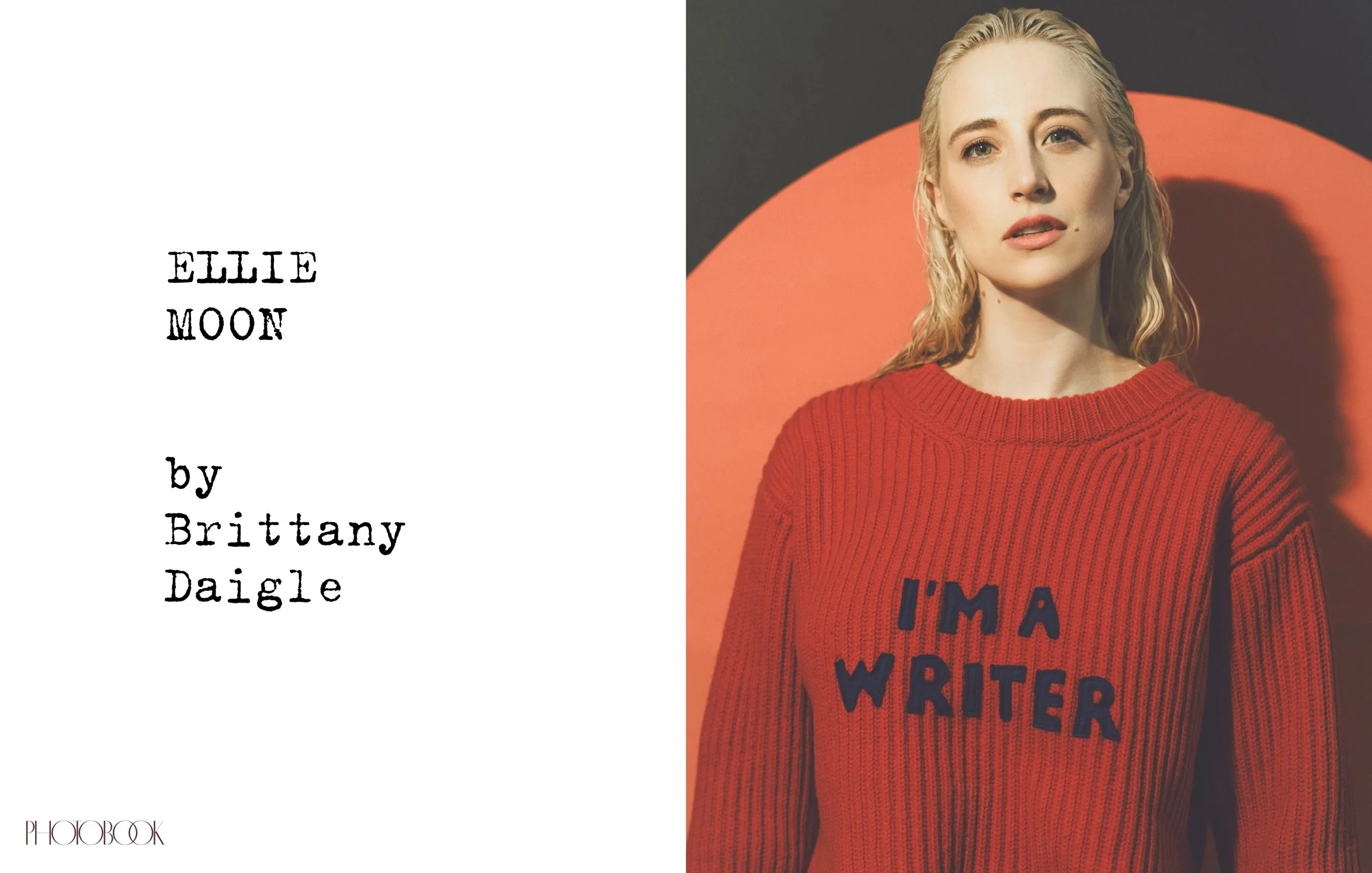
Sweater is custom @sew_yesterday_
“Making art that is exactly what you want to make really is an act of faith in yourself and in the world,” says writer and actress Ellie Moon. Known for her plays like Asking For It and her breakout indie hit Adult Adoption, Moon has carved out a reputation for honesty and sharp understanding of the female experience. Now, she is stepping into a new chapter, navigating the shift from the Canadian indie scene to massive productions with LuckyChap Entertainment.
In her latest work, Moon explores the disorienting nature of the creative process and the blurred lines between personal history and public art. We sat down with this Toronto-based creator to discuss the confessional bias against women writers, working with the legendary Colin Mochrie, and the evolution of her creative shorthand with frequent collaborator Karen Knox.
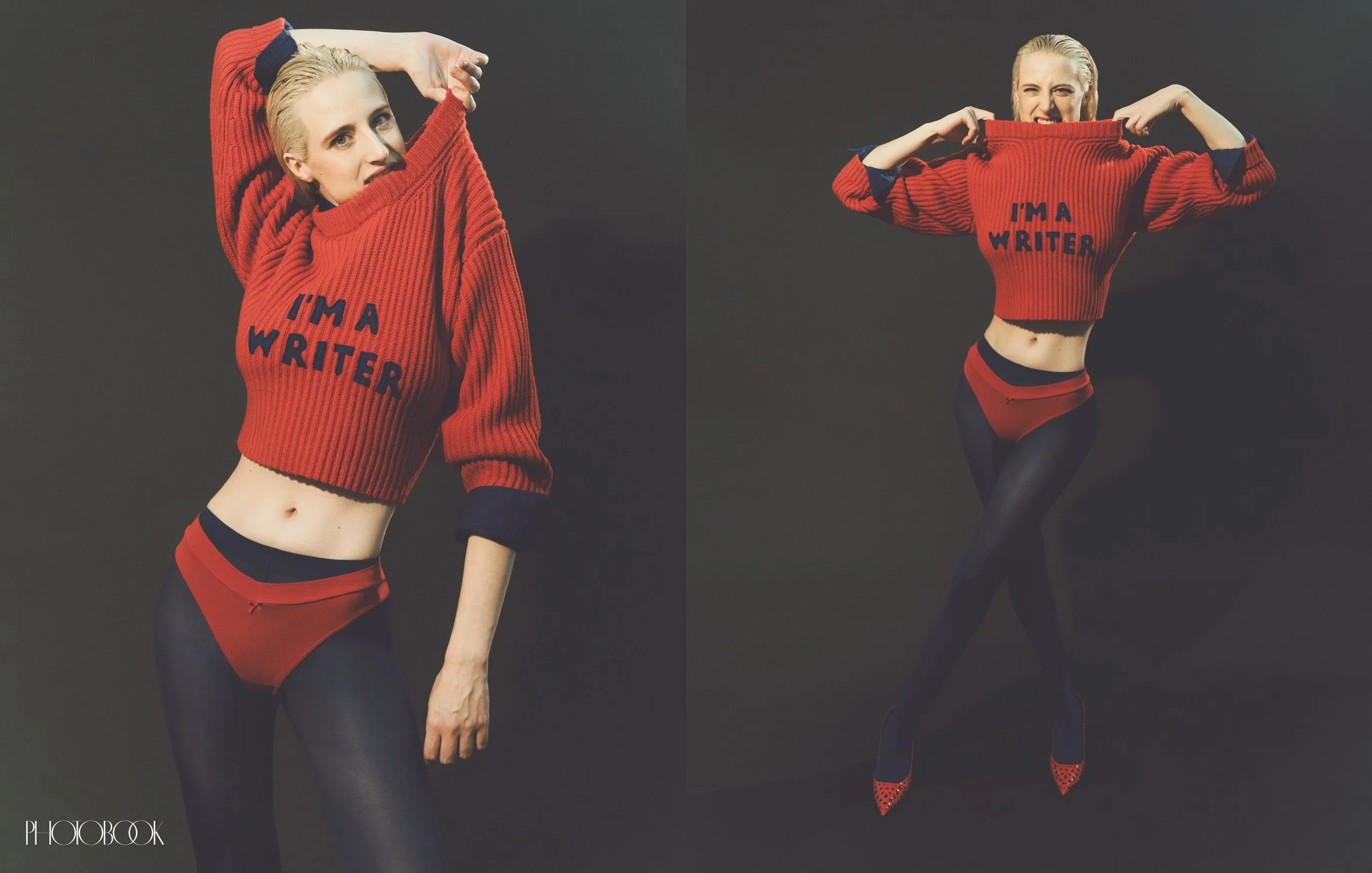
Sweater is custom @sew_yesterday_
Heels by Wishbone
Tights & Underwear by Talent’s Own
Having written plays like Asking For It that drew on real verbatim interviews, have you ever felt the industry tries to "own" your personal experiences for marketing purposes?
Yes, especially when I was just starting out and didn’t have many credits as a writer. There is, I think, a belief or assumption that is not confined to any one industry, which is that the only path to credibility for a young woman writer is to tell a story that is personal or autobiographical. In this culture, we are more likely to see the work of male writers as creative or imaginative, as stories crafted by original, brilliant minds, while seeing the work of women writers as confessional and its quality measured by how brave and honest it is. Because this is a deeply rooted bias in our culture, I can’t really hold anything against the marketing departments that are just trying to do their jobs well in this context.
Was it a challenge to play a character who is essentially "gaslit" by her own creative process?
It was challenging but also nice to get to embody this feeling in a scene, since I’ve felt it in my own life but had never distilled it into a performance before. The challenge, as with Adult Adoption, is that there’s a deeply interior and private evolution that unfolds for this character and her sense of reality. In particular, it was challenging shooting the various scenes out of order while trying to be really precise about what the character believes in one scene in contrast to the scenes before and after, because on the surface, nothing appears to have changed (gaslighting!). So, being really precise in my performance is what tells this part of the story, and that’s a lot of pressure, but a thrilling challenge.
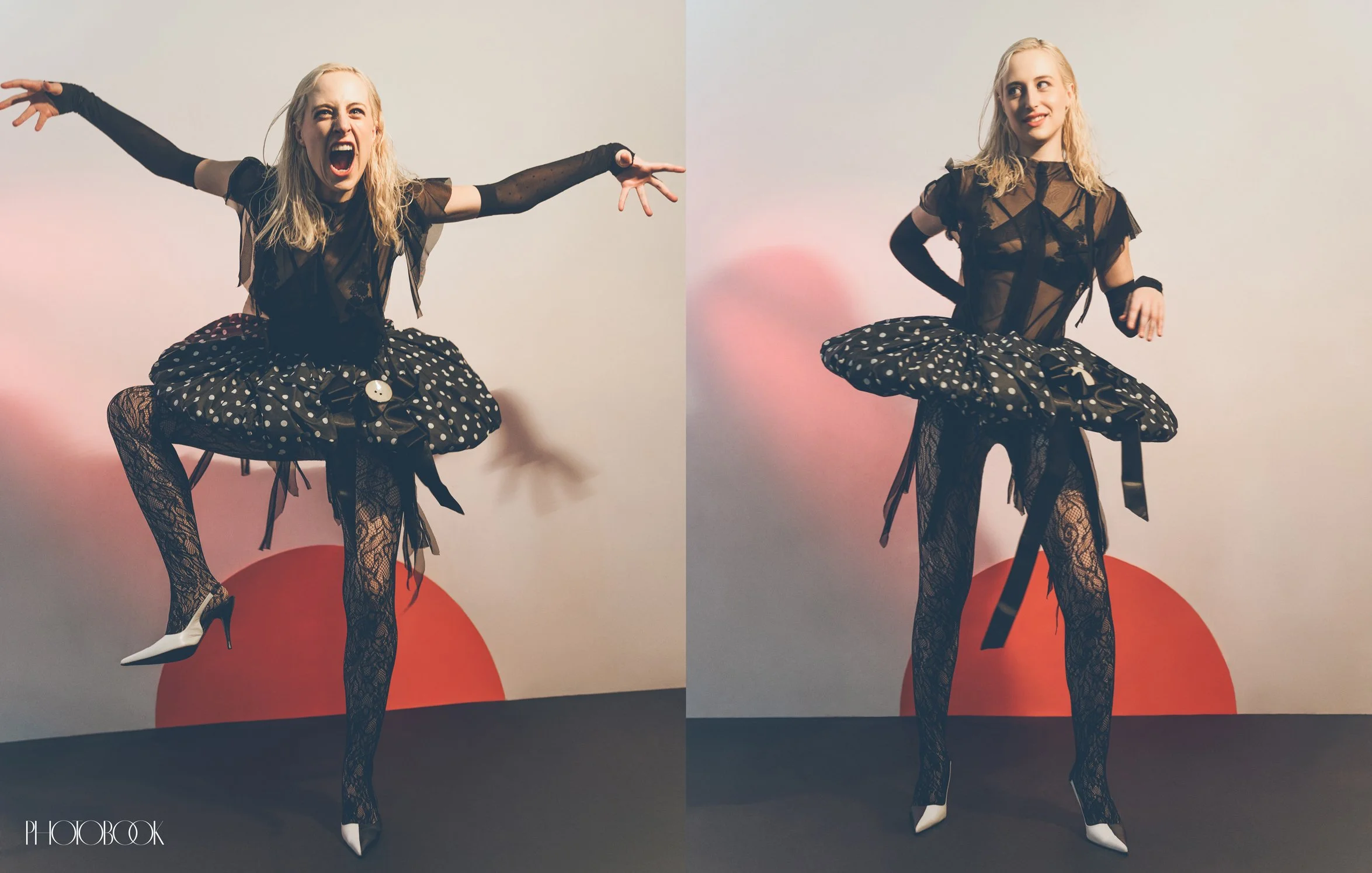
Dress by SAGRADESA
Shoes by D&G (from @picvintageshop)
Tights by Talent’s Own
As a writer, do you believe there should be boundaries on what an artist can "borrow" from their own family or friends?
This is something I think about a lot. I would love to sit in a room full of my favorite writers and talk about this. I think that my own boundaries may be stricter than what is acceptable to many other writers. With that said, I would not be quick to judge others on this. I am always going to be on the side of art existing. As you mentioned, I built my first play from verbatim interviews I did with friends and family, and I told everyone they could pull their contributions until the very last minute if they wanted to. I’ve never really been tempted to borrow something from someone else’s life that was unconnected to my life. I’ve thought a lot more about my responsibility when writing about experiences I’ve shared with other people. Is it okay if someone recognizes themselves in my work? I think that’s okay. Does it matter if people close to them recognize them in the work? What about the rest of the world? Then it gets more tricky.
Colin Mochrie is a giant of improv. Did having him play DS Richardson change the energy of the script?
It was amazing to have Colin on set. And especially because he was there for the very first scene we shot, which was a theatre scene with 50 extras. The extras very generously came out bright and early, and I noticed that as soon as they saw Colin there, it was like they’d each taken an espresso shot. He got us off to this great start and set such a nice tone for the whole shoot. Colin is inspiring because of his craft, but also because of his kindness and humility. He’s a true Canadian legend. I had a very hard time not laughing in the scenes in which we were doing table work. I think he really just wanted to serve the script and he did so perfectly. So, I wouldn’t say he changed the energy of the script, but he did help set the energetic tone for the shoot in an important and lovely way.
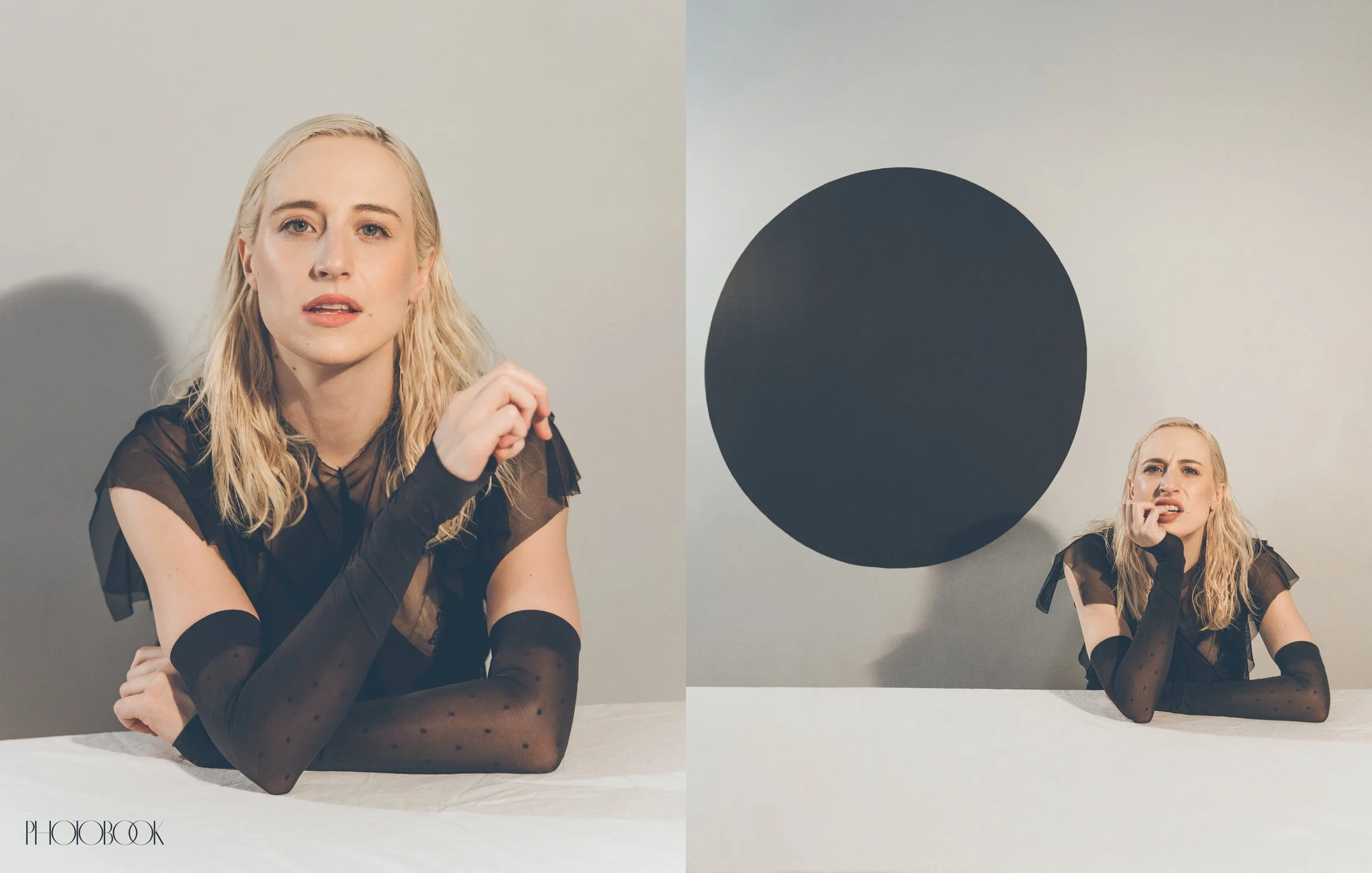
Dress by SAGRADESA
This is Pony Nicole Herauf's feature debut. What was it about her specific visual style that made you feel she was the right person to bring your script to life?
Pony is a visionary filmmaker who I am certain is going to make profound contributions to the medium. Her aesthetic sense and sense of rhythm really blew me away in her shorts, as well as the wild and free performances she inspired from actors. I was thrilled when she chose Young Female Playwright to be her debut feature. Pony knows her own mind and so the choices she makes in filmmaking are considered and always authentic. She doesn’t fight against parts of herself. This means that however daring or challenging or strange her work is, it’s also very cohesive.
You and Karen Knox worked together previously when she directed you in Adult Adoption. How has that relationship informed your work and how has your creative "shorthand" evolved now that you are acting alongside each other instead of her directing you?
It was very special to do this with Knox. I wrote the role for her, but she’s been so busy creating and starring in the upcoming Slo Pitch for Crave that I really didn’t know if she would be able to do it, and so I was thrilled she made the time. As well as being a truly exceptional actor, Knox is one of the people who understands me and my work best. That intimacy elevates our chemistry as Millie and Roxx and those scenes were thrilling to shoot. The Millie and Roxx relationship is fiction, of course, but as the character names suggest, I put some of our personal dynamic into it. It was really fun to navigate the truth and fiction of that together. The more we work together, the less we need to say in order to communicate. We didn’t talk a lot about the scenes in between takes, and instead just chatted about everything else, and then tried things and surprised each other in the takes.
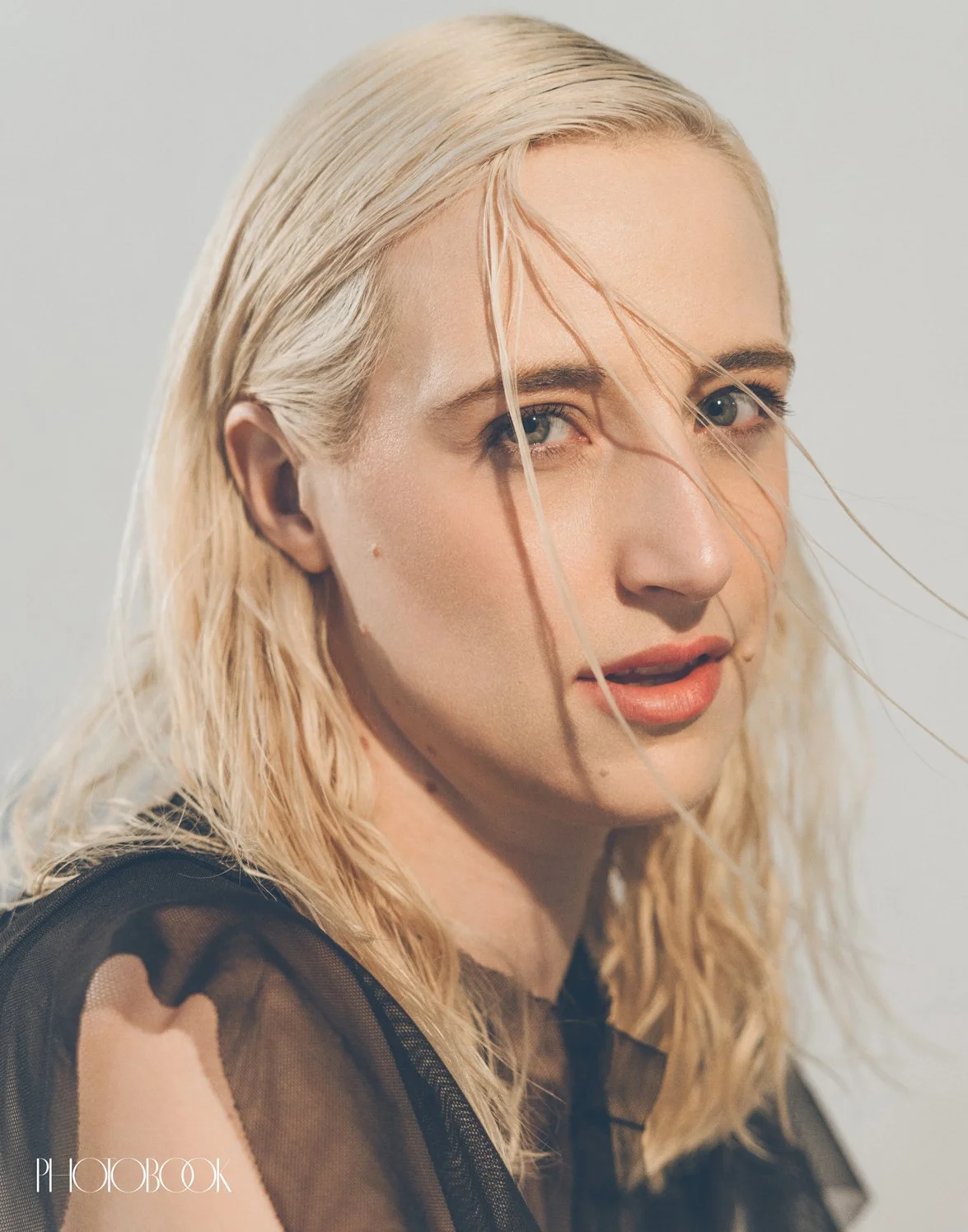
Dress by SAGRADESA
What is the biggest "culture shock" you've experienced moving from indie Canadian film to a massive production with LuckyChap?
I was floored by Barbie, a movie about having to become a real person in a world that wants you to be a symbol, and that idea navigated so masterfully for such a broad audience. I vowed after I saw it to one day be cast in a LuckyChap film, and it means the world to me that this somehow manifested only a couple of years later. The biggest difference really is filming time (since time is money), and having more of it is always amazing. But I’m always shocked by how working at various scales budget-wise ends up feeling very similar. At the end of the day, it’s the same work. I remember chatting with some of the crew on Everybody Wants to F*ck Me who were saying that a traffic jam in London, where we shot, meant they lost time on a unit move and had to shift around the schedule. When you’re working in indie film, it’s easy to imagine those kinds of challenges would magically go away on a bigger budget production.
Looking back at your 26-year-old self, what part of your own "vulnerability hangover" did you put into the character of Millie?
At 26, insanely, my third play at a major Toronto theatre premiered (just before the COVID-19 pandemic shuttered theatres for a couple of years!). I certainly found that detachment got easier and easier from the first to the second to the third play. I think the younger you are, the more you look to the world to tell you who you are and imagine the world is accurately reflecting you back to yourself. You get older, and that need for the world to be that mirror (or that trust that it can be that) goes away, or that’s been my experience. It all seemed terribly important then—like the response to my play would reflect back to me and tell me who I am (and that it would be definitive). The funny thing is, this isn't not true. I did learn a lot about myself based on how the public reflected my work back to me. But the stakes are so much lower now that I know myself much better. I think that sense of the stakes being astronomically high is what I put into the film and gave to Millie.
Does your brain "switch gears" when writing a novel versus a play, or do you find that your voice stays the same regardless of the medium?
The book was a big and long and vast effort compared to any script I’ve written. Many versions of me wrote my book, whereas I think my scripts have all been authored by a single version of me. It is surreal to even be answering a question about it because I worked on it in private for seven years. Scripts are like a blueprint for a performance or a film, and a novel is in its finished form once written. So, writing the novel challenged me to be even more precise about what I was trying to say, and willing to say. It challenged me to hold a lot more in my mind and memory at once.
What are you most curious to see in terms of how American versus Canadian audiences react to the film's darker themes? What does indie film mean to you?
I do have some specific curiosities about how Americans versus Canadians will react to some darker moments. But I won’t get too specific lest I reveal some spoilers. I’ll just say that in Canada, it seems to me that the cultural industries are more risk-averse than their American counterparts. With that said, I have had a really lovely career in Canada writing work that is risky and would be considered risky anywhere. It’s exciting to be making indie films right now because there is an appetite for risk and an engaged and growing audience of people who are committed to seeking out indie film.
CREW CREDITS:
Talent: Ellie Moon
Project: Young Female Playwright
PhotoBook Editor-In-Chief: Alison Hernon
PhotoBook Creative Director: Mike Ruiz
Photographer: Brittany Daigle
Fashion Stylist: Jill Bulger
Tearsheets by Daniel López, Art Director, PhotoBook Magazine
Interview by Lily Kalbasz, Contributor, PhotoBook Magazine
RELATED STORIES